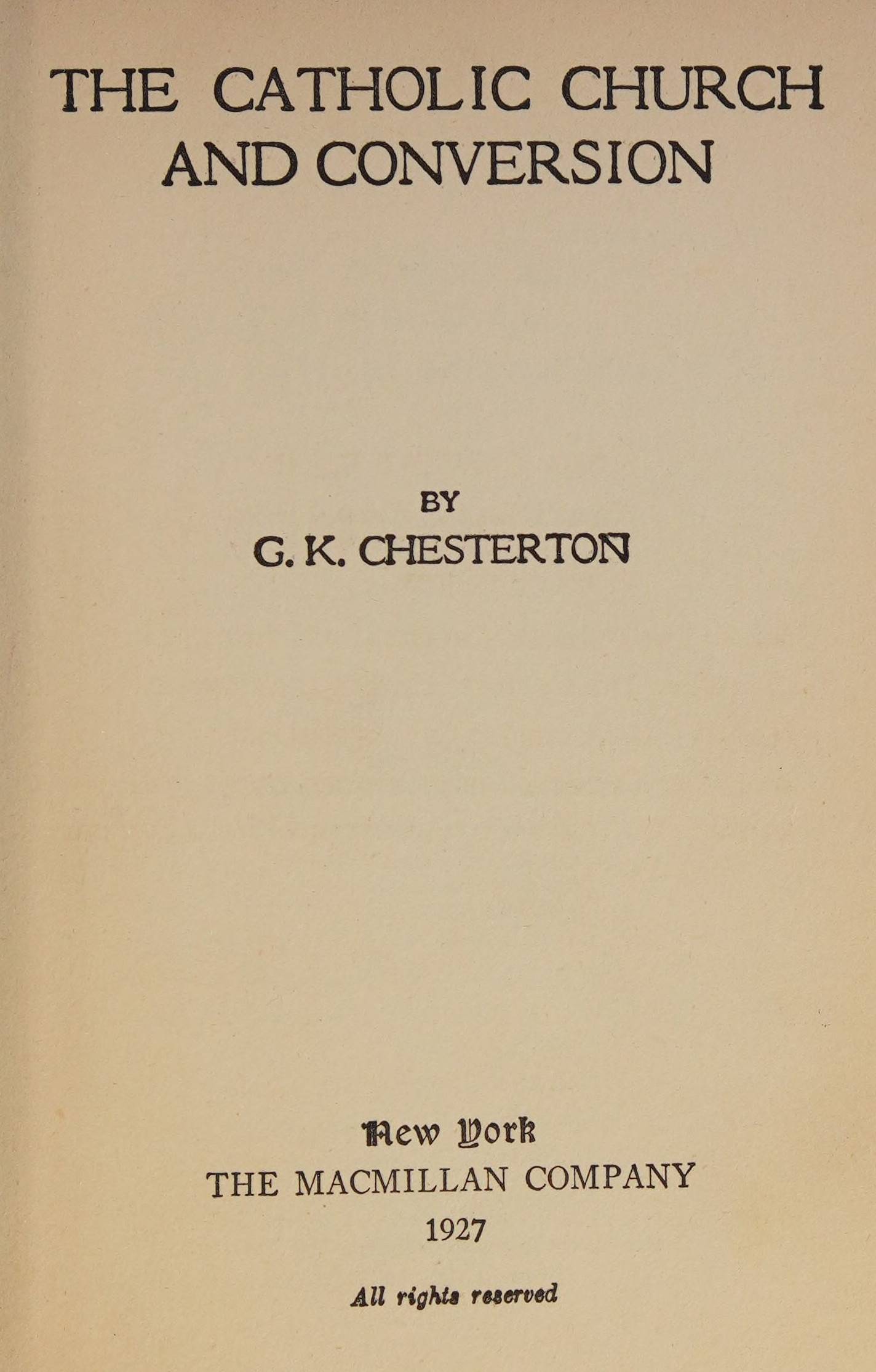
The Catholic Church and Conversion
1926
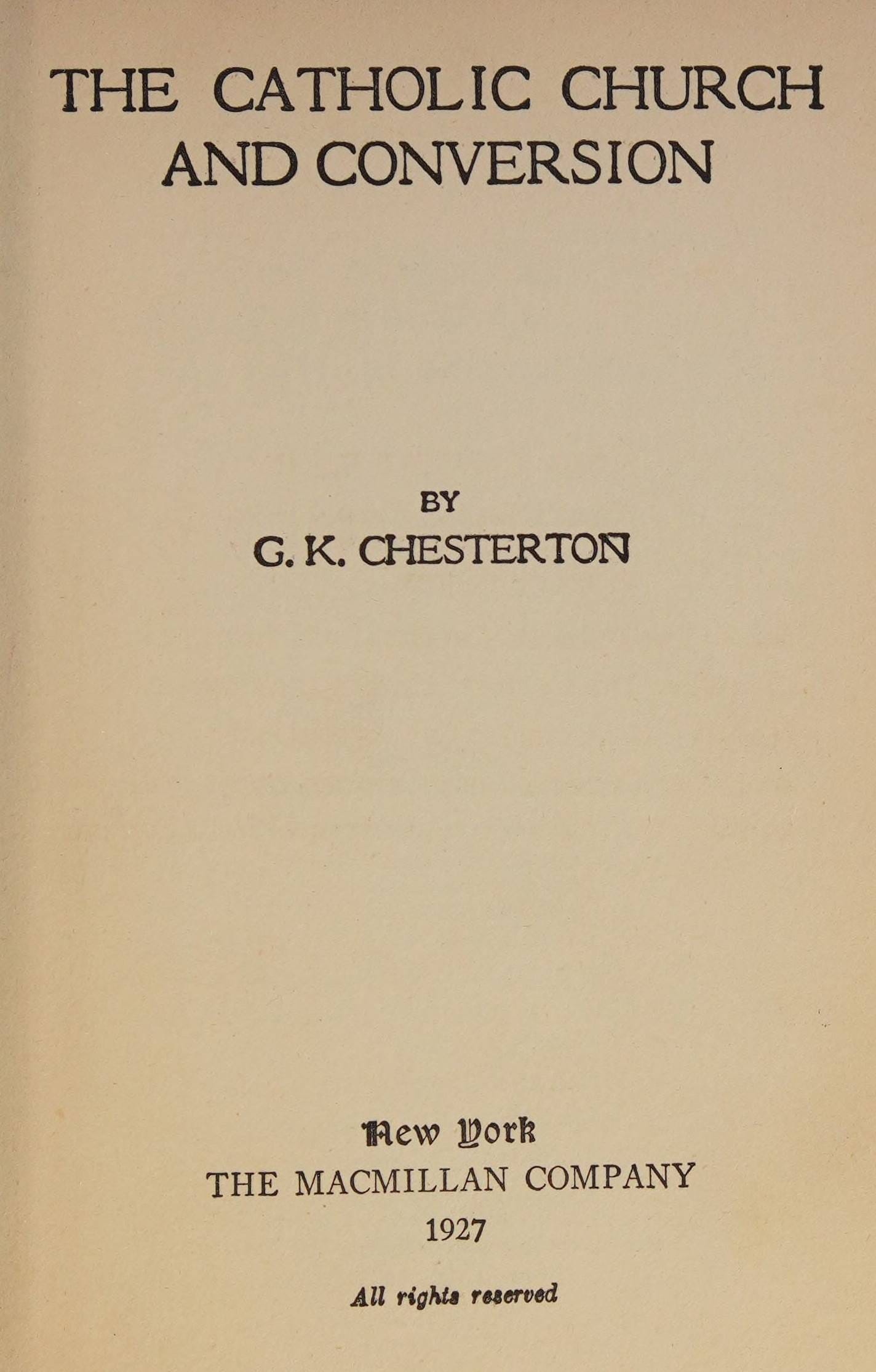
The Catholic Church and Conversion, written by G. K. Chesterton and published in 1926, is a religious apologetic treatise that explores the nature of Catholicism and the process of conversion. Chesterton argues that Catholicism is a vibrant, living force in the modern world, contrasting it with stagnant traditions and addressing common anti-Catholic myths. He outlines the stages of conversion and emphasizes the Church's universal claim over national loyalties, presenting conversion as a means of liberation from sin and a path to objective truth.
Editions
X-Ray
“The Catholic Church is the only thing which saves a man from the degrading slavery of being a child of his age””
— G. K. Chesterton
“To become a Catholic is not to leave off thinking, but to learn how to think.””
— G. K. Chesterton
“What is now called free thought is valued, not because it is free thought, but because it is freedom from thought; because it is free thoughtlessness.””
— G. K. Chesterton
“Religion is of the heart, not of the head; and as long as all our hearts are full of a hatred for everything that our fathers loved, we can go on flatly contradicting each other for ever about what there is to be hated.””
— G. K. Chesterton
“Una parola che ci dica ciò che non sappiamo pesa più di un migliaio di parole che ci dicano ciò che già sappiamo.””
— G. K. Chesterton
“Ciò che oggi chiamiamo libero pensiero è apprezzato non perché sia libero, ma perché è libertà dal pensiero: è libera mancanza di pensiero.””
— G. K. Chesterton
“The last lingering shadow of the Jesuit, gliding behind curtains and concealing himself in cupboards, faded from my young life about the time when I first caught a distant glimpse of the late Father Bernard Vaughan. He was the only Jesuit I ever knew in those days; and as you could generally hear him half a mile away, he seemed to be ill-selected for the duties of a curtain-glider.””
— G. K. Chesterton
“It is true that this general truth was hidden from many by certain definite assertions. I can only call them, in simple language, Protestant lies about Catholic lying. The men who repeated them were not necessarily lying, because they were repeating. But the statements were of the same lucid and precise order as a statement that the Pope has three legs or that Rome is situated at the North Pole. There is no more doubt about their nature than that. One of them, for instance, is the positive statement, once heard everywhere and still heard often: "Roman Catholics are taught that anything is lawful if done for the good of the Church." This is not the fact; and there is an end of it. It refers to a definite statement of an institution whose statements are very definite; and it can be proved to be totally false. Here as always the critics cannot see that they are trying to have it both ways. They are always complaining that our creed is cut and dried; that we are told what to believe and must believe nothing else; that it is all written down for us in bulls and confessions of faith. In so far as this is true, it brings a matter like this to the point of legal and literal truth, which can be tested; and so tested, it is a lie. But even here I was saved at a very early stage by noticing a curious fact. I noticed that those who were most ready to blame priests for relying on rigid formulas seldom took the trouble to find out what the formulas were.””
— G. K. Chesterton
Link to this book
Add a free, dofollow link to Lex on your blog, forum, syllabus, or reading list.

<a href="https://lex-books.com/book/the-catholic-church-and-conversion-c4ef8b95-6ae3-465a-af36-87a41fd494e5"><img src="https://lex-books.com/badges/read-on-lex.svg" alt="Read The Catholic Church and Conversion by G. K. Chesterton free on Lex" width="160" height="40"></a>[](https://lex-books.com/book/the-catholic-church-and-conversion-c4ef8b95-6ae3-465a-af36-87a41fd494e5)[url=https://lex-books.com/book/the-catholic-church-and-conversion-c4ef8b95-6ae3-465a-af36-87a41fd494e5][img]https://lex-books.com/badges/read-on-lex.svg[/img][/url]Read The Catholic Church and Conversion by G. K. Chesterton free on Lex: https://lex-books.com/book/the-catholic-church-and-conversion-c4ef8b95-6ae3-465a-af36-87a41fd494e5Cite this book
Reading this edition for a paper or guide? Copy a citation.
Chesterton, G. K.. The Catholic Church and Conversion. Lex, lex-books.com/book/the-catholic-church-and-conversion-c4ef8b95-6ae3-465a-af36-87a41fd494e5.Chesterton, G. K. (1926). The Catholic Church and Conversion. Lex. https://lex-books.com/book/the-catholic-church-and-conversion-c4ef8b95-6ae3-465a-af36-87a41fd494e5Chesterton, G. K.. The Catholic Church and Conversion. Lex. https://lex-books.com/book/the-catholic-church-and-conversion-c4ef8b95-6ae3-465a-af36-87a41fd494e5.