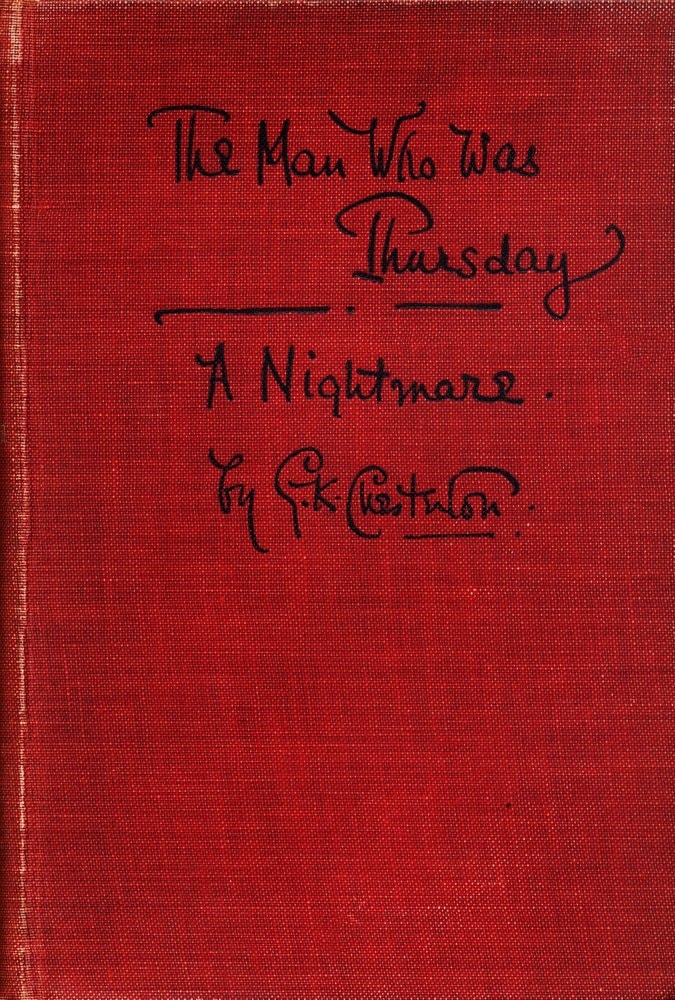
The Man Who Was Thursday: A Nightmare
1908
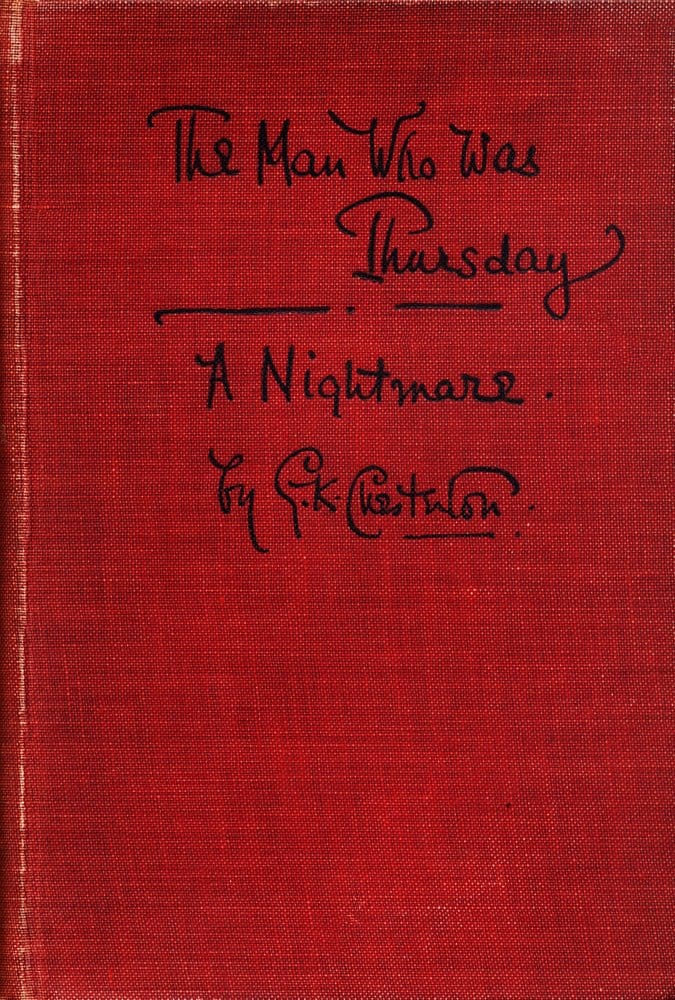
The Man Who Was Thursday: A Nightmare
1908
Gabriel Syme is a poet recruited to infiltrate the Central Council of Anarchists. In the strange suburb of Saffron Park, he meets Lucian Gregory, an anarchist who celebrates destruction in verse. But Syme is a detective in disguise, and his true mission is to become Thursday among seven revolutionaries who call themselves by the days of the week. As he descends deeper into their ranks, the anarchists grow more brilliant and more terrifying, culminating in Sunday, their enigmatic leader whose power seems to transcend the group itself. What unfolds is a fever-dream of logic and lunacy, a chase through Edwardian London that questions not only who the anarchists are, but whether order and chaos are truly opposites, or perhaps the same thing wearing different masks. The novel builds to an ending so strange and daring it has haunted readers for over a century. This is Chesterton at his most playful and most profound: a thriller that is also a philosophical joke, an allegory about good and evil that refuses to end where you expect.
Editions

X-Ray
“Shall I tell you the secret of the whole world? It is that we have only known the back of the world. We see everything from behind, and it looks brutal. That is not a tree, but the back of a tree. That is not a cloud, but the back of a cloud. Cannot you see that everything is stooping and hiding a face? If we could only get round in front--””
— G. K. Chesterton
“Always be comic in a tragedy. What the deuce else can you do?””
— G. K. Chesterton
“Your offer," he said, "is far too idiotic to be declined.””
— G. K. Chesterton
“Moderate strength is shown in violence, supreme strength is shown in levity.””
— G. K. Chesterton
“Thieves respect property; they merely wish the property to become their property that they may more perfectly respect it.””
— G. K. Chesterton
“You've got that eternal idiotic idea that if anarchy came it would come from the poor. Why should it? The poor have been rebels, but they have never been anarchists; they have more interest than anyone else in there being some decent government. The poor man really has a stake in the country. The rich man hasn't; he can go away to New Guinea in a yacht. The poor have sometimes objected to being governed badly; the rich have always objected to being governed at all. Aristocrats were always anarchists””
— G. K. Chesterton
“If you'd take your head home and boil it for a turnip it might be useful. I can't say. But it might.””
— G. K. Chesterton
“I am more than a devil; I am a man. I can do the one thing which Satan himself cannot do”
— G. K. Chesterton
“Why does each thing on the earth war against each other thing? Why does each small thing in the world have to fight against the world itself? Why does a fly have to fight the whole universe? Why does a dandelion have to fight the whole universe? For the same reason that I had to be alone in the dreadful Council of the Days. So that each thing that obeys law may have the glory and isolation of the anarchist. So that each man fighting for order may be as brave and good a man as the dynamiter. So that the real lie of Satan may be flung back in the face of this blasphemer, so that by tears and torture we may earn the right to say to this man, 'You lie!' No agonies can be too great to buy the right to say to this accuser, 'We also have suffered.””
— G. K. Chesterton
Link to this book
Add a free, dofollow link to Lex on your blog, forum, syllabus, or reading list.

<a href="https://lex-books.com/book/the-man-who-was-thursday-a-nightmare-5de6e31d-1153-401f-9cc9-9ea756bf70bb"><img src="https://lex-books.com/badges/read-on-lex.svg" alt="Read The Man Who Was Thursday: A Nightmare by G. K. Chesterton free on Lex" width="160" height="40"></a>[](https://lex-books.com/book/the-man-who-was-thursday-a-nightmare-5de6e31d-1153-401f-9cc9-9ea756bf70bb)[url=https://lex-books.com/book/the-man-who-was-thursday-a-nightmare-5de6e31d-1153-401f-9cc9-9ea756bf70bb][img]https://lex-books.com/badges/read-on-lex.svg[/img][/url]Read The Man Who Was Thursday: A Nightmare by G. K. Chesterton free on Lex: https://lex-books.com/book/the-man-who-was-thursday-a-nightmare-5de6e31d-1153-401f-9cc9-9ea756bf70bbCite this book
Reading this edition for a paper or guide? Copy a citation.
Chesterton, G. K.. The Man Who Was Thursday: A Nightmare. Lex, lex-books.com/book/the-man-who-was-thursday-a-nightmare-5de6e31d-1153-401f-9cc9-9ea756bf70bb.Chesterton, G. K. (1908). The Man Who Was Thursday: A Nightmare. Lex. https://lex-books.com/book/the-man-who-was-thursday-a-nightmare-5de6e31d-1153-401f-9cc9-9ea756bf70bbChesterton, G. K.. The Man Who Was Thursday: A Nightmare. Lex. https://lex-books.com/book/the-man-who-was-thursday-a-nightmare-5de6e31d-1153-401f-9cc9-9ea756bf70bb.