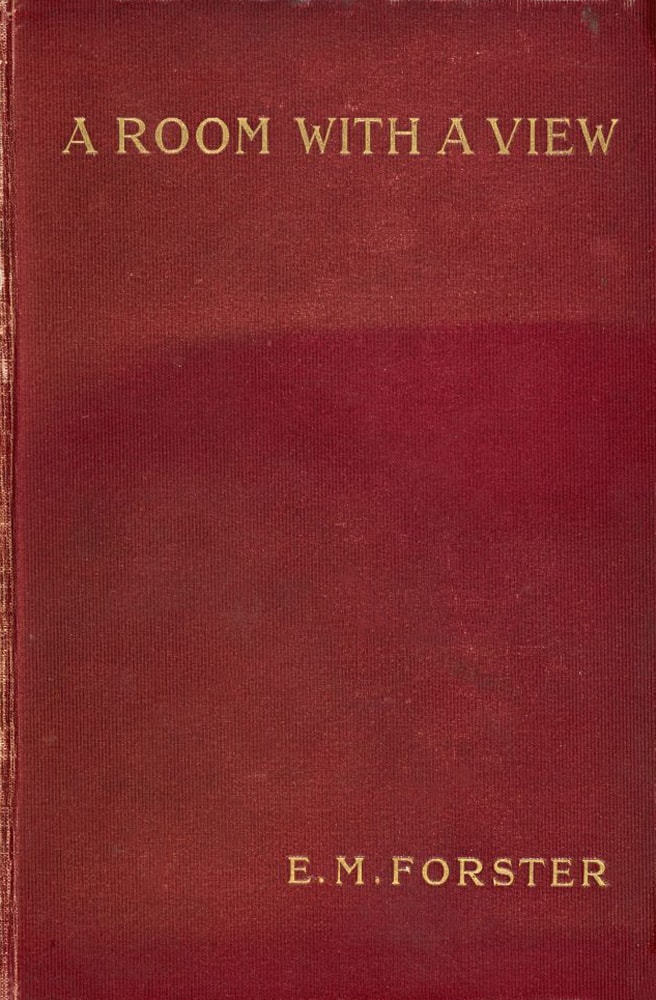
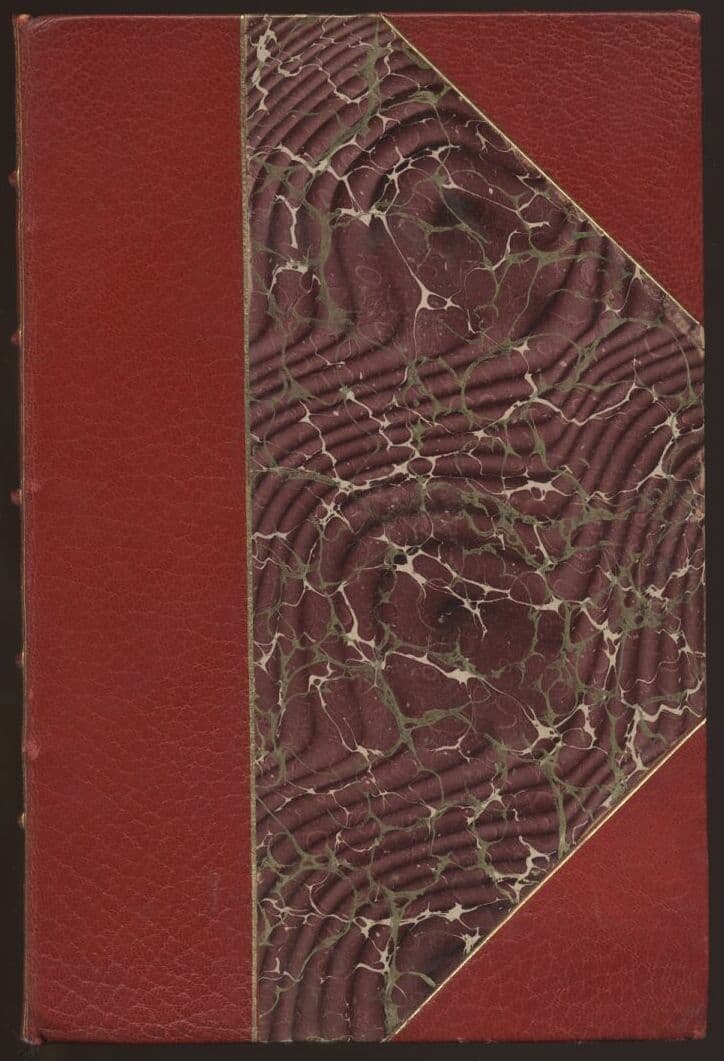
A Room with a View
1908
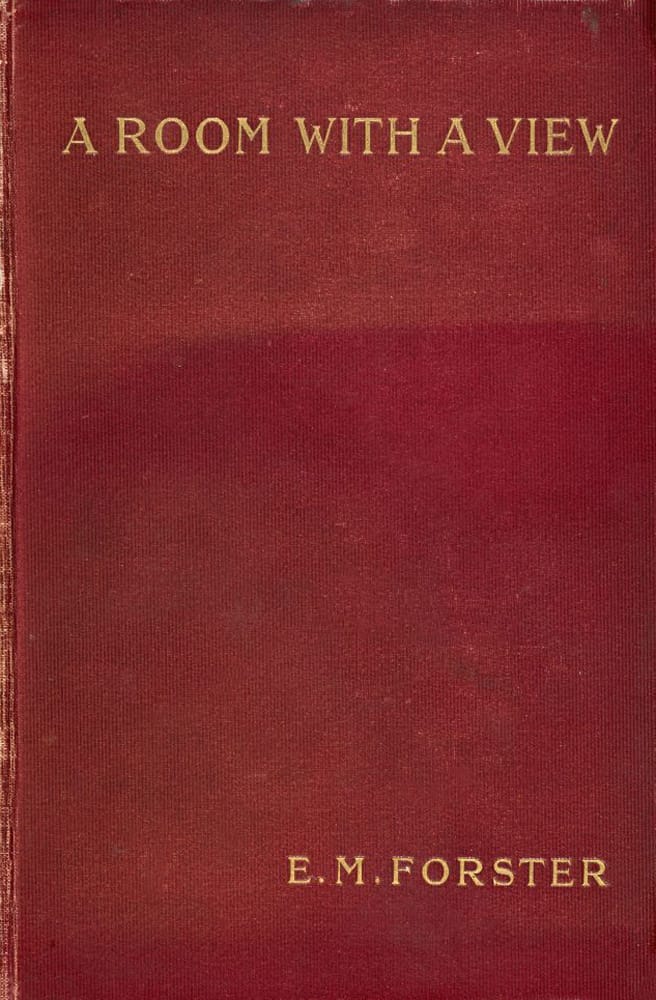
In Florence, beneath the Italian sun, a young Englishwoman's carefully ordered life begins to crack. Lucy Honeychurch arrives with her rigid cousin Charlotte expecting a civilized tour, but encounters the Emersons, a father and son whose unorthodox warmth and directness pull her toward something dangerous: genuine feeling. A kiss in a field of violets rewires her entirely. Back in England, she becomes engaged to the impeccably dull Cecil Vyse, a man who admires her as one might admire a well-furnished room. But Italy will not leave her. When George Emerson reappears in Surrey, Lucy faces her defining choice: remain the polished ornament her class demands, or follow the dangerous current of her own desire. Forster writes with razor precision about the suffocating conventions of Edwardian England while capturing the transformative power of passion. This is a novel about learning to see clearly, about the courage required to choose one's own life, and about the rooms with views that change us forever.
Editions

X-Ray
“It isn't possible to love and part. You will wish that it was. You can transmute love, ignore it, muddle it, but you can never pull it out of you. I know by experience that the poets are right: love is eternal.””
— E. M. Forster
“We cast a shadow on something wherever we stand, and it is no good moving from place to place to save things; because the shadow always follows. Choose a place where you won't do harm - yes, choose a place where you won't do very much harm, and stand in it for all you are worth, facing the sunshine.””
— E. M. Forster
“When I think of what life is, and how seldom love is answered by love; it is one of the moments for which the world was made.””
— E. M. Forster
“Life is easy to chronicle, but bewildering to practice.””
— E. M. Forster
“This desire to govern a woman”
— E. M. Forster
“Let yourself go. Pull out from the depths those thoughts that you do not understand, and spread them out in the sunlight and know the meaning of them.””
— E. M. Forster
“Mistrust all enterprises that require new clothes.””
— E. M. Forster
“Life' wrote a friend of mine, 'is a public performance on the violin, in which you must learn the instrument as you go along.””
— E. M. Forster
“It is fate that I am here,' George persisted, 'but you can call it Italy if it makes you less unhappy.””
— E. M. Forster
About A Room with a View
Chapter Summaries
- 1
- Lucy Honeychurch and her cousin Charlotte Bartlett arrive at the Pension Bertolini in Florence and are disappointed with their north-facing rooms. Mr. Emerson and his son George offer to swap their rooms with a view, which Charlotte indignantly refuses due to their 'ill-bred' manner. Mr. Beebe, a clergyman, is introduced.
- 2
- Lucy goes sightseeing with Miss Lavish, an unconventional novelist, who leads them astray and then abandons Lucy, taking her Baedeker. Lucy encounters Mr. Emerson and George in Santa Croce, where Mr. Emerson openly criticizes a lecturer and encourages Lucy to embrace life, leading to an unexpected kiss from George.
- 3
- Lucy plays the piano, revealing her passionate inner self, which Mr. Beebe observes. Miss Lavish and Miss Bartlett discuss the Emersons, with Miss Lavish revealing she is writing a novel and Miss Alan hinting at Mr. Emerson's 'indelicate' behavior concerning Miss Pole's 'stomach-acidity'. Lucy expresses a desire to go out alone.
Key Themes
- Social Conventions vs. Personal Freedom
- The novel critically examines the stifling nature of Edwardian English society, particularly for women. Lucy's journey is one of breaking free from the expectations of her class and chaperones to embrace a more authentic, self-directed life, often symbolized by the 'view' and the untamed Italian landscape.
- Love and Passion
- A core theme is the distinction between intellectual, detached affection (represented by Cecil) and raw, physical, and emotionally honest passion (represented by George). Lucy's awakening to genuine love is a central aspect of her self-discovery, challenging her preconceived notions of romance and propriety.
- Truth and Lies
- The narrative frequently highlights the contrast between speaking and living truthfully versus maintaining polite falsehoods and self-deception. Lucy's initial lies about her feelings and experiences create internal and external 'muddles' that she must eventually confront to achieve happiness.
Characters
- Lucy Honeychurch(protagonist)
- A young English woman from a respectable middle-class family, initially constrained by societal conventions but gradually awakening to her true desires.
- Charlotte Bartlett(antagonist)
- Lucy's older, unmarried cousin and chaperon, whose rigid adherence to social propriety and self-sacrifice often complicates Lucy's life.
- Mr. Emerson(supporting)
- George's father, an unconventional, truth-telling man who encourages Lucy to live authentically and embrace love.
- George Emerson(protagonist)
- Mr. Emerson's son, a quiet, passionate young man who challenges Lucy's conventional world and awakens her to love.
- Mr. Beebe(supporting)
- A clergyman who is observant, witty, and subtly manipulates events, often with a detached amusement, believing in celibacy.
- Miss Eleanor Lavish(supporting)
- An unconventional, bohemian novelist who seeks 'local colour' and inadvertently exposes Lucy's secret in her book.
Link to this book
Add a free, dofollow link to Lex on your blog, forum, syllabus, or reading list.

<a href="https://lex-books.com/book/a-room-with-a-view-af90c95f-bc9a-47a6-9b5a-4cd278798bd4"><img src="https://lex-books.com/badges/read-on-lex.svg" alt="Read A Room with a View by E. M. Forster free on Lex" width="160" height="40"></a>[](https://lex-books.com/book/a-room-with-a-view-af90c95f-bc9a-47a6-9b5a-4cd278798bd4)[url=https://lex-books.com/book/a-room-with-a-view-af90c95f-bc9a-47a6-9b5a-4cd278798bd4][img]https://lex-books.com/badges/read-on-lex.svg[/img][/url]Read A Room with a View by E. M. Forster free on Lex: https://lex-books.com/book/a-room-with-a-view-af90c95f-bc9a-47a6-9b5a-4cd278798bd4Cite this book
Reading this edition for a paper or guide? Copy a citation.
Forster, E. M.. A Room with a View. Lex, lex-books.com/book/a-room-with-a-view-af90c95f-bc9a-47a6-9b5a-4cd278798bd4.Forster, E. M. (1908). A Room with a View. Lex. https://lex-books.com/book/a-room-with-a-view-af90c95f-bc9a-47a6-9b5a-4cd278798bd4Forster, E. M.. A Room with a View. Lex. https://lex-books.com/book/a-room-with-a-view-af90c95f-bc9a-47a6-9b5a-4cd278798bd4.