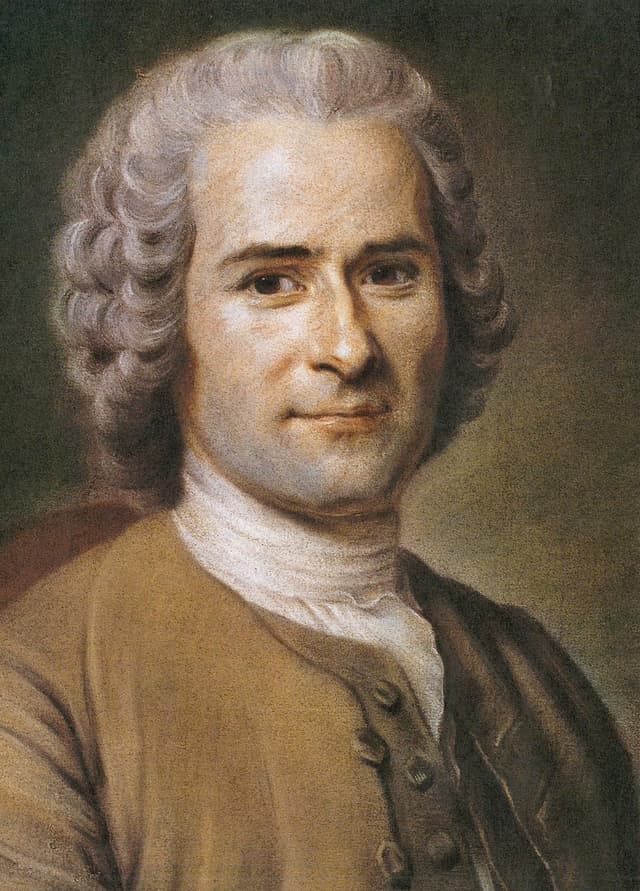
Jean-Jacques Rousseau
Jean-Jacques Rousseau was a prominent Genevan philosopher, writer, and composer whose ideas significantly shaped the intellectual landscape of the Enlightenment. His political philosophy laid the groundwork for modern democratic thought, particularly through works like 'The Social Contract,' which articulated the principles of legitimate political authority and collective sovereignty. In 'Discourse on Inequality,' Rousseau provocatively argued that the institution of private property is the root of social disparities, challenging the status quo of his time and influencing revolutionary ideas in France and beyond. Rousseau's literary contributions extended beyond political theory; his sentimental novel 'Julie, or the New Heloise' played a crucial role in the emergence of preromanticism and romanticism in literature. His educational treatise 'Émile, or On Education' emphasized the importance of individual development within society, advocating for a more natural approach to education. Furthermore, Rousseau's autobiographical works, particularly the posthumously published 'Confessions,' are considered pioneering in the genre, marking a shift towards personal narrative and introspection that would define modern literature. His legacy endures in various fields, from political theory to education and literature, making him a central figure in the evolution of Western thought.
Famous Quotes
View all 19 quotes“People who know little are usually great talkers, while men who know much say little.””
“I prefer liberty with danger than peace with slavery.””
“Man is born free, and everywhere he is in chains.””
Books from the author






Link to this page
Add a free, dofollow link to Lex on your blog, forum, syllabus, or reading list.

<a href="https://lex-books.com/author/jean-jacques-rousseau"><img src="https://lex-books.com/badges/read-on-lex.svg" alt="Jean-Jacques Rousseau on Lex" width="160" height="40"></a>[](https://lex-books.com/author/jean-jacques-rousseau)[url=https://lex-books.com/author/jean-jacques-rousseau][img]https://lex-books.com/badges/read-on-lex.svg[/img][/url]Jean-Jacques Rousseau on Lex: https://lex-books.com/author/jean-jacques-rousseau