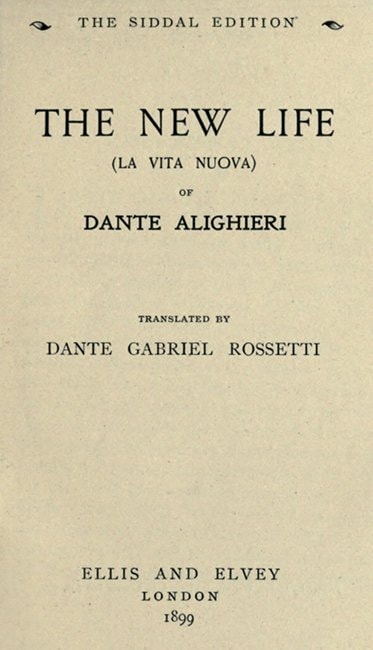
The New Life (la Vita Nuova)
1293
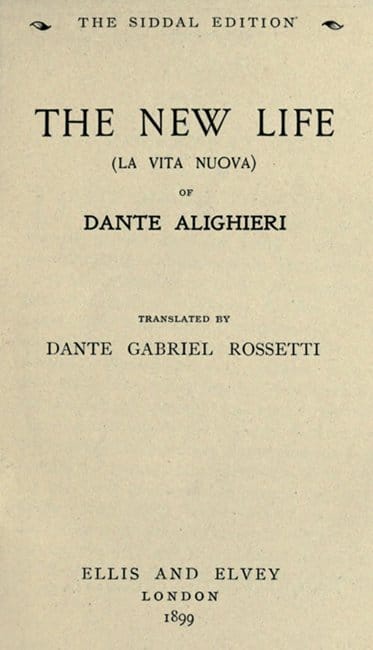
The book that invented modern love begins with a nine-year-old girl in a Florentine street. Dante Alighieri saw Beatrice Portinari once, then spent the rest of his life writing about her. The New Life is the extraordinary result: a book that interweaves thirty-one poems with prose commentary to create something neither autobiography nor allegory, but something more radical, a portrait of love as a religious experience. Dante encounters Beatrice again years later, and her greeting shatters him. From this moment, the book becomes a meditation on how desire can elevate the soul or destroy it. He writes poems celebrating her, poems mourning her absence, poems debating the nature of love itself. When death threatens to take her, Dante constructs an elaborate allegory of love as a lord who visits his soul. The prose that frames each poem is both explanation and confession, tracking the poet's emotional and spiritual crisis with startling intimacy. It endures because it captured something new: the idea that love is not merely emotion but transformation, that the beloved can become a gateway to the divine. Six centuries before romantic poetry existed as we know it, Dante wrote its founding document. Those who have ever loved impossibly, or written about it, or simply wondered what it means to be ruined by a glance, this book is for them.
Editions
X-Ray
“In that book which is my memory,On the first page of the chapter that is the day when I first met you,Appear the words, ‘Here begins a new life’.””
— Dante Alighieri
“Apparuit iam beatitudo vestra,””
— Dante Alighieri
“I say that when she appeared, in whatever place, by the hope embodied in that marvelous greeting, for me no enemy remained, in fact I shone with a flame of charity that made me grant pardon to whoever had offended me: and if anyone had then asked me anything my reply would only have been: ‘Love’, with an aspect full of humility.””
— Dante Alighieri
“In quella parte del libro de la mia memoria dinanzi a la quale poco si potrebbe leggere, si trova una rubrica la quale dice: INCIPIT VITA NOVA””
— Dante Alighieri
“Time and again the thought comes to my mindof the dark condition Love imparts to me;then the pity of it strikes me, and I ask:“Could ever anyone have felt the same?”For Love’s attack is so precipitousthat life itself all but abandons me:nothing survives except one lonely spirit,allowed to live because it speaks of you. With hope of help to come I gather courage,and deathly languid, drained of all defenses,I come to you expecting to be healed;and if I raise my eyes to look at you,within my heart a tremor starts to spread,driving out life, stopping my pulses’ beat.””
— Dante Alighieri
“My lady looks so gentle and so pure When yielding salutation by the way, That the tongue trembles and has nought to say, And the eyes, which fain would see, may not endure. And still, amid the praise she hears secure, She walks with humbleness for her array; Seeming a creature sent from Heaven to stay On earth, and show a miracle made sure. She is so pleasant in the eyes of men That through the sight the inmost heart doth gain A sweetness which needs proof to know it by: And from between her lips there seems to move A soothing essence that is full of love, Saying for ever to the spirit, “Sigh!””
— Dante Alighieri
“Ecce deus fortior me, qui veniens dominabitur michi.””
— Dante Alighieri
“E chi avesse voluto conoscere Amore, fare lo potea mirando lo tremare de li occhi miei.””
— Dante Alighieri
“Names are the consequences of things.””
— Dante Alighieri
Link to this book
Add a free, dofollow link to Lex on your blog, forum, syllabus, or reading list.

<a href="https://lex-books.com/book/the-new-life-la-vita-nuova-4b2191c9-448a-419b-ac81-8aa64892fc0b"><img src="https://lex-books.com/badges/read-on-lex.svg" alt="Read The New Life (la Vita Nuova) by Dante Alighieri free on Lex" width="160" height="40"></a>[](https://lex-books.com/book/the-new-life-la-vita-nuova-4b2191c9-448a-419b-ac81-8aa64892fc0b)[url=https://lex-books.com/book/the-new-life-la-vita-nuova-4b2191c9-448a-419b-ac81-8aa64892fc0b][img]https://lex-books.com/badges/read-on-lex.svg[/img][/url]Read The New Life (la Vita Nuova) by Dante Alighieri free on Lex: https://lex-books.com/book/the-new-life-la-vita-nuova-4b2191c9-448a-419b-ac81-8aa64892fc0bCite this book
Reading this edition for a paper or guide? Copy a citation.
Alighieri, Dante. The New Life (la Vita Nuova). Lex, lex-books.com/book/the-new-life-la-vita-nuova-4b2191c9-448a-419b-ac81-8aa64892fc0b.Alighieri, D. (1293). The New Life (la Vita Nuova). Lex. https://lex-books.com/book/the-new-life-la-vita-nuova-4b2191c9-448a-419b-ac81-8aa64892fc0bAlighieri, Dante. The New Life (la Vita Nuova). Lex. https://lex-books.com/book/the-new-life-la-vita-nuova-4b2191c9-448a-419b-ac81-8aa64892fc0b.