Our National Parks
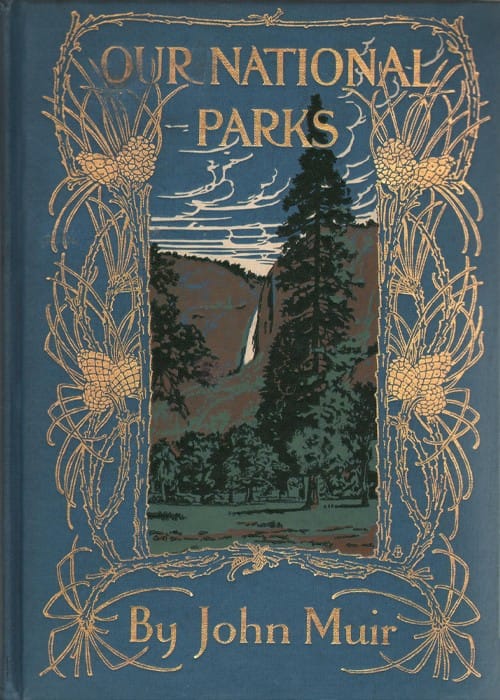
John Muir wrote this book to make you fall in love with wilderness. Published in 1901, it collects his luminous essays on the newly established national parks of the American West: Yosemite's cathedral groves, Yellowstone's erupting geysers, the crystalline Sierra Nevada. Muir was not merely describing landscapes; he was making a radical argument, that these wild places possessed intrinsic worth beyond their economic utility, that they were sacred spaces where the human soul could be restored. His prose crackles with evangelical fervor as he urges readers to leave the 'dusty, exhausting, nerve-wracking din' of civilization and find renewal in the 'grand, symphonious whole' of nature. These essays helped birth the American conservation movement and remain a clarion call to anyone who believes the wild is worth saving. Reading Muir feels like being dragged by the collar into the mountains by someone who cannot fathom why you'd possibly want to stay in a room when the whole luminous world awaits.
Editions
X-Ray
“Thousands of tired, nerve-shaken, over-civilized people are beginning to find out that going to the mountains is going home; that wildness is a necessity””
— John Muir
“One touch of nature makes the whole world kin.””
— John Muir
“One should go to the woods for safety, if for nothing else.””
— John Muir
“He had gone to the higher Sierras... [about Ralph Waldo Emerson's death]””
— John Muir
“It was the afternoon of the day and the afternoon of his life, and his course was now westward down all the mountains into the sunset. [speaking about Ralph Waldo Emerson]””
— John Muir
“It is always interesting to see people in dead earnest, from whatever cause, and earthquakes make everybody earnest.””
— John Muir
“The finest of the glacier meadow gardens lie ...imbedded in the upper pine forests like lakes of light.””
— John Muir
“C. albus...I think the very loveliest of all the lily family,- a spotless soul, plant saint, that every one must love and so be made better. It puts the wildest mountaineer on his good behavior. With this plant the whole world would seem rich though non other existed.””
— John Muir
Link to this book
Add a free, dofollow link to Lex on your blog, forum, syllabus, or reading list.

<a href="https://lex-books.com/book/our-national-parks-7bbccd3c-123c-47e6-914d-1d89be94d838"><img src="https://lex-books.com/badges/read-on-lex.svg" alt="Read Our National Parks by John Muir free on Lex" width="160" height="40"></a>[](https://lex-books.com/book/our-national-parks-7bbccd3c-123c-47e6-914d-1d89be94d838)[url=https://lex-books.com/book/our-national-parks-7bbccd3c-123c-47e6-914d-1d89be94d838][img]https://lex-books.com/badges/read-on-lex.svg[/img][/url]Read Our National Parks by John Muir free on Lex: https://lex-books.com/book/our-national-parks-7bbccd3c-123c-47e6-914d-1d89be94d838Cite this book
Reading this edition for a paper or guide? Copy a citation.
Muir, John. Our National Parks. Lex, lex-books.com/book/our-national-parks-7bbccd3c-123c-47e6-914d-1d89be94d838.Muir, J. (n.d.). Our National Parks. Lex. https://lex-books.com/book/our-national-parks-7bbccd3c-123c-47e6-914d-1d89be94d838Muir, John. Our National Parks. Lex. https://lex-books.com/book/our-national-parks-7bbccd3c-123c-47e6-914d-1d89be94d838.