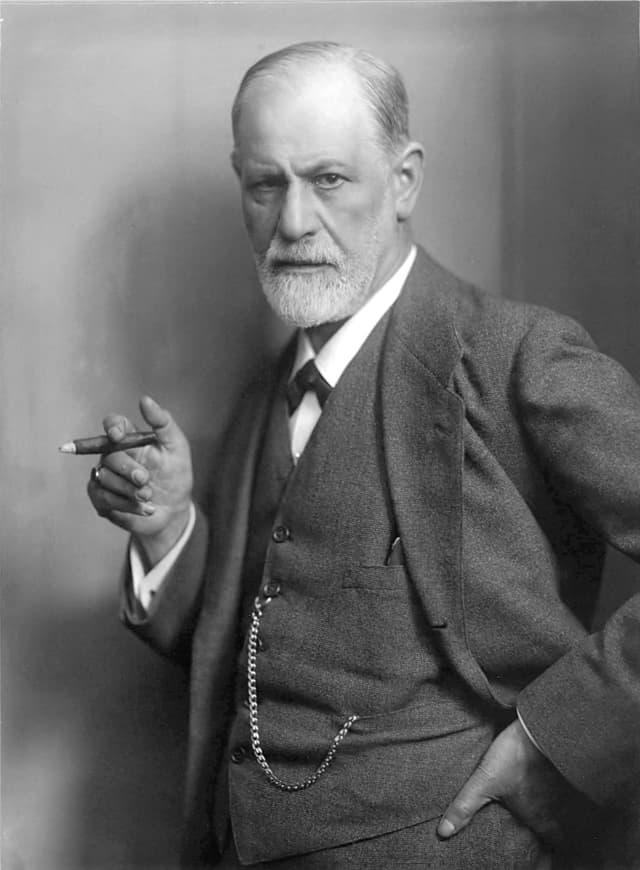
Sigmund Freud
Sigmund Freud was an Austrian neurologist renowned as the founder of psychoanalysis, a revolutionary clinical method for understanding and treating psychological disorders. Born in Freiberg, Moravia, to Galician Jewish parents, he pursued medicine at the University of Vienna, where he qualified in 1881. Freud established his clinical practice in Vienna in 1886 and became a prominent figure in the field of neuropathology. His innovative techniques, such as free association and the concept of transference, transformed the therapeutic landscape, allowing for deeper exploration of the human psyche. Freud's theories on the unconscious mind, particularly his models of id, ego, and superego, provided a framework for understanding human behavior and motivation that has had a lasting impact on psychology and beyond. Freud's work also delved into the complexities of human sexuality, introducing concepts like the Oedipus complex and the role of repressed desires in mental health. His analysis of dreams as wish fulfillments further illustrated the intricate workings of the mind. In addition to his psychological theories, Freud offered critical insights into religion and culture, examining their psychological underpinnings. His ideas sparked both admiration and controversy, positioning him as a pivotal figure in 20th-century thought. After fleeing Austria due to Nazi persecution, Freud spent his final years in the United Kingdom, where he continued to influence the fields of psychology, literature, and philosophy until his death in 1939.
Famous Quotes
View all 18 quotes“One day, in retrospect, the years of struggle will strike you as the most beautiful.””
“Being entirely honest with oneself is a good exercise.””
“Most people do not really want freedom, because freedom involves responsibility, and most people are frightened of responsibility.””
Books from the author



























Link to this page
Add a free, dofollow link to Lex on your blog, forum, syllabus, or reading list.

<a href="https://lex-books.com/author/sigmund-freud"><img src="https://lex-books.com/badges/read-on-lex.svg" alt="Sigmund Freud on Lex" width="160" height="40"></a>[](https://lex-books.com/author/sigmund-freud)[url=https://lex-books.com/author/sigmund-freud][img]https://lex-books.com/badges/read-on-lex.svg[/img][/url]Sigmund Freud on Lex: https://lex-books.com/author/sigmund-freud