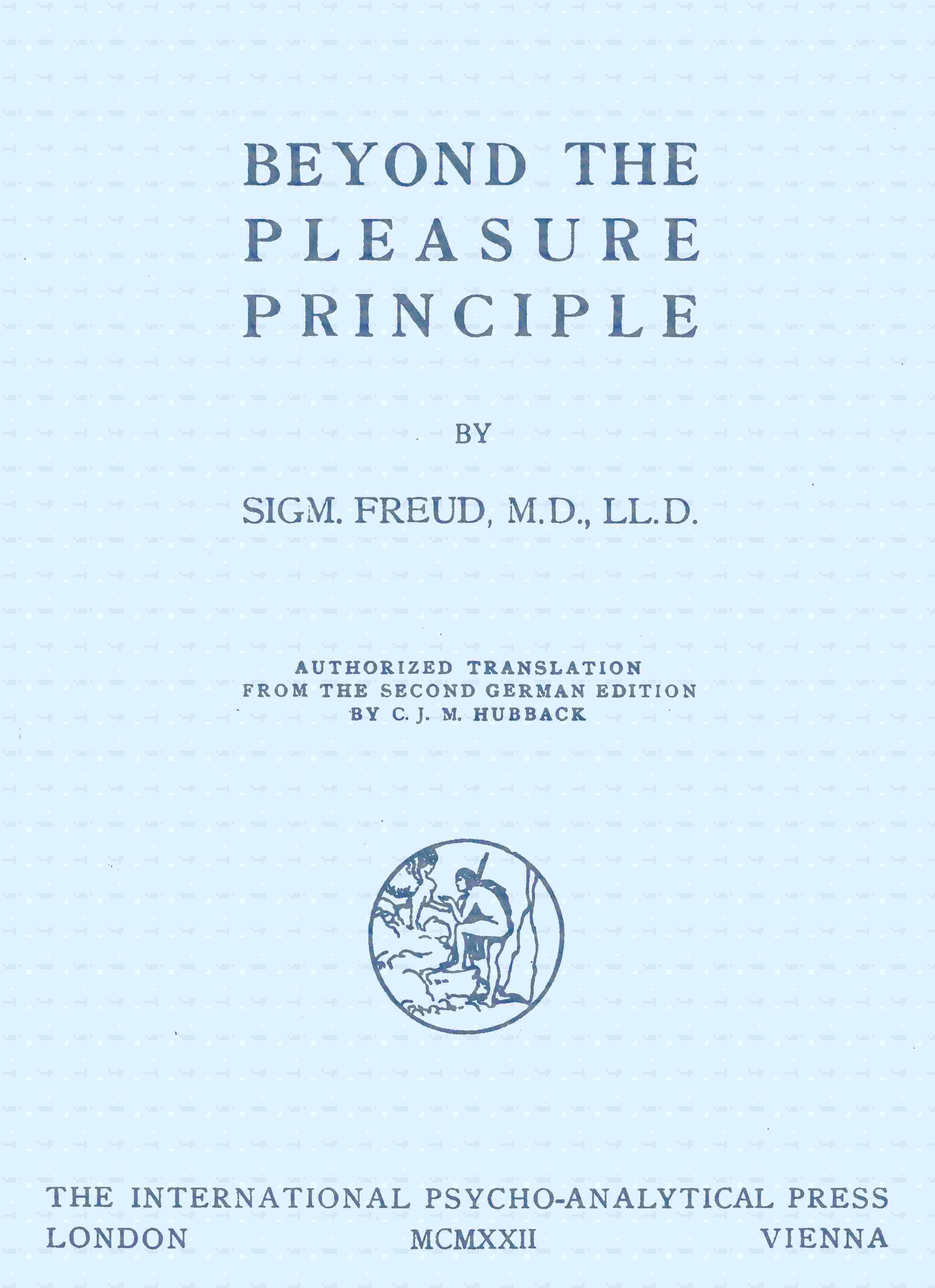
Beyond the Pleasure Principle
1920
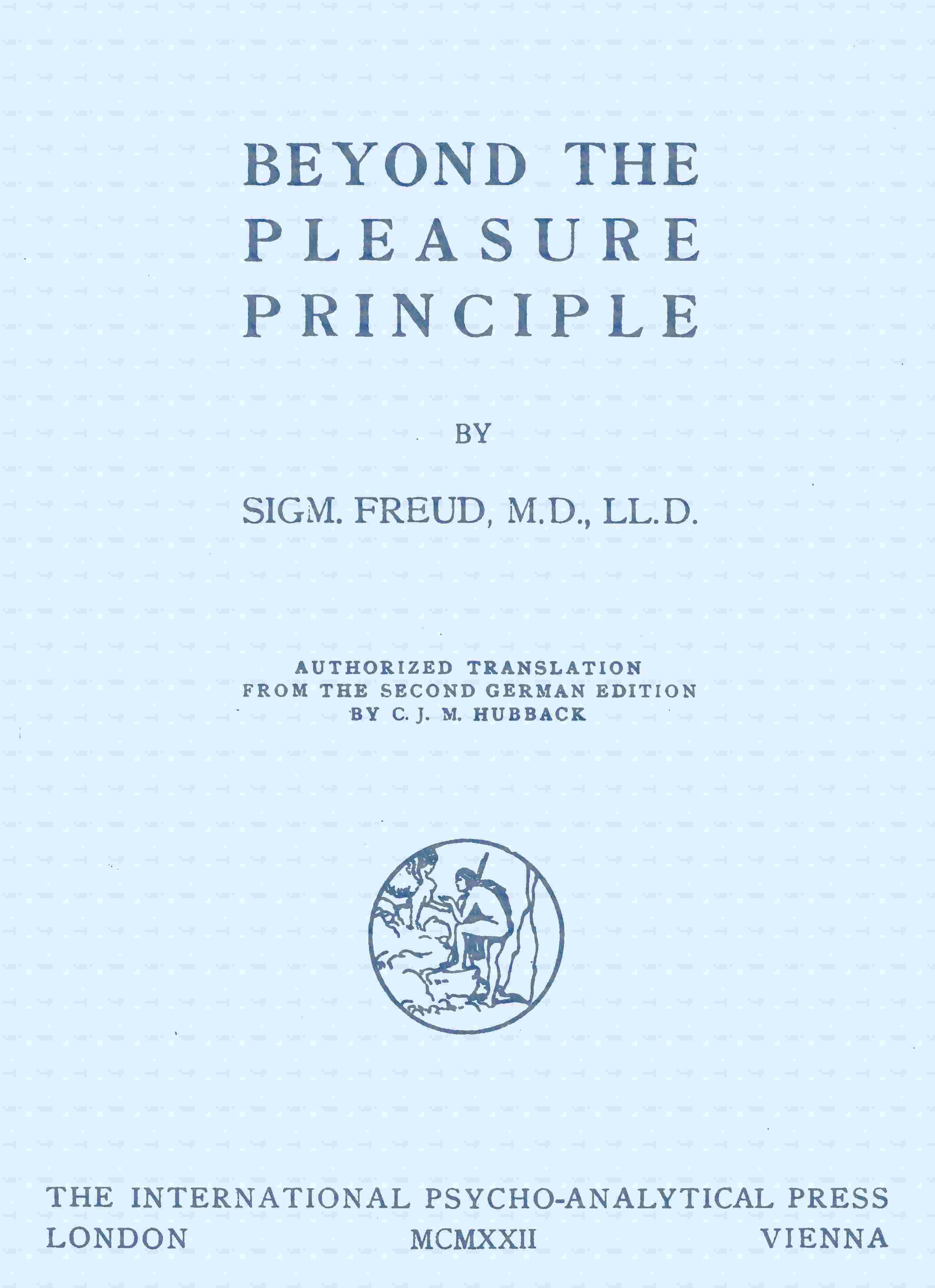
Beyond the Pleasure Principle
1920
Translated by C. J. M. (Caroline Jane Mary) Hubback
In 1920, Freud committed an act of intellectual heresy: he overthrew his own theory. For two decades, he had argued that humans are governed by the pleasure principle, the avoidance of pain, the pursuit of satisfaction. Then came the war neuroses, the traumatized soldiers, the puzzling repetition of nightmares. Something else was at work. Something that drew the mind back toward destruction, toward the inorganic, toward death. What Freud proposed was staggering: beneath Eros, the life drive, exists another instinct, the death drive (Thanatos). We are not merely pulled toward pleasure but also toward annihilation, expressed through aggression, self-sabotage, and the compulsive re-enactment of trauma. He builds this case through clinical observations of children's play, traumatic dreams, and the repetition compulsion seen in neurotic patients. The book remains essential reading for anyone seeking to understand the darker currents of human nature and the origins of concepts that continue to shape psychotherapy today. For serious readers of psychology, philosophy, and existential thought.
Editions
X-Ray
“The patient cannot remember the whole of what is repressed in him, and what he cannot remember may be precisely the essential part of it.. He is obliged to repeat the repressed material as a contemporary experience instead of remembering it as something in the past.””
— Sigmund Freud
“Many of us will also find it hard to abandon our belief that in man himself there dwells an impulse towards perfection, which has brought him to his present heights of intellectual prowess and ethical sublimation, and from which it might be expected that his development into superman will be ensured. But I do not believe in the existence of such an inner impulse, and I see no way of preserving this pleasing illusion. The development of man up to now does not seem to me to need any explanation differing from that of animal development, and the restless striving towards further perfection which may be observed in a minority of human beings is easily explicable as the result of that repression of instinct upon which what is most valuable in human culture is built.””
— Sigmund Freud
“Most of the 'pain' we experience is of a perceptual order, perception either of the urge of unsatisfied instincts or of something in the external world which may be painful in itself or may arouse painful anticipations in the psychic apparatus and is recognised by it as 'danger.””
— Sigmund Freud
“It is plainly the case that children repeat everything in their play that has made a powerful impression on them, and that in so doing they abreact the intensity of the ecperience and make themselves so to speak master of the situation.””
— Sigmund Freud
“If man must himself die, after first losing his most beloved ones by death, he would prefer that his life be forfeit to an inexorable law of nature, the sublime †Å¬³Ç·, than to a mere accident which perhaps could have been in some way avoided. But perhaps this belief in the incidence of death as the necessary consequence of an inner law of being is also only one of those illusions that we have fashioned for ourselves 'so as to endure the burden of existence'. It is certainly not a primordial belief: the idea of a 'natural death' is alien to primitive races; they ascribe every death occurring among themselves to the influence of an enemy or an evil spirit. So let””
— Sigmund Freud
“Under the influence of the instinct of the ego for self-preservation it is replaced by the 'reality-principle ', which without giving up the intention of ultimately attaining pleasure yet demands and enforces the postponement of satisfaction, the renunciation of manifold possibilities of it, and the temporary endurance of 'pain' on the long and circuitous road to pleasure. The pleasure-principle however remains for a long time the method of operation of the sex impulses, which are not so easily educable, and it happens over and over again that whether acting through these impulses or operating in the ego itself it prevails over the reality-principle to the detriment of the whole organism.””
— Sigmund Freud
“The reaction to these claims of impulse and these threats of danger, a reaction in which the real activity of the psychic apparatus is manifested, may be guided correctly by the pleasure-principle or by the reality-principle which modifies this.””
— Sigmund Freud
“The details of the process by which repression changes a possibility of pleasure into a source of 'pain' are not yet fully understood, or are not yet capable of clear presentation, but it is certain that all neurotic 'pain' is of this kind, is pleasure which cannot be experienced as such.””
— Sigmund Freud
“So long as we trace the development from its final outcome backwards, the chain of events appears continuous, and we feel we have gained an insight which is completely satisfactory or even exhaustive. But if we proceed in the reverse way, if we start from the premises inferred from the analysis and try to follow these up to the final results, then we no longer get the impression of an inevitable sequence of events which could not have otherwise been determined.””
— Sigmund Freud
Link to this book
Add a free, dofollow link to Lex on your blog, forum, syllabus, or reading list.

<a href="https://lex-books.com/book/beyond-the-pleasure-principle-fbad306a-820d-48d5-8555-fe6b8bc47689"><img src="https://lex-books.com/badges/read-on-lex.svg" alt="Read Beyond the Pleasure Principle by Sigmund Freud free on Lex" width="160" height="40"></a>[](https://lex-books.com/book/beyond-the-pleasure-principle-fbad306a-820d-48d5-8555-fe6b8bc47689)[url=https://lex-books.com/book/beyond-the-pleasure-principle-fbad306a-820d-48d5-8555-fe6b8bc47689][img]https://lex-books.com/badges/read-on-lex.svg[/img][/url]Read Beyond the Pleasure Principle by Sigmund Freud free on Lex: https://lex-books.com/book/beyond-the-pleasure-principle-fbad306a-820d-48d5-8555-fe6b8bc47689Cite this book
Reading this edition for a paper or guide? Copy a citation.
Freud, Sigmund. Beyond the Pleasure Principle. Lex, lex-books.com/book/beyond-the-pleasure-principle-fbad306a-820d-48d5-8555-fe6b8bc47689.Freud, S. (1920). Beyond the Pleasure Principle. Lex. https://lex-books.com/book/beyond-the-pleasure-principle-fbad306a-820d-48d5-8555-fe6b8bc47689Freud, Sigmund. Beyond the Pleasure Principle. Lex. https://lex-books.com/book/beyond-the-pleasure-principle-fbad306a-820d-48d5-8555-fe6b8bc47689.