Totem and Taboo: Resemblances Between the Psychic Lives of Savages and Neurotics
1913
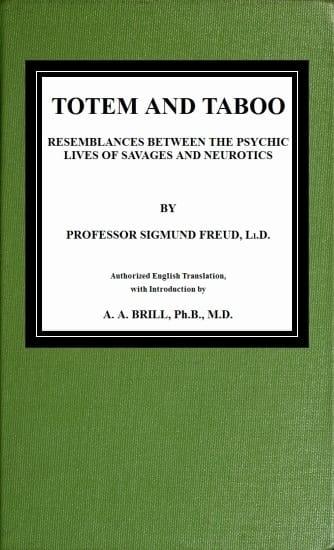
Totem and Taboo: Resemblances Between the Psychic Lives of Savages and Neurotics
1913
Translated by A. A. (Abraham Arden) Brill
In 1913, Sigmund Freud ventured into anthropology and emerged with a theory so daring it still provokes debate today. Totem and Taboo argues that the psychological processes governing "savage" societies and neurotics are fundamentally identical, that the incest taboo and totemic prohibitions we call primitive are the same unconscious compulsions operating in modern patients. Freud's centerpiece is the "primal horde" hypothesis: civilization, he proposes, was born from a collective guilt, the murder of the father by his sons, and every subsequent taboo, law, and moral prohibition is an echo of that original crime. The book remains electrifying not because it's settled science, but because Freud asked a question no one had thought to ask: What if the rituals of Australian aborigines, the obsessions of your Viennese analysand, and the Ten Commandments all stem from the same psychic source? Whether you accept his conclusions or not, Totem and Taboo is the text that made it impossible to think about religion, family, and morality without engaging psychoanalysis. It is Freud at his most ambitious and most provocative.
Editions
X-Ray
“No neurotic harbors thoughts of suicide which are not murderous impulses against others redirected upon himself.””
— Sigmund Freud
“psychoanalytic investigation of the individual teaches with especial emphasis that god is in every case modeled after the father and that our personal relation to god is dependent upon our relation to our physical father, fluctuating and changing with him, and that god at bottom is nothing but an exalted father.””
— Sigmund Freud
“the principle which controls magic, and the technique of the animistic method of thought, is “Omnipotence of Thought.””
— Sigmund Freud
“But we must not let our judgment about primitive men be influenced too far by the analogy with neurotics. Differences must also be taken into account. Of course the sharp division between thinking and doing as we draw it does not exist either with savages or with neurotics. But the neurotic is above all inhibited in his actions; with him the thought is a complete substitute for the dead. Primitive man is not inhabited, the thought is directly converted into the deed, the deed is for him so to speak rather a substitute for the thought, and for that reason I think we may well assume in the case we are discussing, though without vouching for the absolute certainty to the decision, that "in the beginning was the deed.””
— Sigmund Freud
“If we survey the relation of survivors to the dead through the course of the ages, it is very evident that the ambivalent feeling has extraordinarily abated. We now find it easy to suppress whatever unconscious hostility towards the dead there may still exist without any special psychic effort on our part. Where formerly satisfied hate and painful tenderness struggled with each other, we now find piety, which appears like a cicatrice and demands : De mortuis nil nisi bene.Only neurotics still blur the mourning for the loss of their dear ones with attacks of compulsive reproaches which psychoanalysis reveals as the old ambivalent emotional feeling. How this change was brought about, and to what extent constitutional changes and real improvement of familiar relations share in causing the abatement of the ambivalent feeling, need not be discussed here.But this example would lead us to assume that the psychic impulses of primitive man possessed a higher degree of ambivalence than is found at present among civilized human beings. Withthe decline of this ambivalence the taboo, as the compromise symptom of the ambivalent conflict, also slowly disappeared. Neurotics who are compelled to reproduce this conflict, together with the taboo resulting from it, may be said to have brought with them an atavistic remnant in the form of an archaic constitution the compensation of which in the interest of cultural demands entails the most prodigious psychic efforts on their part.””
— Sigmund Freud
“prohibición, porque sin ella hubiera penetrado la””
— Sigmund Freud
“1o La falta de motivación de las prescripciones; 2o Su imposición por una necesidad interna; 3o Su facultad de desplazamiento y contagio, y 4o La causación de actos ceremoniales y de prescripciones, emanados de las prohibiciones mismas.””
— Sigmund Freud
“y si no estuviese habituado a designar a tales personas con el nombre de neuróticos obsesivos hallaría muy adecuado el nombre de enfermedad del tabú para caracterizar sus estados.””
— Sigmund Freud
Link to this book
Add a free, dofollow link to Lex on your blog, forum, syllabus, or reading list.

<a href="https://lex-books.com/book/totem-and-taboo-resemblances-between-the-psychic-lives-of-savages-and-neurotics-3d046201-821d-4039-8a41-3d716c8f734b"><img src="https://lex-books.com/badges/read-on-lex.svg" alt="Read Totem and Taboo: Resemblances Between the Psychic Lives of Savages and Neurotics by Sigmund Freud free on Lex" width="160" height="40"></a>[](https://lex-books.com/book/totem-and-taboo-resemblances-between-the-psychic-lives-of-savages-and-neurotics-3d046201-821d-4039-8a41-3d716c8f734b)[url=https://lex-books.com/book/totem-and-taboo-resemblances-between-the-psychic-lives-of-savages-and-neurotics-3d046201-821d-4039-8a41-3d716c8f734b][img]https://lex-books.com/badges/read-on-lex.svg[/img][/url]Read Totem and Taboo: Resemblances Between the Psychic Lives of Savages and Neurotics by Sigmund Freud free on Lex: https://lex-books.com/book/totem-and-taboo-resemblances-between-the-psychic-lives-of-savages-and-neurotics-3d046201-821d-4039-8a41-3d716c8f734bCite this book
Reading this edition for a paper or guide? Copy a citation.
Freud, Sigmund. Totem and Taboo: Resemblances Between the Psychic Lives of Savages and Neurotics. Lex, lex-books.com/book/totem-and-taboo-resemblances-between-the-psychic-lives-of-savages-and-neurotics-3d046201-821d-4039-8a41-3d716c8f734b.Freud, S. (1913). Totem and Taboo: Resemblances Between the Psychic Lives of Savages and Neurotics. Lex. https://lex-books.com/book/totem-and-taboo-resemblances-between-the-psychic-lives-of-savages-and-neurotics-3d046201-821d-4039-8a41-3d716c8f734bFreud, Sigmund. Totem and Taboo: Resemblances Between the Psychic Lives of Savages and Neurotics. Lex. https://lex-books.com/book/totem-and-taboo-resemblances-between-the-psychic-lives-of-savages-and-neurotics-3d046201-821d-4039-8a41-3d716c8f734b.