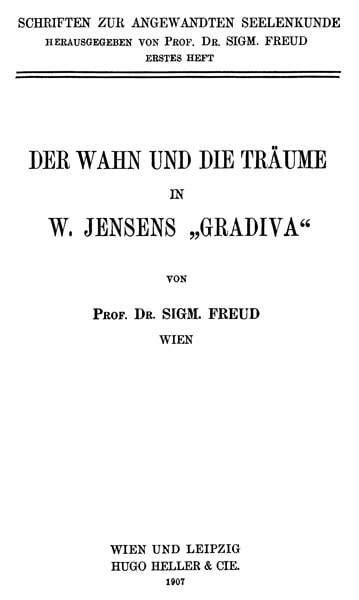
Der Wahn Und Die Träume in W. Jensens »gradiva«
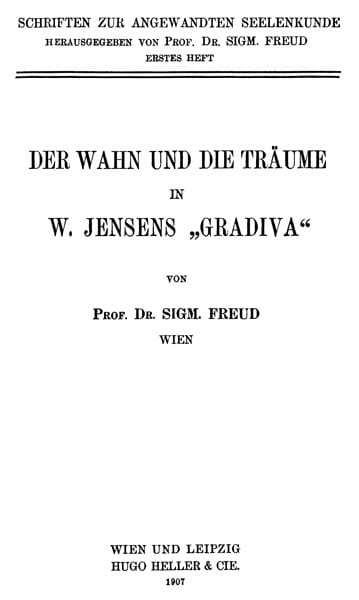
Der Wahn Und Die Träume in W. Jensens »gradiva«
In 1903, German author Wilhelm Jensen published a peculiar novella about Norbert Hanold, a young archaeologist who becomes obsessively fascinated by an ancient Roman relief depicting a woman walking. Hanold's fixation spirals into vivid dreams and elaborate fantasies until reality itself begins to blur. Seven years later, Sigmund Freud offered his only extended literary analysis, treating Jensen's strange story as a window into the human psyche. Freud reads Hanold's delusion not as madness but as a beautifully coded message from the unconscious: his obsession with the ancient Gradiva is really a reclamation of repressed memories from childhood, a forgotten girl named Zoë who once walked with the same peculiar gait. This slim volume contains both the novella and Freud's analysis, making it a unique artifact in the psychoanalytic canon: a work of literature and its interpretation bound together. For anyone curious about how psychoanalysis reads narrative, or how a 2,000-year-old relief can become a portal to buried desire, this book remains strangely vital.
Editions
X-Ray
“Experience teaches that for most people there is a limit beyond which their constitution cannot comply with the demands of civilization. All who wish to reach a higher standard than their constitution will allow, fall victims to neurosis. It would have been better for them if they could have remained less "perfect".””
— Sigmund Freud
“One of these rules is to the effect that a dream is invariably related to the events of the day before the dream. Our author seems to be wishing to show that he has followed this rule, for he attaches the dream immediately to Hanold’s ‘pedestrian researches’.””
— Sigmund Freud
“It is hidden behind a play upon words, an ambiguity. “Somewhere in the sun Gradiva was sitting." We have quite correctly related this to the spot where he met her father, the zoologist. But could it not also mean in the "Sun"- that is, Gradiva is staying in the Albergo del Sole, the Sun Hotel?””
— Sigmund Freud
“There is far less freedom and arbitrariness in mental life, however, than we are inclined to assume - there may even be none at all.””
— Sigmund Freud
“Dupa cum se stie, in domeniul ocultismului este valabil principiul: cazurile negative nu dovedesc nimic.””
— Sigmund Freud
Link to this book
Add a free, dofollow link to Lex on your blog, forum, syllabus, or reading list.

<a href="https://lex-books.com/book/der-wahn-und-die-tr-ume-in-w-jensens-gradiva-05b3d899-cb78-414a-b2fb-ab823fcaed66"><img src="https://lex-books.com/badges/read-on-lex.svg" alt="Read Der Wahn Und Die Träume in W. Jensens »gradiva« by Sigmund Freud free on Lex" width="160" height="40"></a>[](https://lex-books.com/book/der-wahn-und-die-tr-ume-in-w-jensens-gradiva-05b3d899-cb78-414a-b2fb-ab823fcaed66)[url=https://lex-books.com/book/der-wahn-und-die-tr-ume-in-w-jensens-gradiva-05b3d899-cb78-414a-b2fb-ab823fcaed66][img]https://lex-books.com/badges/read-on-lex.svg[/img][/url]Read Der Wahn Und Die Träume in W. Jensens »gradiva« by Sigmund Freud free on Lex: https://lex-books.com/book/der-wahn-und-die-tr-ume-in-w-jensens-gradiva-05b3d899-cb78-414a-b2fb-ab823fcaed66Cite this book
Reading this edition for a paper or guide? Copy a citation.
Freud, Sigmund. Der Wahn Und Die Träume in W. Jensens »gradiva«. Lex, lex-books.com/book/der-wahn-und-die-tr-ume-in-w-jensens-gradiva-05b3d899-cb78-414a-b2fb-ab823fcaed66.Freud, S. (n.d.). Der Wahn Und Die Träume in W. Jensens »gradiva«. Lex. https://lex-books.com/book/der-wahn-und-die-tr-ume-in-w-jensens-gradiva-05b3d899-cb78-414a-b2fb-ab823fcaed66Freud, Sigmund. Der Wahn Und Die Träume in W. Jensens »gradiva«. Lex. https://lex-books.com/book/der-wahn-und-die-tr-ume-in-w-jensens-gradiva-05b3d899-cb78-414a-b2fb-ab823fcaed66.