West-Running Brook
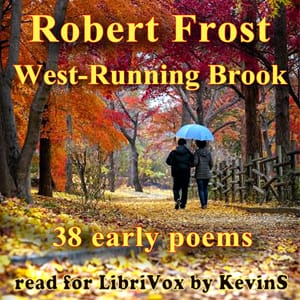
Some poetry asks to be understood. Other poetry asks to be felt. Frost's 'West-Running Brook' does both, quietly, in lines that sound like conversation but cut like prophecy. Compiled in 1923 but not published until after Frost's death, this collection gathers thirty-eight poems that circle the constants of his work: the New England landscape, the darkness that gathers at the edges of ordinary life, and the stubborn, luminous persistence of language as a way of holding on to something vanishing. The collection opens with 'Acquainted with the Night, ' perhaps the most precise poem ever written about loneliness. 'I have been one acquainted with the night.' With that single admission, Frost transforms the act of walking through darkness into an existential reckoning. The six sections here move from the tentative renewal of 'Spring Pools' through the deep blacks of 'Fiat Nox' (let there be night), to the title poem's brook running west against the grain of nature. Throughout, Frost wields the plainspoken American voice like a weapon against sentimentality, finding in the simplest images - a birchtree, a stone wall, a frozen brook - the weight of everything unsaid. These early poems, many appearing in book form for the first time, show a poet still becoming the master America would claim as its own. For those who know Frost, they are the pleasure of new terrain. For those who do not, they are a perfect place to begin: not his most famous book, but perhaps his most intimate one.
Editions

Read by
Group Narration
2 readers
KevinS, Larry Wilson, Michele Fry
Link to this book
Add a free, dofollow link to Lex on your blog, forum, syllabus, or reading list.

<a href="https://lex-books.com/book/west-running-brook-2009af15-a135-4a90-8dde-ee9a288d4b2b"><img src="https://lex-books.com/badges/read-on-lex.svg" alt="Read West-Running Brook by Robert Frost free on Lex" width="160" height="40"></a>[](https://lex-books.com/book/west-running-brook-2009af15-a135-4a90-8dde-ee9a288d4b2b)[url=https://lex-books.com/book/west-running-brook-2009af15-a135-4a90-8dde-ee9a288d4b2b][img]https://lex-books.com/badges/read-on-lex.svg[/img][/url]Read West-Running Brook by Robert Frost free on Lex: https://lex-books.com/book/west-running-brook-2009af15-a135-4a90-8dde-ee9a288d4b2bCite this book
Reading this edition for a paper or guide? Copy a citation.
Frost, Robert. West-Running Brook. Lex, lex-books.com/book/west-running-brook-2009af15-a135-4a90-8dde-ee9a288d4b2b.Frost, R. (n.d.). West-Running Brook. Lex. https://lex-books.com/book/west-running-brook-2009af15-a135-4a90-8dde-ee9a288d4b2bFrost, Robert. West-Running Brook. Lex. https://lex-books.com/book/west-running-brook-2009af15-a135-4a90-8dde-ee9a288d4b2b.