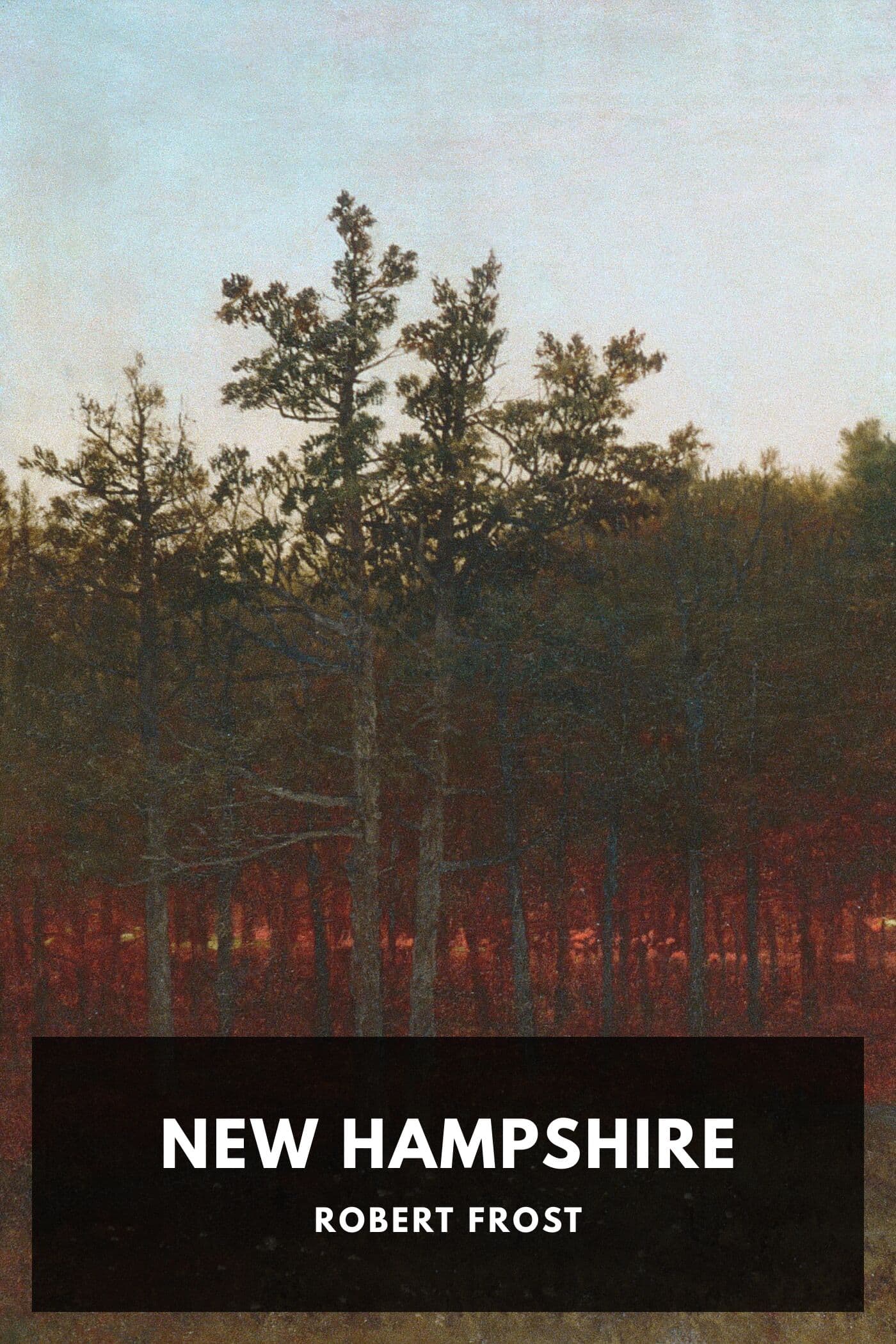
New Hampshire, a Poem; With Notes and Grace Notes
1923
In 1923, Robert Frost published a book that was half epic poem, half lyric collection, and all New England. The title poem runs for pages, introducing a cast of characters from across America who boast about their home states while the speaker champions modest New Hampshire, a place that offers only itself, without much to sell. Around this central narrative orbit fourteen "Notes" poems that the title poem directly references, followed by thirty "Grace Notes" that close the collection. But it is the shorter works that have become part of the language: "Fire and Ice," with its meditation on how the world will end; "Nothing Gold Can Stay," the hardest tight thing about loss; "Stopping by Woods on a Snowy Evening," with its famous unresolved repetition. The collection won Frost his first Pulitzer Prize, and it remains the best entry point to America's most quoted poet. What makes this book endure is its range: the playfulness of the long poem, the compression of the short ones, and the way Frost transforms a New England hill into a mirror for all human longing.
Editions
X-Ray
“The tree the tempest with a crash of woodThrows down in front of us is not to barOur passage to our journey's end for good,But just to ask us who we think we are””
— Robert Frost
“Love at the lips was touchAs sweet as I could bear;And once that seemed too much;I lived on air””
— Robert Frost
“For to be social is to be forgiving.””
— Robert Frost
“I may as well confess myself the authorOf several books against the world in general.””
— Robert Frost
“I make a virtue of my suffering From nearly everything that goes on round me. In other words, I know wherever I am, Being the creature of literature I am, I shall not lack for pain to keep me awake.””
— Robert Frost
“No wonder poets sometimes have to seem So much more businesslike than businessmen. Their wares are so much harder to get rid of.””
— Robert Frost
“The birds that came to it through the airAt broken windows flew out and in,Their murmur more like the sigh we sighFrom too much dwelling on what has been.Yet for them the lilac renewed its leaf,And the aged elm, though touched with fire;And the dry pump fung up an awkward arm;And the fence post carried a strand of wire.For them there was really nothing sad.But though they rejoiced in the nest they kept,One had to be versed in country thingsNot to believe the phoebes wept.””
— Robert Frost
“Now no joy but lacks salt,That is not dashed with painAnd weariness and fault;I crave the stainOf tears, the aftermarkOf almost too much love,The sweet of bitter barkAnd burning clove.””
— Robert Frost
“I had not taken the first step in knowledge;I had not learned to let go with the hands,As still I have not learned to with the heart.And have no wish to with the heart”
— Robert Frost
Link to this book
Add a free, dofollow link to Lex on your blog, forum, syllabus, or reading list.

<a href="https://lex-books.com/book/new-hampshire-a-poem-with-notes-and-grace-notes-111e0e7a-98ec-4a29-a5ea-42844938c5bf"><img src="https://lex-books.com/badges/read-on-lex.svg" alt="Read New Hampshire, a Poem; With Notes and Grace Notes by Robert Frost free on Lex" width="160" height="40"></a>[](https://lex-books.com/book/new-hampshire-a-poem-with-notes-and-grace-notes-111e0e7a-98ec-4a29-a5ea-42844938c5bf)[url=https://lex-books.com/book/new-hampshire-a-poem-with-notes-and-grace-notes-111e0e7a-98ec-4a29-a5ea-42844938c5bf][img]https://lex-books.com/badges/read-on-lex.svg[/img][/url]Read New Hampshire, a Poem; With Notes and Grace Notes by Robert Frost free on Lex: https://lex-books.com/book/new-hampshire-a-poem-with-notes-and-grace-notes-111e0e7a-98ec-4a29-a5ea-42844938c5bfCite this book
Reading this edition for a paper or guide? Copy a citation.
Frost, Robert. New Hampshire, a Poem; With Notes and Grace Notes. Lex, lex-books.com/book/new-hampshire-a-poem-with-notes-and-grace-notes-111e0e7a-98ec-4a29-a5ea-42844938c5bf.Frost, R. (1923). New Hampshire, a Poem; With Notes and Grace Notes. Lex. https://lex-books.com/book/new-hampshire-a-poem-with-notes-and-grace-notes-111e0e7a-98ec-4a29-a5ea-42844938c5bfFrost, Robert. New Hampshire, a Poem; With Notes and Grace Notes. Lex. https://lex-books.com/book/new-hampshire-a-poem-with-notes-and-grace-notes-111e0e7a-98ec-4a29-a5ea-42844938c5bf.