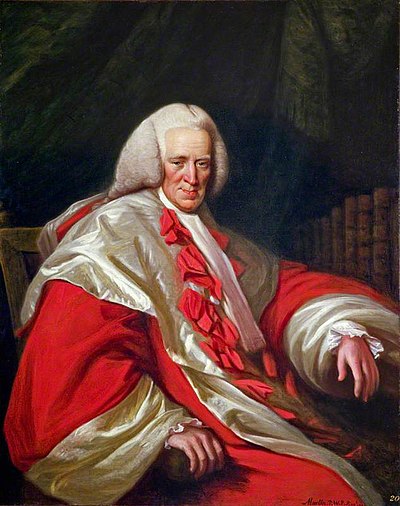
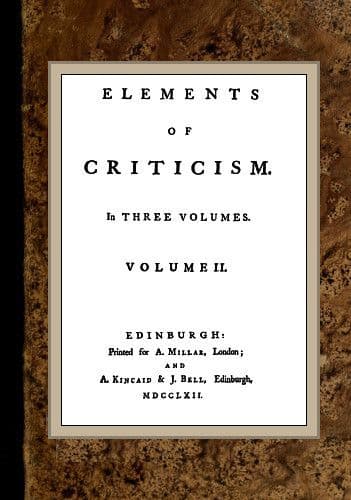
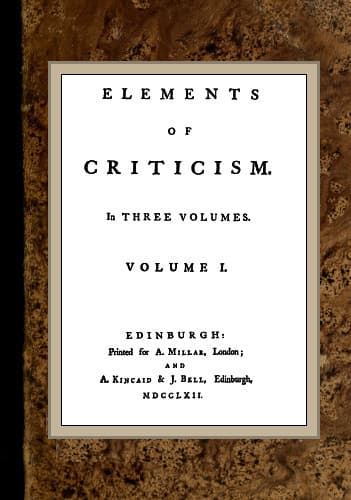
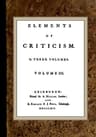
Elements of Criticism, Volume III.
1762
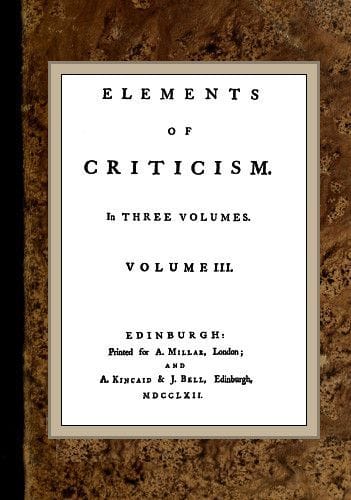
In an age when critics were just beginning to systematize their discipline, Henry Home, Lord Kames, produced a treatise that asked a deceptively simple question: why do some comparisons seize the mind while others fall flat? This third volume of Elements of Criticism zeroes in on comparisons and figures of speech as machines for producing meaning. Kames argues that these rhetorical tools serve a dual purpose, they instruct the understanding while simultaneously delighting the heart. A well-crafted comparison can elevate a humble subject to grandeur, or reduce a mighty one to absurdity; the critic's task is to understand why. Drawing liberally from Shakespeare and Milton, Kames dissects the anatomy of effective comparison: when to emphasize similarity, when to deploy contrast, and how cultural context shapes what readers find persuasive. What makes this 1762 text enduring is its fundamental insight, that we comprehend the world through comparison, and that the stakes of rhetorical choice are nothing less than the elevation or debasement of ideas. For readers interested in the history of aesthetic theory, the birth of modern literary criticism, or simply the mechanics of how language achieves its effects, this volume remains essential reading.
Editions
Link to this book
Add a free, dofollow link to Lex on your blog, forum, syllabus, or reading list.

<a href="https://lex-books.com/book/elements-of-criticism-volume-iii-0449e212-7d53-46b1-99b8-3a0819edf9cf"><img src="https://lex-books.com/badges/read-on-lex.svg" alt="Read Elements of Criticism, Volume III. by Henry Home, Lord Kames free on Lex" width="160" height="40"></a>[](https://lex-books.com/book/elements-of-criticism-volume-iii-0449e212-7d53-46b1-99b8-3a0819edf9cf)[url=https://lex-books.com/book/elements-of-criticism-volume-iii-0449e212-7d53-46b1-99b8-3a0819edf9cf][img]https://lex-books.com/badges/read-on-lex.svg[/img][/url]Read Elements of Criticism, Volume III. by Henry Home, Lord Kames free on Lex: https://lex-books.com/book/elements-of-criticism-volume-iii-0449e212-7d53-46b1-99b8-3a0819edf9cfCite this book
Reading this edition for a paper or guide? Copy a citation.
Henry Home, Lord Kames. Elements of Criticism, Volume III.. Lex, lex-books.com/book/elements-of-criticism-volume-iii-0449e212-7d53-46b1-99b8-3a0819edf9cf.Henry Home, L. K. (1762). Elements of Criticism, Volume III.. Lex. https://lex-books.com/book/elements-of-criticism-volume-iii-0449e212-7d53-46b1-99b8-3a0819edf9cfHenry Home, Lord Kames. Elements of Criticism, Volume III.. Lex. https://lex-books.com/book/elements-of-criticism-volume-iii-0449e212-7d53-46b1-99b8-3a0819edf9cf.