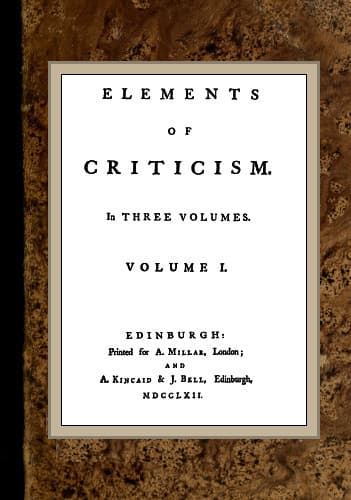
Elements of Criticism, Volume II.
1762
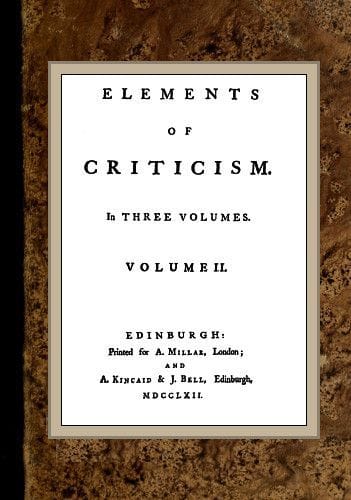
Before cultural theory, before semiotics, there was Kames asking a simpler and harder question: why does art affect us at all? In this volume, he dissects the invisible grammar of appropriateness, what he calls congruity and propriety, and shows how our sense of what fits (in a painting, a poem, a social exchange) shapes every emotional response we have to art. It's a bracing, philosophical argument that taste isn't arbitrary but rooted in human nature itself. Kames builds toward a radical claim: that criticism requires understanding not just texts, but the people who make and receive them. The result is a book that feels surprisingly modern in its insistence that aesthetic judgment and psychological insight cannot be separated. For readers curious about where modern literary theory came from, or anyone who has ever wondered why a room feels wrong or a line of poetry suddenly breaks open, this remains a genuinely illuminating place to start.
Editions
Link to this book
Add a free, dofollow link to Lex on your blog, forum, syllabus, or reading list.

<a href="https://lex-books.com/book/elements-of-criticism-volume-ii-1db6531b-8de8-47a8-b9f9-6ed71d809f3e"><img src="https://lex-books.com/badges/read-on-lex.svg" alt="Read Elements of Criticism, Volume II. by Henry Home, Lord Kames free on Lex" width="160" height="40"></a>[](https://lex-books.com/book/elements-of-criticism-volume-ii-1db6531b-8de8-47a8-b9f9-6ed71d809f3e)[url=https://lex-books.com/book/elements-of-criticism-volume-ii-1db6531b-8de8-47a8-b9f9-6ed71d809f3e][img]https://lex-books.com/badges/read-on-lex.svg[/img][/url]Read Elements of Criticism, Volume II. by Henry Home, Lord Kames free on Lex: https://lex-books.com/book/elements-of-criticism-volume-ii-1db6531b-8de8-47a8-b9f9-6ed71d809f3eCite this book
Reading this edition for a paper or guide? Copy a citation.
Henry Home, Lord Kames. Elements of Criticism, Volume II.. Lex, lex-books.com/book/elements-of-criticism-volume-ii-1db6531b-8de8-47a8-b9f9-6ed71d809f3e.Henry Home, L. K. (1762). Elements of Criticism, Volume II.. Lex. https://lex-books.com/book/elements-of-criticism-volume-ii-1db6531b-8de8-47a8-b9f9-6ed71d809f3eHenry Home, Lord Kames. Elements of Criticism, Volume II.. Lex. https://lex-books.com/book/elements-of-criticism-volume-ii-1db6531b-8de8-47a8-b9f9-6ed71d809f3e.