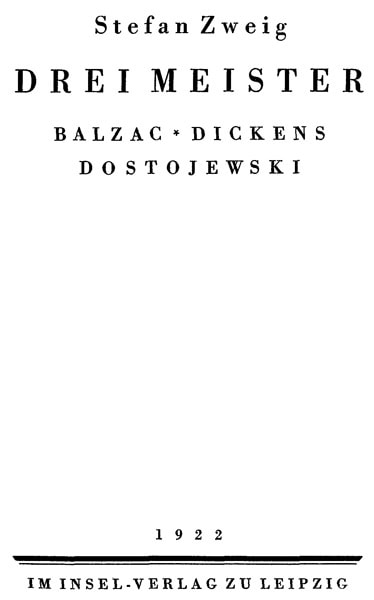
Drei Meister: Balzac, Dickens, Dostojewski
1920
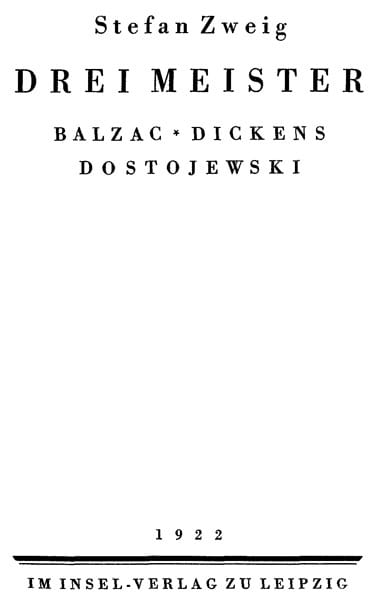
Stefan Zweig turns his psychological mastery on three titans of the 19th-century novel: Balzac, Dickens, and Dostoevsky. Written across twenty-five years and first published in 1920, this volume proposes something audacious: that these three writers, so different in temperament and vision, together form a complete picture of what the novelist can be. Balzac maps French society like a conqueror charting territory; Dickens chronicles the domestic world with warmth and wit; Dostoevsky plunges into the abyss of the individual soul. Zweig argues that none can be understood in isolation - each compensates for what the others cannot reach. This is not an introduction for the uninitiated. Zweig assumes you have read these authors, have felt the pull of Balzac's relentless ambition, the ache of Dickens's forgotten children, the vertigo of Dostoevsky's criminals and saints. What emerges is a meditation on the novel as cosmic act - how some writers do not merely tell stories but construct entire worlds with their own gravity and laws. For readers who believe literature can map the human condition, who seek to understand why these three still cast such long shadows, this remains essential reading.
Editions
X-Ray
“Dickens bütün İngilizler gibi sadece dudaklarıyla gülümser, bütün vücuduyla değil. Neşesi kendi kendini yakmaz, sadece parıldar ve ışıklarını insanların damarlarına saçar, binlerce küçük alev içinde yanıp söner, muzip bir hayalet ve Irrlicht gibidir, gerçekliğin tam orta yerinde fevkalade bir şakacıdır.””
— Stefan Zweig
“Wo die anderen enden, beginnen erst die Tragödien Dostojewskis, denn er will nicht Liebe, nicht laue Aussöhnung der Geschlechter als Sinn und Triumph der Welt. Er knüpft wieder an die große Tradition der Antike an, wo nicht, ein Weib zu erringen, sondern die Welt und alle Götter zu bestehen, Sinn und Größe eines Schicksals war. Bei ihm hebt sich der Mensch wieder auf, nicht mit dem Blick zu den Frauen, sondern mit der offenen Stirne zu seinem Gott. Seine Tragödie ist größer als die von Geschlecht zu Geschlecht und vom Mann zum Weib.””
— Stefan Zweig
“Edebiyatta sınırları aşan önemli kişiler arasında, günümüzün en büyüğü Dostoyevski'dir, ruh alanında kimse ondan daha fazla yeni ülke keşfetmemiştir; bu müthiş, bu ölçüye sığmaz adamın kendi ifadesiyle "ölçülemezlik ve sonsuzluk, yeryüzünün kendisi kadar elzemdi". Dostoyevski hiçbir yerde duraklamamıştır, "Her yerde sınırı aştım," diye yazar bir mektubunda gururla ve kendinden yakınarak, "her yerde".””
— Stefan Zweig
“Dostoyevski bir yığın bilgiyi yeni bir insanlık için feda etmiştir ve bu yeni insanlığa en derin sırrını, en son formülünü, en unutulmaz sözünü söylemiştir: "Hayatı hayatın anlamından daha çok sevin.””
— Stefan Zweig
“Balzac'ın bir kahramanı dünyayı boyunduruk altına almak ister, Dostoyevski'nin kahramanı ise onu alt etmek. Her ikisinde de günlük yaşamın üstüne çıkma gayreti, sonsuzluğa bir yönelim vardır. Dickens insanlarının hepsi mütevazıdır. Tanrım, ne istiyor bunlar? Yılda 100 pound, sevimli bir eş, bir düzine çocuk, dostlar için donatılmış güzel bir masa, Londra civarında, penceresi yeşil bir manzaraya bakan, küçük bir bahçe içinde bir kır evi ve bir avuç mutluluk.””
— Stefan Zweig
“Bilmək deyil, sadəcə xəyal etək insanı xoşbəxt edər””
— Stefan Zweig
Link to this book
Add a free, dofollow link to Lex on your blog, forum, syllabus, or reading list.

<a href="https://lex-books.com/book/drei-meister-balzac-dickens-dostojewski-50a53008-5a3b-4eed-905f-0de8dfd520c3"><img src="https://lex-books.com/badges/read-on-lex.svg" alt="Read Drei Meister: Balzac, Dickens, Dostojewski by Stefan Zweig free on Lex" width="160" height="40"></a>[](https://lex-books.com/book/drei-meister-balzac-dickens-dostojewski-50a53008-5a3b-4eed-905f-0de8dfd520c3)[url=https://lex-books.com/book/drei-meister-balzac-dickens-dostojewski-50a53008-5a3b-4eed-905f-0de8dfd520c3][img]https://lex-books.com/badges/read-on-lex.svg[/img][/url]Read Drei Meister: Balzac, Dickens, Dostojewski by Stefan Zweig free on Lex: https://lex-books.com/book/drei-meister-balzac-dickens-dostojewski-50a53008-5a3b-4eed-905f-0de8dfd520c3Cite this book
Reading this edition for a paper or guide? Copy a citation.
Zweig, Stefan. Drei Meister: Balzac, Dickens, Dostojewski. Lex, lex-books.com/book/drei-meister-balzac-dickens-dostojewski-50a53008-5a3b-4eed-905f-0de8dfd520c3.Zweig, S. (1920). Drei Meister: Balzac, Dickens, Dostojewski. Lex. https://lex-books.com/book/drei-meister-balzac-dickens-dostojewski-50a53008-5a3b-4eed-905f-0de8dfd520c3Zweig, Stefan. Drei Meister: Balzac, Dickens, Dostojewski. Lex. https://lex-books.com/book/drei-meister-balzac-dickens-dostojewski-50a53008-5a3b-4eed-905f-0de8dfd520c3.