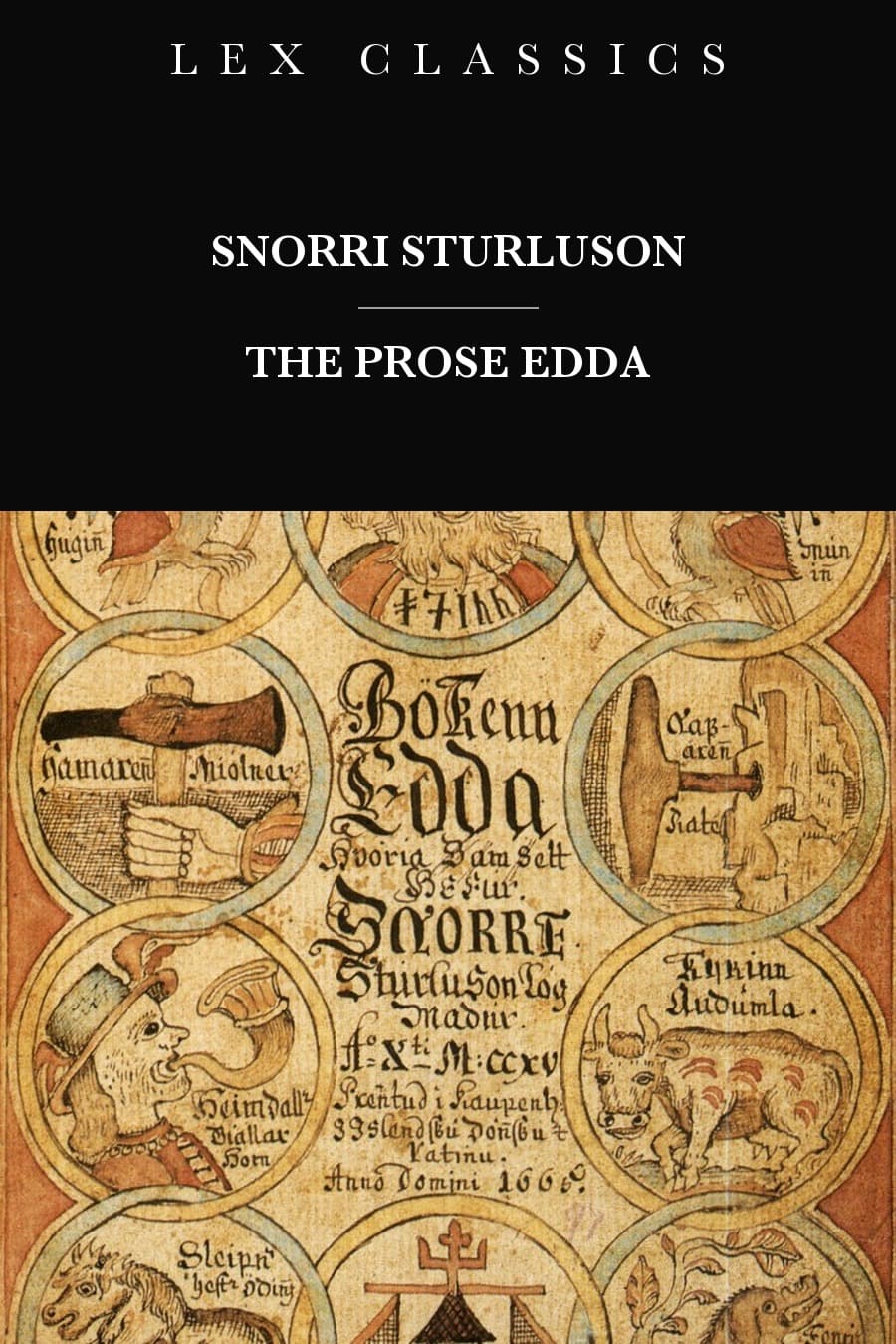
The Younger Edda; Also Called Snorre's Edda, or the Prose Edda
The Prose Edda is where the Norse gods live. Written by Icelandic chieftain Snorri Sturluson around 1220, it preserves the pagan myths that once ruled Viking imagination before Christianity swept Scandinavia. Here is the creation: from the void called Ginungagap, the giant Ymir's body becomes the world, and Odin and his brothers build humanity's home from flesh and bone. Here are the Aesir in their hall, drinking and feasting and quarreling, bound by fate to a doom they cannot escape. Ragnarok waits for them all - the final battle where gods and giants destroy each other, where the world sinks into the sea and rises again, remade. These are tales of prophecy and defiance, of warriors who know death is certain and fight anyway. The verses crackle with old power. This is not merely mythology; it is the worldview of a warrior culture that looked at the cosmos and saw only one honest truth: everything ends. For anyone who has loved Tolkien, or Wagner, or any story of doomed heroism and ancient magic, the Prose Edda is the original fire.
Editions
X-Ray
“And now, if you have anything more to ask, I can't think how you can manage it, for I've never heard anyone tell more of the story of the world. Make what use of it you can.””
— Snorri Sturluson
“A sword age, a wind age, a wolf age. No longer is there mercy among men.””
— Snorri Sturluson
“But Loki's relations with Svadilfari were such that a while later he gave birth to a colt.””
— Snorri Sturluson
“They all laughed, except Tyr; he lost his hand.””
— Snorri Sturluson
“The story is that Odin travelled from home and came to a place where nine slaves were cutting hay. He asked if they wanted him to sharpen their scythes. They agreed. Then he took a whetstone from his belt and sharpened the scythes. To them it seemed that the scythes now cut much better, and they wanted to buy the whetstone. Odin set this price on the stone: he asked that whoever wanted to buy it should give what he thought was reasonable. They all said they wanted it and each asked to buy it, but instead he threw it into the air. They all scrambled to catch it with the result that they slit each other’s throats with their scythes.””
— Snorri Sturluson
“The Midgard Serpent opened its mouth and swallowed the ox head. The hook dug into the gums of its mouth, and when the serpent felt this, he snapped back so hard that both of Thor’s fists slammed against the gunwale. Thor now became angry and, taking on his divine strength, he strained so hard that both his feet pushed through the bottom of the boat. Using the sea floor to brace himself, he began pulling the serpent up on board. It can be said that no one has seen a more terrifying sight than this: Thor, narrowing his eyes at the serpent, while the serpent spits out poison and stares straight back from below. It is told that the giant Hymir changed colour. He grew pale and feared for his life when he saw the serpent and also the sea rushing in and out of the boat.””
— Snorri Sturluson
“Loki was now captured, and with no thought of mercy he was taken to a cave. They [the Æsir] took three flat stones and, setting them on their edges, broke a hole through each of them. Then they caught Loki’s sons, Vali and Nari or Narfi. The Æsir changed Vali into a wolf, and he ripped apart his brother Narfi. Next the Æsir took his guts, and with them they bound Loki on to the top of the three stones – one under his shoulders, a second under his loins and the third under his knees. The fetters became iron. ‘Then Skadi took a poisonous snake and fastened it above Loki so that its poison drips on to his face. But Sigyn, his wife, placed herself beside him from where she holds a bowl to catch the drops of venom. When the bowl becomes full, she leaves to pour out the poison, and at that moment the poison drips on to Loki’s face. He convulses so violently that the whole earth shakes – it is what is known as an earthquake. He will lie bound there until Ragnarok.””
— Snorri Sturluson
“The past is the mirror that reflects the future.””
— Snorri Sturluson
“Yang terbaik adalah menjadi setengah bijak, tidak terlalu bodoh dan terlalu pandai. Orang pandai yang pengetahuannya dalam jarang merasakan kebahagiaan di hatinya.””
— Snorri Sturluson
About The Younger Edda; Also Called Snorre's Edda, or the Prose Edda
Chapter Summaries
- Translator’s Preface
- This preface explains the translator's editorial decisions, such as supplying missing punctuation, omitting vowel modifiers from names in the body text, and noting spelling variations for certain characters like Svanhild.
- The Fooling of Gylfe (Foreword)
- This section introduces the book's content, the translator Rasmus B. Anderson, and publication details. It then provides a concise poetic summary of Norse cosmology, spanning from the creation of the world to the ultimate destruction of Ragnarok and the subsequent regeneration.
- Preface
- The preface describes the primordial state of Ginungagap, the creation of Ymer, and the subsequent shaping of the world from his body by Odin and his brothers. It then outlines the inevitable Ragnarok, the twilight of the gods, and the eventual regeneration of a new, green earth with returning gods and new human life.
Key Themes
- Cosmology and Creation
- The Edda meticulously details the creation of the universe from the primordial void of Ginungagap, the birth of Ymer, and the subsequent shaping of the world by Odin and his brothers, establishing a foundational narrative for Norse existence and the origins of all beings.
- Fate and Prophecy
- A pervasive theme is the inescapable nature of fate, particularly the prophesied events of Ragnarok, which the gods are aware of and prepare for, yet cannot ultimately prevent. This highlights a sense of cosmic determinism and the limits of even divine power against destiny.
- Order vs. Chaos
- The narrative is driven by the constant struggle between the ordered realm of the Æsir (Asgard, Midgard) and the chaotic, destructive forces of the giants and Loke's monstrous children. This represents the eternal battle between creation and destruction, civilization and wildness.
Characters
- Odin(protagonist)
- The chief of the Æsir gods, god of wisdom, war, poetry, and death, who seeks knowledge and prepares for Ragnarok.
- Thor(supporting)
- The strongest of all gods and men, protector of Asgard and Midgard, wielder of the hammer Mjolner, and known for fighting giants.
- Loke(antagonist)
- A trickster god of giant lineage, known for his cunning, deceit, and ultimately, for instigating Balder's death and leading forces against the gods at Ragnarok.
- Frigg(supporting)
- Odin's wife and the queen of the Æsir, goddess of foresight and motherhood, who tries to protect her son Balder.
- Balder(supporting)
- The beloved, fair, and wise son of Odin and Frigg, whose death is a major tragedy and a precursor to Ragnarok.
- Frey(supporting)
- A Vanir god of fertility, peace, and good harvests, who sacrifices his sword for love and rules over the fruits of the earth.
Link to this book
Add a free, dofollow link to Lex on your blog, forum, syllabus, or reading list.

<a href="https://lex-books.com/book/the-younger-edda-also-called-snorre-s-edda-or-the-prose-edda-3cab3aa7-fdd2-4c89-bbb8-480e2bdc2bff"><img src="https://lex-books.com/badges/read-on-lex.svg" alt="Read The Younger Edda; Also Called Snorre's Edda, or the Prose Edda by Snorri Sturluson free on Lex" width="160" height="40"></a>[](https://lex-books.com/book/the-younger-edda-also-called-snorre-s-edda-or-the-prose-edda-3cab3aa7-fdd2-4c89-bbb8-480e2bdc2bff)[url=https://lex-books.com/book/the-younger-edda-also-called-snorre-s-edda-or-the-prose-edda-3cab3aa7-fdd2-4c89-bbb8-480e2bdc2bff][img]https://lex-books.com/badges/read-on-lex.svg[/img][/url]Read The Younger Edda; Also Called Snorre's Edda, or the Prose Edda by Snorri Sturluson free on Lex: https://lex-books.com/book/the-younger-edda-also-called-snorre-s-edda-or-the-prose-edda-3cab3aa7-fdd2-4c89-bbb8-480e2bdc2bffCite this book
Reading this edition for a paper or guide? Copy a citation.
Sturluson, Snorri. The Younger Edda; Also Called Snorre's Edda, or the Prose Edda. Lex, lex-books.com/book/the-younger-edda-also-called-snorre-s-edda-or-the-prose-edda-3cab3aa7-fdd2-4c89-bbb8-480e2bdc2bff.Sturluson, S. (n.d.). The Younger Edda; Also Called Snorre's Edda, or the Prose Edda. Lex. https://lex-books.com/book/the-younger-edda-also-called-snorre-s-edda-or-the-prose-edda-3cab3aa7-fdd2-4c89-bbb8-480e2bdc2bffSturluson, Snorri. The Younger Edda; Also Called Snorre's Edda, or the Prose Edda. Lex. https://lex-books.com/book/the-younger-edda-also-called-snorre-s-edda-or-the-prose-edda-3cab3aa7-fdd2-4c89-bbb8-480e2bdc2bff.