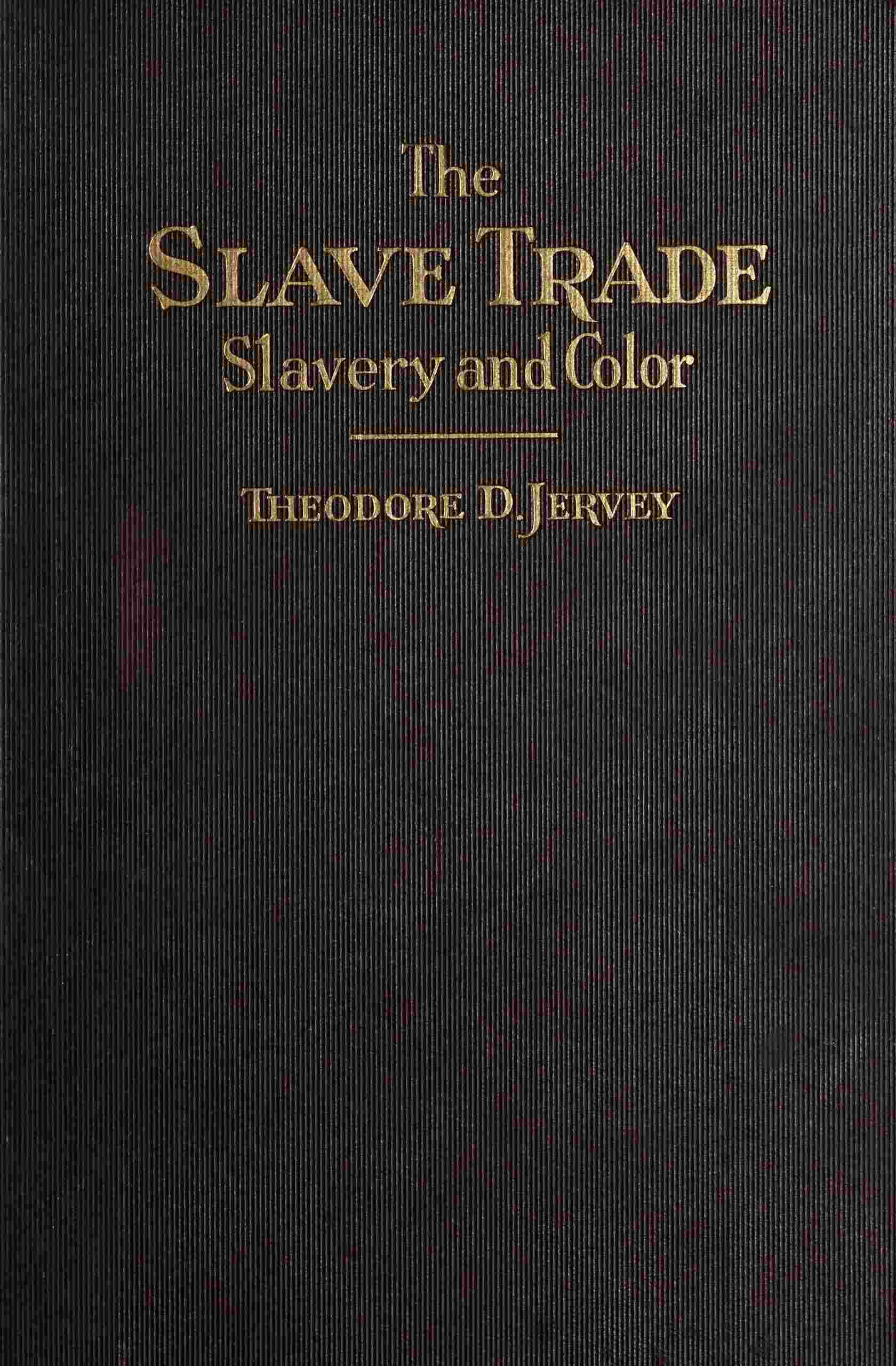
The Slave Trade: Slavery and Color by Theodore D. Jervey (1925)
Jervey, Theodore D. The Slave Trade: Slavery and Color . Columbia, South Carolina: The State Company, 1925. Historical Context Jervey’s book was published in 1925, at a time when the United States was in the midst of the Jim Crow era. Racial segregation was legally enforced across the South, and the Lost Cause mythology was widely promoted by Southern historians and institutions. Jervey, a South Carolinian himself, seeks to interpret the long history of slavery and race relations in the United States through a Southern, conservative lens—often downplaying slavery’s brutality or justifying its existence on economic and political grounds. The work draws heavily on debates surrounding the U.S. Constitution, the interstate slave trade, and sectional disputes in the decades leading to the Civil War. Jervey also draws on early 20th-century anxieties about racial "purity" and social order, revealing deep-seated white supremacist views that were widespread at the time. Core Issues Presented The book addresses several intertwined issues: the legality and morality of the slave trade, the racial ideology underpinning slavery, and the political compromises made in the U.S. Constitution regarding the importation of slaves. Jervey critiques both Northern and Southern stances on slavery, but he ultimately defends the South’s economic and political choices. He distinguishes between the issues of slavery and racial hierarchy, arguing that “color” was the more persistent and global problem. Importantly, he attempts to reframe the debates of the Founding Fathers and Southern legislators as pragmatic rather than immoral. Contemporary Viewpoints (at Time of Publication) At the time Jervey was writing, pro-segregationist and “states’ rights” views were dominant in Southern historical scholarship. His framing reflects that. In contrast, Black intellectuals like W. E. B. Du Bois and institutions like the NAACP were offering counter-narratives that emphasized slavery’s inherent violence and racial injustice. During the 1920s, the Harlem Renaissance was flourishing, yet Southern elites—like Jervey—viewed any attempt to elevate Black history or civil rights as radical. Thus, Jervey represents a mainstream white Southern viewpoint of his era, but one that was increasingly challenged in Northern circles and by African American scholars. Modern Historiographical Interpretations Modern historians view Jervey’s book as an example of revisionist, pro-slavery historiography aligned with the "Lost Cause" school. It minimizes the brutality of slavery and overstates Southern political reasonableness. While Jervey claims to seek “truth,” contemporary scholars critique his methodology and racial assumptions. Historians in the tradition of Eric Foner or Ira Berlin would argue that Jervey selectively presents evidence and distorts constitutional debates to exonerate Southern leaders. His emphasis on race as an unchangeable biological and cultural factor reflects discredited 19th-century racial science, not modern social analysis. Relevance to Today’s Issues This text is relevant to ongoing discussions about systemic racism, historical memory, and how we teach slavery in schools. Jervey’s book serves as a cautionary example of how historical narratives can be weaponized to justify inequality. Understanding how race and slavery were rationalized helps students recognize the roots of present-day disparities—especially in education, criminal justice, and voting rights. Debates about the role of monuments, history textbooks, and critical race theory echo these earlier struggles to control the narrative of America’s past. Why This Text Matters Jervey’s book illustrates how white elites in the post-Reconstruction South sought to control the historical narrative about slavery. As a primary source, it reveals not just the past, but how that past was remembered and rewritten to serve the political interests of the early 20th century. This book is more than a historical account—it is a window into how race and history intersect in the shaping of national identity. It reminds us that historical memory is not neutral and must be critically interrogated. Modern Reader Takeaway Modern readers should ask: How do power and privilege shape the telling of history? What are the dangers of normalizing injustice through legal or constitutional language? How does racial ideology persist even after the abolition of slavery? Engaging with texts like this challenges readers to recognize bias, interrogate sources, and reflect on the legacy of race and slavery in shaping American society. AP/IB Essay and Discussion Prompts APUSH Short Answer (SAQ): Compare the arguments made by Theodore Jervey in The Slave Trade with those of 19th-century abolitionists. What constitutional and economic reasoning did each side use? IB Paper 3 Essay Prompt: Evaluate the extent to which the U.S. Constitution supported the institution of slavery. Use evi
Editions
Link to this book
Add a free, dofollow link to Lex on your blog, forum, syllabus, or reading list.

<a href="https://lex-books.com/book/the-slave-trade-slavery-and-color-by-theodore-d-jervey-1925-b55794a6-7bc4-4d63-83dd-5ccb67493d00"><img src="https://lex-books.com/badges/read-on-lex.svg" alt="Read The Slave Trade: Slavery and Color by Theodore D. Jervey (1925) by Theodore D. Jervey free on Lex" width="160" height="40"></a>[](https://lex-books.com/book/the-slave-trade-slavery-and-color-by-theodore-d-jervey-1925-b55794a6-7bc4-4d63-83dd-5ccb67493d00)[url=https://lex-books.com/book/the-slave-trade-slavery-and-color-by-theodore-d-jervey-1925-b55794a6-7bc4-4d63-83dd-5ccb67493d00][img]https://lex-books.com/badges/read-on-lex.svg[/img][/url]Read The Slave Trade: Slavery and Color by Theodore D. Jervey (1925) by Theodore D. Jervey free on Lex: https://lex-books.com/book/the-slave-trade-slavery-and-color-by-theodore-d-jervey-1925-b55794a6-7bc4-4d63-83dd-5ccb67493d00Cite this book
Reading this edition for a paper or guide? Copy a citation.
Jervey, Theodore D.. The Slave Trade: Slavery and Color by Theodore D. Jervey (1925). Lex, lex-books.com/book/the-slave-trade-slavery-and-color-by-theodore-d-jervey-1925-b55794a6-7bc4-4d63-83dd-5ccb67493d00.Jervey, T. D. (n.d.). The Slave Trade: Slavery and Color by Theodore D. Jervey (1925). Lex. https://lex-books.com/book/the-slave-trade-slavery-and-color-by-theodore-d-jervey-1925-b55794a6-7bc4-4d63-83dd-5ccb67493d00Jervey, Theodore D.. The Slave Trade: Slavery and Color by Theodore D. Jervey (1925). Lex. https://lex-books.com/book/the-slave-trade-slavery-and-color-by-theodore-d-jervey-1925-b55794a6-7bc4-4d63-83dd-5ccb67493d00.