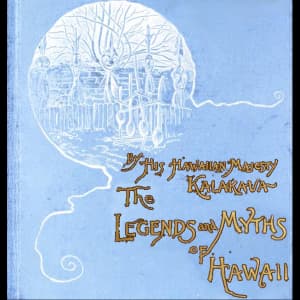
The Legends and Myths of Hawaii: The fables and folk-lore of a strange people
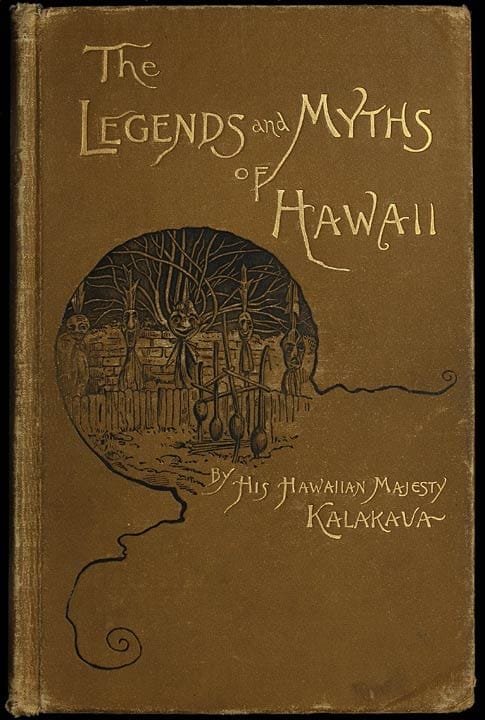
In 1888, Hawaii's last king committed to writing the stories his people had carried orally for generations, stories already beginning to fade as the islands shifted beneath colonial pressure. David Kalakaua was not merely a collector but an inheritor of this tradition, and his account pulses with the authority of a living culture. The legends unfold with vivid particularity: Hina, whose tragedy echoes across the islands; Hua, the strange king of Hana; Kelea, the legendary surf-rider of Maui who abandons her royal status to chase waves with reckless joy. Here are akua and menehune, shape-shifting chiefs and matters of kapu, Hawaiian cosmology rendered not as anthropology but as living belief. The stories do not soften the savage elements: cannibalistic feasts, brutal warfare, passions that erupt without modern restraint. This is a civilization still in touch with forces modern readers have sanitized from our own myths. What makes this volume invaluable is its timing. Written just years before the overthrow of the Hawaiian monarchy, it captures a worldview in its final unaltered state.
Editions
X-Ray
“To render the kings and higher nobility still more exclusive, they had a court language which was understood only by themselves, and which was changed in part from time to time as its expressions found interpretation beyond the royal circle. Some portions of this court language have been preserved.””
— David Kalakaua
“Instances are given in Hawaiian tradition of the tide of battle being turned, on more than one occasion, by desperate women transformed from camp-followers into warriors; and as late as 1819 we behold Manona, wife of Kekuokalani, the last sturdy champion of the gods of his fathers, falling lifeless in battle upon the body of her dead husband at Kuamoo, while Kaahumanu and Kalakau, widows of the great Kamehameha, commanded the fleet of canoes operating with the land forces under Kalaimoku.””
— David Kalakaua
“bones. In the fear that the bones of the mois and distinguished chiefs might fall into the hands of their enemies and be used for fish-hooks, arrow-points for shooting mice, and other debasing purposes, they were usually destroyed or hidden.””
— David Kalakaua
“All implements of war or industry known to the early Hawaiians were made either of wood, stone, or bone, as the islands are destitute of metals; but with these rude helps they laid up hewn-stone walls, felled trees, made canoes and barges, manufactured cloths and cordage, fashioned weapons, constructed dwellings and temples, roads and fish-ponds, and tilled the soil. They had axes, adzes and hammers of stone, spades of wood, knives of flint and ivory, needles of thorn and bone, and spears and daggers of hardened wood. They wove mats for sails and other purposes, and from the inner bark of the paper mulberry-tree beat out a fine, thin cloth called kapa, which they ornamented with colors and figures.””
— David Kalakaua
“The chiefs inherited their titles and tabu privileges quite as frequently through the rank of one parent as of the other. As Hawaiian women of distinction usually had more than one husband, and the chiefs were seldom content with a single wife, the difficulty of determining the rights and ranks of their children was by no means easy; but the averment of the mother was generally accepted as conclusive and sufficient evidence in that regard.””
— David Kalakaua
“The people made their own household gods, and destroyed them when they failed to contribute to their success. For example, at Ninole, on the southeast coast of Hawaii, is a small beach called Kaloa, the stones of which, it was thought, propagated by contact with each other. From the large stones the people made gods to preside over their games. When a stone was selected for a god it was taken to the heiau where certain ceremonies were performed over it. It was then dressed and taken to witness some game or pastime. If the owner was successful it was accepted as a god; if unsuccessful more than once or twice, it was thrown away or wrought into an axe or adze.””
— David Kalakaua
“When the high-priest Paao arrived with Pili he introduced some new gods while recognizing the old, strengthened and enlarged the scope of the tabu, and established an hereditary priest-hood independent of, and second only in authority to, the supreme political head. Different grades of priests also came into existence, such as seers, prophets, astrologers and kahunas of various function, including the power of healing and destroying. In fact, the priesthood embraced ten distinct grades or colleges, each possessing and exercising powers peculiar to it, and the mastery of all of them was one of the qualifications of the high-priesthood. The tutelar deity of the entire body was Uli.””
— David Kalakaua
“In 1840 the first written constitution was given to the people, guaranteeing to them a representative government. In February, 1843, Lord Paulet, of the English navy, took formal possession of the islands, but in the July following their sovereignty was restored through the action of Admiral Thomas. In November of the same year France and England mutually agreed to refrain from seizure or occupation of the islands, or any portion of them, and the United States, while declining to become a party to the agreement, promptly acknowledged the independence of the group.””
— David Kalakaua
“And now let it be remarked with emphasis that the value of missionary labors in the Hawaiian group should not be measured by the small number of natives who to-day may be called Christians, but rather by the counsel and assistance of these thrifty religious teachers in securing and maintaining the independence of the islands, and by degrees establishing a mild and beneficent constitutional government, under which taxation is as light and life and property are as secure as in any other part of the civilized world.””
— David Kalakaua
Link to this book
Add a free, dofollow link to Lex on your blog, forum, syllabus, or reading list.

<a href="https://lex-books.com/book/the-legends-and-myths-of-hawaii-the-fables-and-folk-lore-of-a-strange-people-82564436-4e53-421c-9b3c-3e92713c5768"><img src="https://lex-books.com/badges/read-on-lex.svg" alt="Read The Legends and Myths of Hawaii: The fables and folk-lore of a strange people by David Kalakaua free on Lex" width="160" height="40"></a>[](https://lex-books.com/book/the-legends-and-myths-of-hawaii-the-fables-and-folk-lore-of-a-strange-people-82564436-4e53-421c-9b3c-3e92713c5768)[url=https://lex-books.com/book/the-legends-and-myths-of-hawaii-the-fables-and-folk-lore-of-a-strange-people-82564436-4e53-421c-9b3c-3e92713c5768][img]https://lex-books.com/badges/read-on-lex.svg[/img][/url]Read The Legends and Myths of Hawaii: The fables and folk-lore of a strange people by David Kalakaua free on Lex: https://lex-books.com/book/the-legends-and-myths-of-hawaii-the-fables-and-folk-lore-of-a-strange-people-82564436-4e53-421c-9b3c-3e92713c5768Cite this book
Reading this edition for a paper or guide? Copy a citation.
Kalakaua, David. The Legends and Myths of Hawaii: The fables and folk-lore of a strange people. Lex, lex-books.com/book/the-legends-and-myths-of-hawaii-the-fables-and-folk-lore-of-a-strange-people-82564436-4e53-421c-9b3c-3e92713c5768.Kalakaua, D. (n.d.). The Legends and Myths of Hawaii: The fables and folk-lore of a strange people. Lex. https://lex-books.com/book/the-legends-and-myths-of-hawaii-the-fables-and-folk-lore-of-a-strange-people-82564436-4e53-421c-9b3c-3e92713c5768Kalakaua, David. The Legends and Myths of Hawaii: The fables and folk-lore of a strange people. Lex. https://lex-books.com/book/the-legends-and-myths-of-hawaii-the-fables-and-folk-lore-of-a-strange-people-82564436-4e53-421c-9b3c-3e92713c5768.