The Fourth Dimension
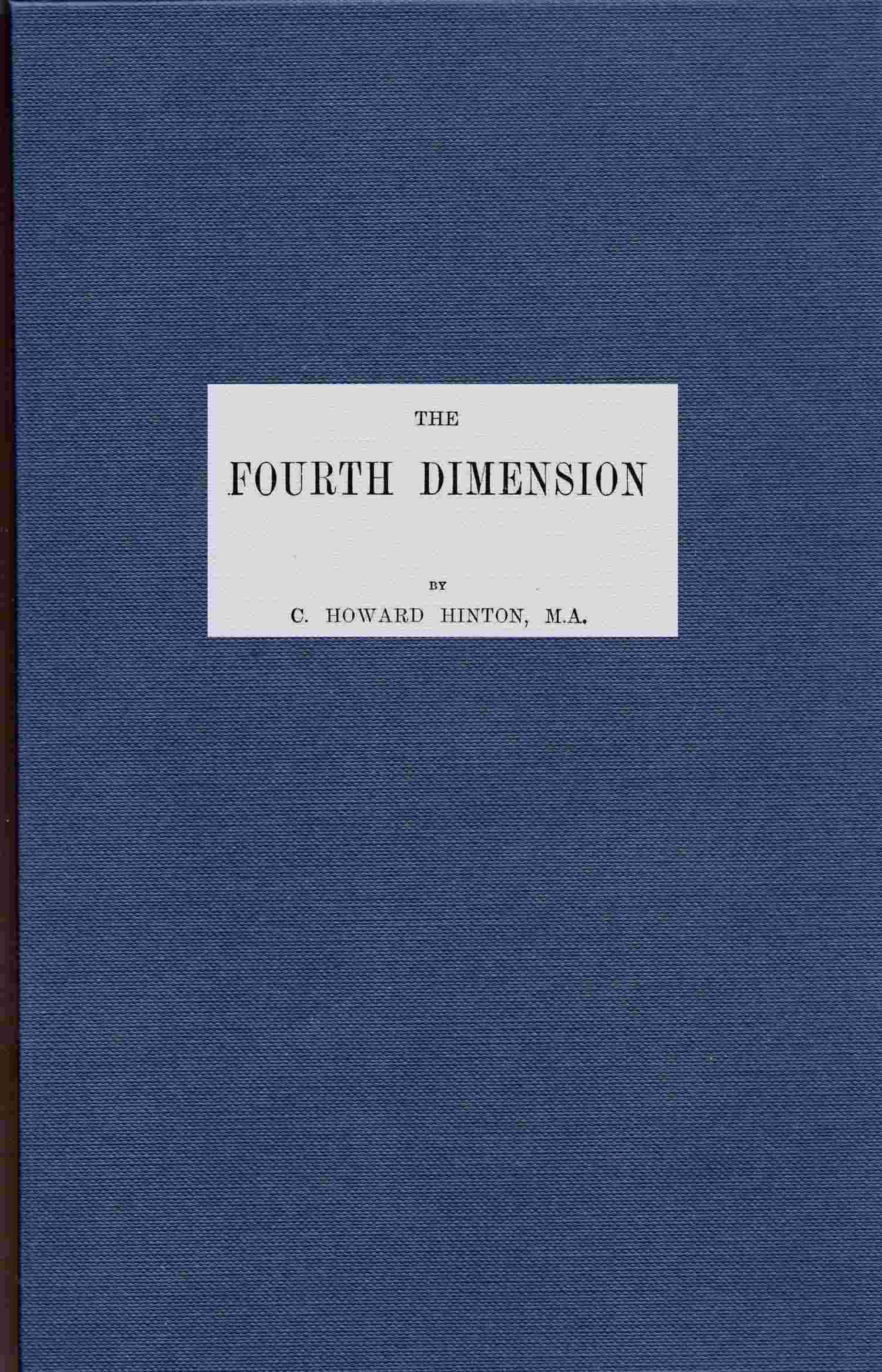
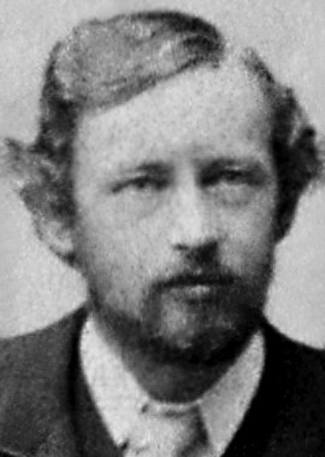
What would it mean to perceive a fourth dimension? Charles Howard Hinton asked this question in the late nineteenth century, and his answer became one of the earliest attempts to make higher-dimensional space intelligible to the general reader. Drawing on careful analogy, he asks readers to imagine how a being confined to a flat plane might conceive of our three-dimensional world, then extends that logic upward, Hinton trains the mind to grasp what the eye cannot see. The book ventures beyond geometry into philosophy, exploring what higher dimensionality suggests about perception, consciousness, and the very nature of reality. His engagement with Kant's theory of experience asks whether our intuition of space is learned or inherent. Though written over a century before modern string theory and relativity entered the popular imagination, this book laid the conceptual groundwork for how we now think about dimensions. It influenced everything from early science fiction to the tesseract, and remains a remarkable journey into the limits of human imagination, for readers curious about mathematics, philosophy, or the strange architecture of the possible.
Editions

X-Ray
“How do you explain the law and order in nature?" we ask the philosophers. All except Kant reply by assuming law and order somewhere, and then showing how we can recognise it.In explaining our notions, philosophers from other than the Kantian standpoint, assume the notions as existing outside us, and then it is no difficult task to show how they come to us, either by inspiration or by observation.We ask "Why do we have an idea of law in nature?" "Because natural processes go according to law", we are answered, "and experience inherited or acquired, gives us this notion". But when we speak about the law in nature we are speaking about a notion of our own. So all that these expositors do is to explain our notion by an assumption of it.””
— Charles Howard Hinton
“In the attempt to penetrate into the nature of the higher, to grasp within our ken that which transcends all analogies, because what we know are merely partial views of it, the purely material and physical path affords a means of approach pursuing which we are in less likelihood of error than if we use the more frequently trodden path of framing conceptions which in their elevation and beauty seem to us ideally perfect.””
— Charles Howard Hinton
Link to this book
Add a free, dofollow link to Lex on your blog, forum, syllabus, or reading list.

<a href="https://lex-books.com/book/the-fourth-dimension-5341633c-e235-4c56-8bca-0724a408e8b6"><img src="https://lex-books.com/badges/read-on-lex.svg" alt="Read The Fourth Dimension by Charles Howard Hinton free on Lex" width="160" height="40"></a>[](https://lex-books.com/book/the-fourth-dimension-5341633c-e235-4c56-8bca-0724a408e8b6)[url=https://lex-books.com/book/the-fourth-dimension-5341633c-e235-4c56-8bca-0724a408e8b6][img]https://lex-books.com/badges/read-on-lex.svg[/img][/url]Read The Fourth Dimension by Charles Howard Hinton free on Lex: https://lex-books.com/book/the-fourth-dimension-5341633c-e235-4c56-8bca-0724a408e8b6Cite this book
Reading this edition for a paper or guide? Copy a citation.
Hinton, Charles Howard. The Fourth Dimension. Lex, lex-books.com/book/the-fourth-dimension-5341633c-e235-4c56-8bca-0724a408e8b6.Hinton, C. H. (n.d.). The Fourth Dimension. Lex. https://lex-books.com/book/the-fourth-dimension-5341633c-e235-4c56-8bca-0724a408e8b6Hinton, Charles Howard. The Fourth Dimension. Lex. https://lex-books.com/book/the-fourth-dimension-5341633c-e235-4c56-8bca-0724a408e8b6.