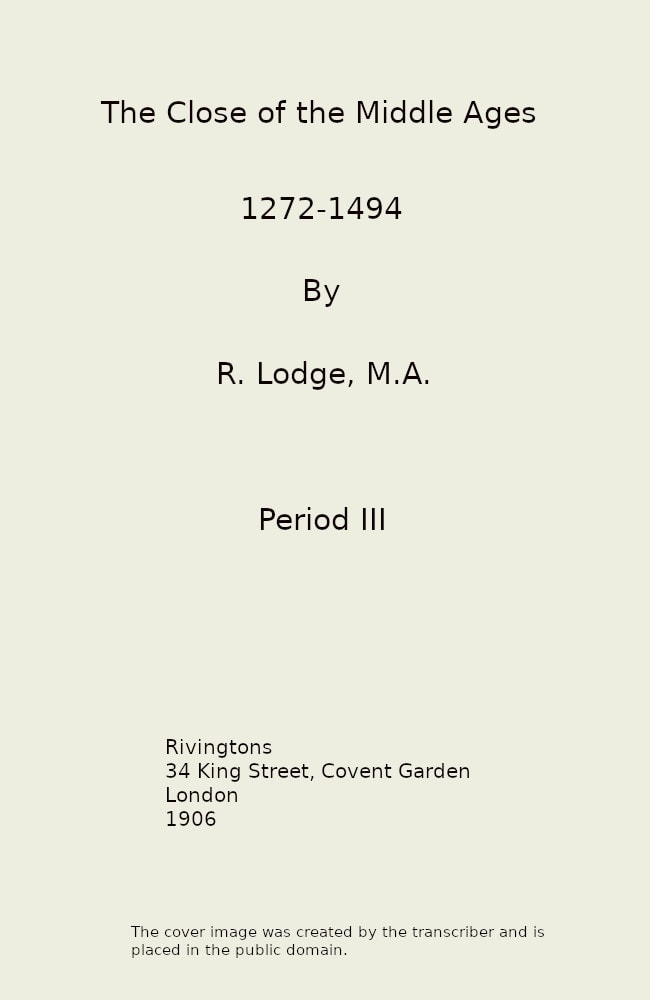
The Close of the Middle Ages, 1272-1494, 3rd Ed.
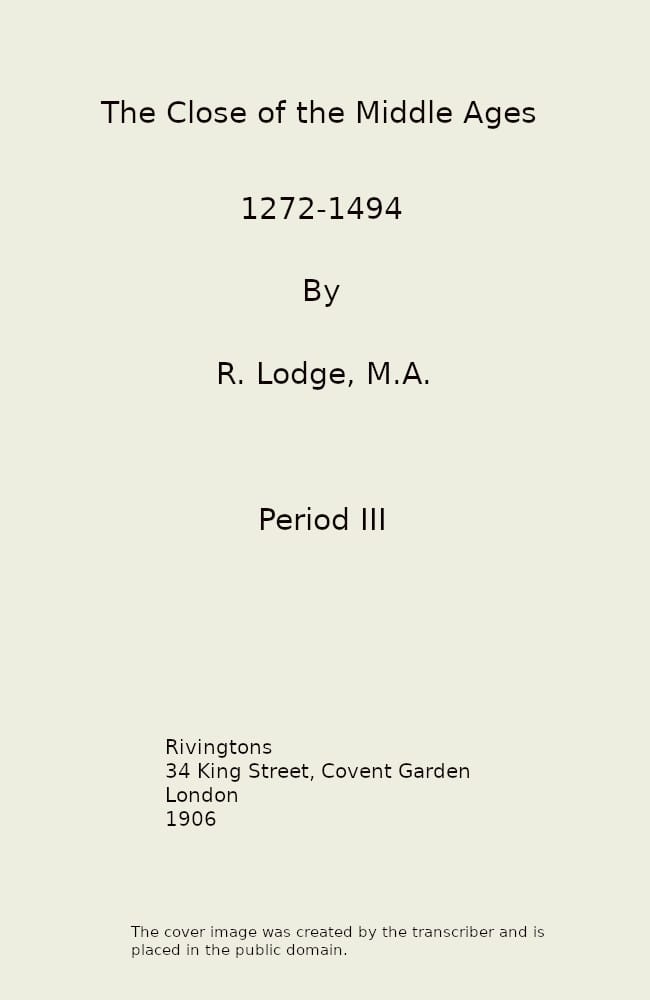
The period from 1272 to 1494 witnessed the unraveling of the medieval world and the violent, uneven birth of something new. This was an era when the old certainties crumbled: the once-mighty Holy Roman Empire grew hollow as German princes tightened their grip on local power, while the papacy splintered under the strain of Avignon and schism. The Hundred Years' War redrew the map of France and England, the Black Death shattered medieval society to its core, and the fall of Constantinople in 1494 marked the end of any pretense of Christian unity against the Ottoman advance. Richard Lodge traces these interlocking crises not as isolated catastrophes but as part of a coherent transformation, showing how the disintegration of feudal bonds and the rise of territorial states laid the groundwork for the early modern world. His account remains grounded in primary sources and contemporary scholarship, offering readers a clear-eyed synthesis of a complex era that defies simple narratives of decline or renewal. For students of European history and anyone seeking to understand how the Middle Ages actually ended, this volume provides an indispensable guide.
Editions
X-Ray
Elected King of the Romans, he was the founder of the Hapsburg dynasty's power by securing Austria and other territories in south-eastern Germany.
Son of Rudolf I. and King of the Romans, he pursued aggressive dynastic expansion, particularly in Bohemia, before his assassination.
Elected Emperor, he attempted a quixotic revival of imperial power in Italy, neglecting German affairs, and died there.
Emperor who engaged in a prolonged and ultimately unsuccessful struggle against the Avignon Papacy, leading to a schism in the Empire.
About The Close of the Middle Ages, 1272-1494, 3rd Ed.
Chapter Summaries
- 1
- This chapter details the decline of the German monarchy and the Holy Roman Empire after the Great Interregnum. It focuses on the reigns of Rudolf I. of Hapsburg, Adolf of Nassau, Albert I., and Henry VII. of Luxemburg, highlighting their attempts to consolidate power, often through dynastic aggrandizement, and the growing independence of German princes and cities.
- 2
- This chapter introduces Italy's fragmented political landscape, dominated by city-states and the rivalry of Guelfs and Ghibellines, and the influence of the Angevin kingdom of Naples. It covers the Sicilian Vespers, the Avignon Papacy, the complex Florentine and Venetian constitutions, and Henry VII.'s ultimately failed attempt to reassert imperial authority in Italy.
- 3
- This chapter traces the consolidation of the French monarchy under Philip III. and Philip IV., marked by territorial acquisitions like Toulouse, Champagne, and Navarre, and the development of centralized administrative bodies. It also covers Philip IV.'s conflicts with England and the Papacy, and the crucial establishment of the Salic Law during the reigns of his sons.
Key Themes
- The Decline of Universal Medieval Authority
- The book extensively illustrates the weakening of the Holy Roman Empire, which became a 'shadowy claim' over Italy and a 'feeble kingship' in Germany. Similarly, the Papacy's authority was undermined by the Avignon residence and the Great Schism, transforming popes into temporal princes focused on Italian politics rather than spiritual leadership.
- The Rise of National States and Monarchical Centralization
- This theme is central, particularly in France and Spain. French kings like Philip IV. and Louis XI. systematically dismantled feudal power and built centralized administrations. In Spain, the union of Castile and Aragon under Ferdinand and Isabella created a powerful, unified monarchy, contrasting sharply with Germany's continued fragmentation.
- Political Fragmentation and Internal Conflict
- Germany and Italy serve as prime examples of this theme. Germany remained a 'bundle of states' plagued by princely rivalries and weak imperial authority, while Italy's city-states engaged in constant feuds and power struggles, often inviting foreign intervention. This internal disunity prevented the formation of strong national entities in these regions.
Characters
- Rudolf I. of Hapsburg(protagonist)
- Elected King of the Romans, he was the founder of the Hapsburg dynasty's power by securing Austria and other territories in south-eastern Germany.
- Albert I. of Hapsburg(protagonist)
- Son of Rudolf I. and King of the Romans, he pursued aggressive dynastic expansion, particularly in Bohemia, before his assassination.
- Henry VII. of Luxemburg(protagonist)
- Elected Emperor, he attempted a quixotic revival of imperial power in Italy, neglecting German affairs, and died there.
- Lewis IV. the Bavarian(protagonist)
- Emperor who engaged in a prolonged and ultimately unsuccessful struggle against the Avignon Papacy, leading to a schism in the Empire.
- Charles IV. of Luxemburg(protagonist)
- King of Bohemia and Emperor, he consolidated Luxemburg power, issued the Golden Bull, and focused on building a territorial monarchy in Germany.
- Sigismund of Luxemburg(protagonist)
- Son of Charles IV., King of Hungary and Bohemia, and Emperor, he played a central role in the Council of Constance and faced the Hussite Wars.
Link to this book
Add a free, dofollow link to Lex on your blog, forum, syllabus, or reading list.

<a href="https://lex-books.com/book/the-close-of-the-middle-ages-1272-1494-3rd-ed-5e2aa0ae-b291-4a4d-8e2e-b6ec6d4bc867"><img src="https://lex-books.com/badges/read-on-lex.svg" alt="Read The Close of the Middle Ages, 1272-1494, 3rd Ed. by Richard Lodge free on Lex" width="160" height="40"></a>[](https://lex-books.com/book/the-close-of-the-middle-ages-1272-1494-3rd-ed-5e2aa0ae-b291-4a4d-8e2e-b6ec6d4bc867)[url=https://lex-books.com/book/the-close-of-the-middle-ages-1272-1494-3rd-ed-5e2aa0ae-b291-4a4d-8e2e-b6ec6d4bc867][img]https://lex-books.com/badges/read-on-lex.svg[/img][/url]Read The Close of the Middle Ages, 1272-1494, 3rd Ed. by Richard Lodge free on Lex: https://lex-books.com/book/the-close-of-the-middle-ages-1272-1494-3rd-ed-5e2aa0ae-b291-4a4d-8e2e-b6ec6d4bc867Cite this book
Reading this edition for a paper or guide? Copy a citation.
Lodge, Richard. The Close of the Middle Ages, 1272-1494, 3rd Ed.. Lex, lex-books.com/book/the-close-of-the-middle-ages-1272-1494-3rd-ed-5e2aa0ae-b291-4a4d-8e2e-b6ec6d4bc867.Lodge, R. (n.d.). The Close of the Middle Ages, 1272-1494, 3rd Ed.. Lex. https://lex-books.com/book/the-close-of-the-middle-ages-1272-1494-3rd-ed-5e2aa0ae-b291-4a4d-8e2e-b6ec6d4bc867Lodge, Richard. The Close of the Middle Ages, 1272-1494, 3rd Ed.. Lex. https://lex-books.com/book/the-close-of-the-middle-ages-1272-1494-3rd-ed-5e2aa0ae-b291-4a4d-8e2e-b6ec6d4bc867.