The Burnout Society
2010
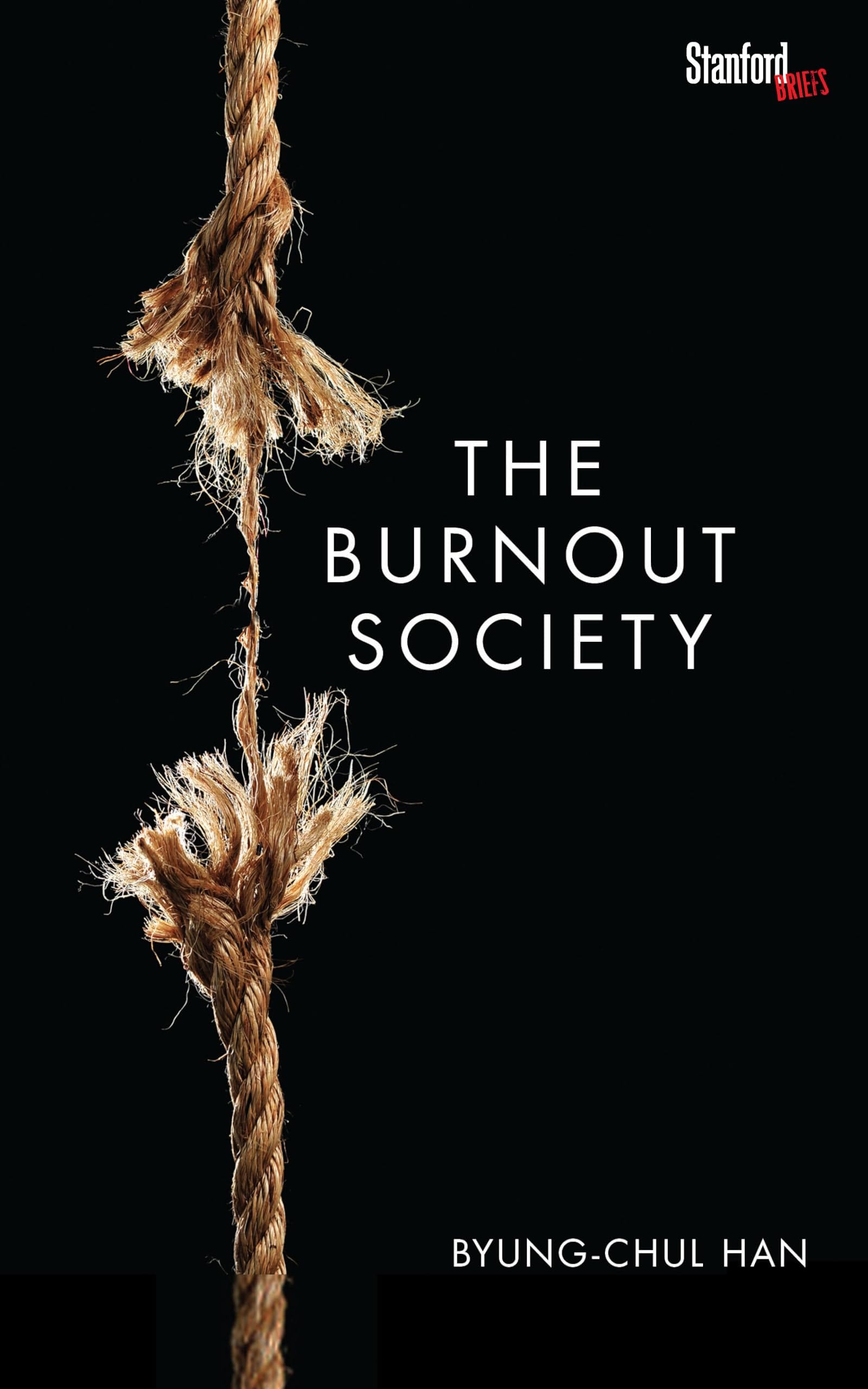
Cover uploaded by Thaj Anaz
Our competitive, service-oriented societies are taking a toll on the late-modern individual. Rather than improving life, multitasking, "user-friendly" technology, and the culture of convenience are producing disorders that range from depression to attention deficit disorder to borderline personality disorder. Byung-Chul Han interprets the spreading malaise as an inability to manage negative experiences in an age characterized by excessive positivity and the universal availability of people and goods. Stress and exhaustion are not just personal experiences, but social and historical phenomena as well. Denouncing a world in which every against-the-grain response can lead to further disempowerment, he draws on literature, philosophy, and the social and natural sciences to explore the stakes of sacrificing intermittent intellectual reflection for constant neural connection.
Editions

X-Ray
“The complaint of the depressive individual, “Nothing is possible,” can only occur in a society that thinks, “Nothing is impossible.””
— Byung-Chul Han, Erik Butler
“The acceleration of contemporary life also plays a role in this lack of being. The society of laboring and achievement is not a free society. It generates new constraints. Ultimately, the dialectic of master and slave does not yield a society where everyone is free and capable of leisure, too. Rather, it leads to a society of work in which the master himself has become a laboring slave. In this society of compulsion, everyone carries a work camp inside. This labor camp is defined by the fact that one is simultaneously prisoner and guard, victim and perpetrator. One exploits oneself. It means that exploitation is possible even without domination.””
— Byung-Chul Han, Erik Butler
“If sleep represents the high point of bodily relaxation, deep boredom is the peak of mental relaxation. A purely hectic rush produces nothing new. It reproduces and accelerates what is already available.””
— Byung-Chul Han, Erik Butler
“Today’s society is no longer Foucault’s disciplinary world of hospitals, madhouses, prisons, barracks, and factories. It has long been replaced by another regime, namely a society of fitness studios, office towers, banks, airports, shopping malls, and genetic laboratories. Twenty-first-century society is no longer a disciplinary society, but rather an achievement society [Leistungsgesellschaft]. Also, its inhabitants are no longer “obedience-subjects” but “achievement-subjects.” They are entrepreneurs of themselves.””
— Byung-Chul Han, Erik Butler
“In social networks, the function of "friends" is primarily to heighten narcissism by granting attention, as consumers, to the ego exhibited as a commodity.””
— Byung-Chul Han, Erik Butler
“The violence of positivity does not deprive, it saturates; it does not exclude, it exhausts.””
— Byung-Chul Han, Erik Butler
“From a pathological standpoint, the incipient twenty-first century is determined neither by bacteria nor by viruses, but by neurons. Neurological illnesses such as depression, attention deficit hyperactivity disorder (ADHD), borderline personality disorder (BPD), and burnout syndrome mark the landscape of pathology at the beginning of the twenty-first century. They are not infections, but infarctions; they do not follow from the negativity of what is immunologically foreign, but from an excess of positivity. Therefore, they elude all technologies and techniques that seek to combat what is alien.””
— Byung-Chul Han, Erik Butler
“What proves problematic is not individual competition per se, but rather its self-referentiality, which escalates into absolute competition. That is, the achievement-subject competes with itself; it succumbs to the destructive compulsion to outdo itself over and over, to jump over its own shadow. This self-constraint, which poses as freedom, has deadly results.””
— Byung-Chul Han, Erik Butler
“Today, everyone is an auto-exploiting labourer in his or her own enterprise. People are now master and slave in one. Even class struggle has transformed into an inner struggle against oneself.””
— Byung-Chul Han, Erik Butler

Link to this book
Add a free, dofollow link to Lex on your blog, forum, syllabus, or reading list.

<a href="https://lex-books.com/book/the-burnout-society-b14e1ed4-d749-46ff-a217-f0f4d1b9fe9e"><img src="https://lex-books.com/badges/read-on-lex.svg" alt="Read The Burnout Society by Byung-Chul Han, Erik Butler free on Lex" width="160" height="40"></a>[](https://lex-books.com/book/the-burnout-society-b14e1ed4-d749-46ff-a217-f0f4d1b9fe9e)[url=https://lex-books.com/book/the-burnout-society-b14e1ed4-d749-46ff-a217-f0f4d1b9fe9e][img]https://lex-books.com/badges/read-on-lex.svg[/img][/url]Read The Burnout Society by Byung-Chul Han, Erik Butler free on Lex: https://lex-books.com/book/the-burnout-society-b14e1ed4-d749-46ff-a217-f0f4d1b9fe9eCite this book
Reading this edition for a paper or guide? Copy a citation.
Byung-Chul Han, Erik Butler. The Burnout Society. Lex, lex-books.com/book/the-burnout-society-b14e1ed4-d749-46ff-a217-f0f4d1b9fe9e.Byung-Chul Han, E. B. (2010). The Burnout Society. Lex. https://lex-books.com/book/the-burnout-society-b14e1ed4-d749-46ff-a217-f0f4d1b9fe9eByung-Chul Han, Erik Butler. The Burnout Society. Lex. https://lex-books.com/book/the-burnout-society-b14e1ed4-d749-46ff-a217-f0f4d1b9fe9e.