Peter Schlemihls wundersame Geschichte

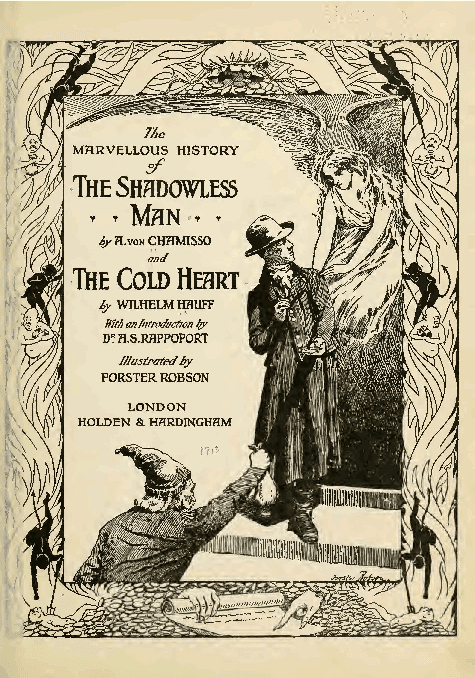
In 1814, a young man named Peter Schlemihl makes a deal with a mysterious gray stranger in a foreign garden: he trades his shadow for a bottomless purse of gold. At first, the wealth seems a triumph. But when people notice his missing shadow, they recoil from him with an instinctive horror that borders on the supernatural. He becomes a pariah, shunned by a society that cannot name what frightens them about him, only that something is fundamentally wrong. Schlemihl's isolation is not merely social but existential: he has traded away the very thing that anchors a person to the world of light and human connection. When Schlemihl falls in love with the beautiful Mina, her father's condition seems simple: retrieve his shadow, and he may have his daughter's hand. But the shadow cannot be bought back with gold. The gray man returns, and reveals his true nature: he is the Devil, and the only currency he accepts for the shadow is Schlemihl's soul. The novella builds to its devastating climax, where Schlemihl must choose between love and damnation, between the appearance of normalcy and the preservation of his immortal self. Adelbert von Chamisso wrote this fairy tale from the bone-deep knowledge of exile. Born a French aristocrat, he fled the Revolution and spent his life as a German poet and botanist, never fully belonging to either world. Peter Schlemihl is his shadow story: a gothic parable about what it means to be human, to belong, to be seen. It endures because every reader recognizes Schlemihl's loneliness, his longing to be accepted despite the thing that makes him different. It is for anyone who has felt like an outsider looking in at a world that demands conformity.
Editions

Link to this book
Add a free, dofollow link to Lex on your blog, forum, syllabus, or reading list.

<a href="https://lex-books.com/book/peter-schlemihls-wundersame-geschichte-1b3a12d9-0b87-4d96-b9a0-6f45488b3790"><img src="https://lex-books.com/badges/read-on-lex.svg" alt="Read Peter Schlemihls wundersame Geschichte by Adelbert von Chamisso free on Lex" width="160" height="40"></a>[](https://lex-books.com/book/peter-schlemihls-wundersame-geschichte-1b3a12d9-0b87-4d96-b9a0-6f45488b3790)[url=https://lex-books.com/book/peter-schlemihls-wundersame-geschichte-1b3a12d9-0b87-4d96-b9a0-6f45488b3790][img]https://lex-books.com/badges/read-on-lex.svg[/img][/url]Read Peter Schlemihls wundersame Geschichte by Adelbert von Chamisso free on Lex: https://lex-books.com/book/peter-schlemihls-wundersame-geschichte-1b3a12d9-0b87-4d96-b9a0-6f45488b3790Cite this book
Reading this edition for a paper or guide? Copy a citation.
Chamisso, Adelbert von. Peter Schlemihls wundersame Geschichte. Lex, lex-books.com/book/peter-schlemihls-wundersame-geschichte-1b3a12d9-0b87-4d96-b9a0-6f45488b3790.Chamisso, A. V. (n.d.). Peter Schlemihls wundersame Geschichte. Lex. https://lex-books.com/book/peter-schlemihls-wundersame-geschichte-1b3a12d9-0b87-4d96-b9a0-6f45488b3790Chamisso, Adelbert von. Peter Schlemihls wundersame Geschichte. Lex. https://lex-books.com/book/peter-schlemihls-wundersame-geschichte-1b3a12d9-0b87-4d96-b9a0-6f45488b3790.