Peter Schlemihl
1814
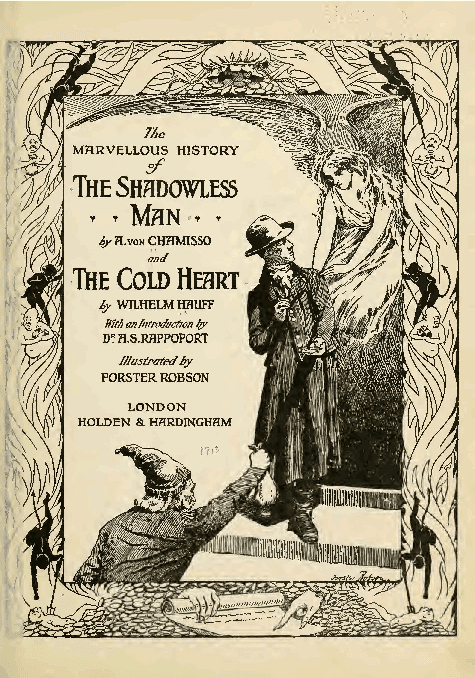
The man who sold his shadow. That's the premise that has haunted readers since 1814. Peter Schlemihl, a wandering young man with nothing, encounters a mysterious stranger in grey who offers him the purse of Fortunatus, infinite gold, in exchange for something seemingly trivial: his shadow. It seems like a bargain. But Schlemihl soon discovers that a man without a shadow cannot walk in the sunlight, cannot marry the woman he loves, cannot exist peacefully among his fellow men. He becomes a pariah, wealthy but utterly alone. Written as a gift for the children of Chamisso's patron, this deceptively simple fairy tale unfolds into a piercing meditation on alienation, identity, and the terrible price of success. The shadow, that dark silhouette that follows us everywhere, becomes a brilliant metaphor for the part of ourselves we cannot sell: our belonging, our integrity, our very soul. Over two centuries later, Peter Schlemihl remains unsettling because we've all, at some point, been tempted to trade our authentic selves for acceptance.
Editions
X-Ray
“I am a solitary wave in the dark and desolate sea: and the sparkling glass I drank was drugged with misery.””
— Adelbert von Chamisso
“What use would wings be to a man bound in iron fetters? They would only drive him to even greater despair.””
— Adelbert von Chamisso
“In Wirklichkeit war ich schon wach, aber ich hielt noch die Augen zu, um die Traaumgestalten noch länger vor meiner Seele zu behalten.””
— Adelbert von Chamisso
“Alles, was der Mensch tut, unvollkommen ist. Aber wer will sich schon seine Unvollkommenheit eingestehen?””
— Adelbert von Chamisso
“Was sein soll, muß geschehen, und was sein sollte, das geschah.””
— Adelbert von Chamisso
“L'impressione che mi resi conto di aver fatto sulla bella mi fece diventare, esattamente come lei desiderava, simile ad uno scemo””
— Adelbert von Chamisso
“Morao sam, naravno, da izigravam ćudljivog osobenjaka. Ali bogatašima to lepo pristaje.””
— Adelbert von Chamisso
“Ko samo nogom kroči sa pravoga puta, naći će se neočekivano na drugim stazama koje će ga vući sve niže i niže.””
— Adelbert von Chamisso
Link to this book
Add a free, dofollow link to Lex on your blog, forum, syllabus, or reading list.

<a href="https://lex-books.com/book/peter-schlemihl-884897f6-304f-48cc-8107-afc7930bf44d"><img src="https://lex-books.com/badges/read-on-lex.svg" alt="Read Peter Schlemihl by Adelbert von Chamisso free on Lex" width="160" height="40"></a>[](https://lex-books.com/book/peter-schlemihl-884897f6-304f-48cc-8107-afc7930bf44d)[url=https://lex-books.com/book/peter-schlemihl-884897f6-304f-48cc-8107-afc7930bf44d][img]https://lex-books.com/badges/read-on-lex.svg[/img][/url]Read Peter Schlemihl by Adelbert von Chamisso free on Lex: https://lex-books.com/book/peter-schlemihl-884897f6-304f-48cc-8107-afc7930bf44dCite this book
Reading this edition for a paper or guide? Copy a citation.
Chamisso, Adelbert von. Peter Schlemihl. Lex, lex-books.com/book/peter-schlemihl-884897f6-304f-48cc-8107-afc7930bf44d.Chamisso, A. V. (1814). Peter Schlemihl. Lex. https://lex-books.com/book/peter-schlemihl-884897f6-304f-48cc-8107-afc7930bf44dChamisso, Adelbert von. Peter Schlemihl. Lex. https://lex-books.com/book/peter-schlemihl-884897f6-304f-48cc-8107-afc7930bf44d.