Modern Essays
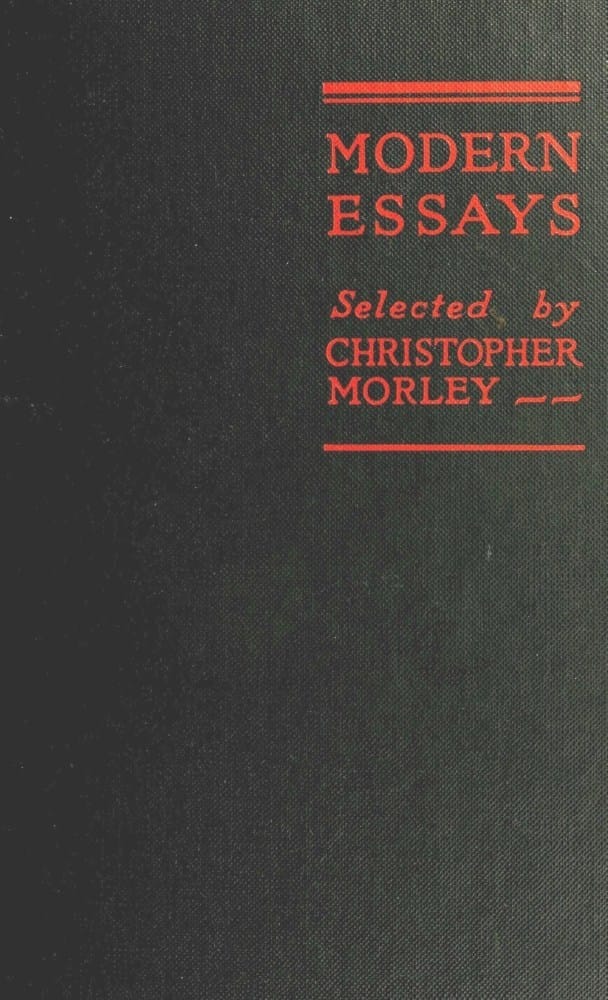
A curated anthology of essays from the early 20th century, showcasing the form at its most vital and varied. Christopher Morley opens the collection with a candid reflection on the anthologist's craft: the impossible task of capturing an era's literary spirit in a single volume. The essays here reject the strictures of plot in favor of mood, observation, and the private satisfactions of genuine thinking. What emerges is a portrait of a transitional moment in English letters, when writers were still experimenting with the essay's loose, intimate boundaries. The collection serves as both time capsule and timeless meditation on what essays can do that no other form can: linger in the uncertain, follow a thought wherever it leads, and capture the texture of a life or moment without pretending to resolve it. For readers who believe the essay is the most human of literary forms, this collection offers proof.
Editions
X-Ray
“Our anxiety does not come from thinking about the future,’33 noted the writer Kahlil Gibran, ‘but from wanting to control it.””
— Unknown
“In an age when we are ever more targeted and profiled and mined for information, reading a book allows you to be, for so long as the covers hold you, truly quiet and undisturbed.””
— Unknown
“The woman that does not require validation from anyone is the most feared individual on the planet. Our desire for validation is far older than the internet.””
— Unknown
“When my best friends had babies we were lucky that our friendships preexisted our new charges by decades. We never forgot who we once were to each other whilst embracing who we’d become. I may not have been able to see myself after my daughters birth but my best friends never lost sight of me.””
— Unknown
“Empathy has become a misused buzz-word. It is transformed into a catch all term for everything good as a synonym of the morality, kindness and compassion. It is frequently mistaken for sympathy, which means aligning yourself with someone suffering, not inhabiting it.””
— Unknown
“It can’t be long before burnout is recognized by the NHS as a type of work-related stress. But we should be vary of using it as a non-specific term. Almost every single zeitgeisty buzz word or phrase has suffered the fate of overextension. Like “gaslighting” now applied to the mere act of criticizing a woman and “toxic” now applied to any kind of friendship or relationship that isn’t gold style perfect. I’ve heard people describing themselves as burned out when actually they are just really tired.””
— Unknown
“In the 1970s, the literary critic Lionel Trilling mused that the authentic self, though best left undefined, was most likely the 'distinction between an inner true self and an outer false self'. The internet has created a strict line between these selves, where we understand our extrinsic self to be one crouching inside our smartphone and our intrinsic self to be hiding at home on the sofa. But it is not enough to have these separate selves; it is inauthentic to present one self online and another at home. And so we attempt to break down these boundaries through endless sharing, turning ourselves inside out for the consumption of others. Sharing has become how we socialise.””
— Unknown
“A cornerstone of 'hustle culture' is that you should be narrating your career on social media - so that you are doing and performing your job at the same time. I am struck by this revelation every time I tweet about a new podcast episode, or an article I wrote. It is easy enough to make my work visible, but many jobs 'are about "thinking" and there's no visible product that comes from thinking', notes Derek Thompson. Making work out of the work can drain what you find fulfilling about your job in the first place. 'Having to externalise your whole life inherently takes away from the things that are scientifically made to make us happy,' as Thompson states.””
— Unknown
“The idea of relatability is 'flattening and deceptively homogenising, writes Liu, because it ignores the fact that womanhood is a 'deeply variegated class'. And also because relatable is a coded word for likeable. Such is our obsession with on-screen female relatability that even murderers must be someone that other women can align with (perish the thought that we could absorb or enjoy women we cannot identify with).””
— Unknown
Link to this book
Add a free, dofollow link to Lex on your blog, forum, syllabus, or reading list.

<a href="https://lex-books.com/book/modern-essays-35a86175-2d8d-4b4b-80e5-9348362b35e4"><img src="https://lex-books.com/badges/read-on-lex.svg" alt="Read Modern Essays by Unknown free on Lex" width="160" height="40"></a>[](https://lex-books.com/book/modern-essays-35a86175-2d8d-4b4b-80e5-9348362b35e4)[url=https://lex-books.com/book/modern-essays-35a86175-2d8d-4b4b-80e5-9348362b35e4][img]https://lex-books.com/badges/read-on-lex.svg[/img][/url]Read Modern Essays by Unknown free on Lex: https://lex-books.com/book/modern-essays-35a86175-2d8d-4b4b-80e5-9348362b35e4Cite this book
Reading this edition for a paper or guide? Copy a citation.
Unknown. Modern Essays. Lex, lex-books.com/book/modern-essays-35a86175-2d8d-4b4b-80e5-9348362b35e4.Unknown (n.d.). Modern Essays. Lex. https://lex-books.com/book/modern-essays-35a86175-2d8d-4b4b-80e5-9348362b35e4Unknown. Modern Essays. Lex. https://lex-books.com/book/modern-essays-35a86175-2d8d-4b4b-80e5-9348362b35e4.