Conversations on the Plurality of Worlds
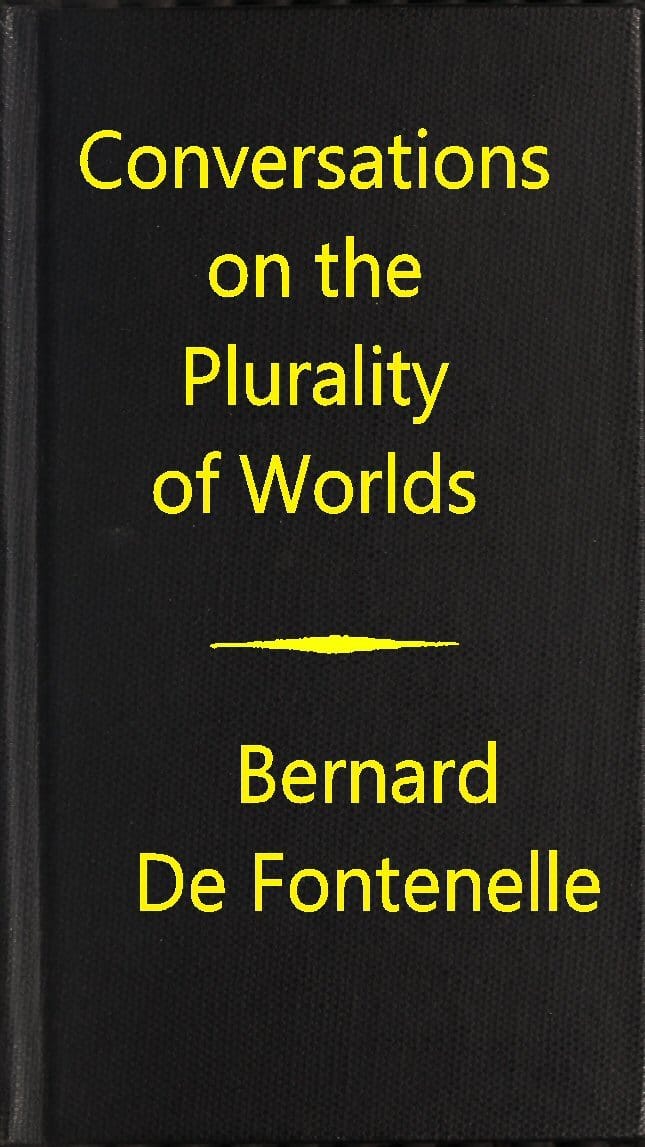
In 1686, a young polymath did something no serious scientist had done before: he wrote about the heavens in French, not Latin, and dressed his astronomical treatise as a romantic evening stroll. The result is this charming, radical little book, one of the first works of popular science ever written. Through a series of dialogues between a philosopher and a marchioness, Fontenelle guides his reader through the new Copernican cosmos, explaining with playful clarity why Earth spins around the Sun and what that means for our place in the universe. But he goes further still, boldly speculating on whether the Moon might harbor life, whether the planets are worlds like our own, and whether the stars are distant suns circled by their own inhabited worlds. Written with wit, elegance, and genuine wonder, this book captures a moment when humanity was first learning to look at the night sky and ask: are we alone? It remains astonishingly prescient, posing questions we still struggle to answer.
Editions
X-Ray
“But I've never yet heard anyone say that the Moon was inhabited," she replied, "except as a fantasy and a delusion.""This may be a fantasy too," I answered. "I don't take sides in these matters except as one does in civil wars, when the uncertainty of what might happen makes one maintain contacts on the opposite side and make arrangements even with the enemy. As for me, although I see the Moon as inhabited, I still live on good terms with those who don't believe it, and I keep myself in a position where I could shift to their opinion honorably if they gained the upper hand.””
— M. de Fontenelle
“Kuvitellaanpa jos itse olisimme järkiolentoja, mutta emme ihmisiä, ja asuisimme Kuussa. Kykenisimmekö me silloin kuvittelemaan sen Maata kansoittavan merkillisen olennon, jota sanotaan ihmiseksi? Osaisimmeko kuvitella olentoa, jolla olisi niin päättömiä intohimoja ja niin syvällisiä mietteitä; niin lyhyt elämä ja niin kauaskantoisia tarkoitusperiä; niin paljon tietoa tuiki hyödyttömistä asioista ja niin suuri tietämättömyys kaikkein tärkeimmistä; niin suuri kaipuu vapauteen ja niin suuri taipumus orjuuteen; niin suuri pyrkimys onneen ja niin vähän kykyä olla onnellinen?””
— M. de Fontenelle
Link to this book
Add a free, dofollow link to Lex on your blog, forum, syllabus, or reading list.

<a href="https://lex-books.com/book/conversations-on-the-plurality-of-worlds-57b70b96-732e-424a-976f-b721add05764"><img src="https://lex-books.com/badges/read-on-lex.svg" alt="Read Conversations on the Plurality of Worlds by M. de Fontenelle free on Lex" width="160" height="40"></a>[](https://lex-books.com/book/conversations-on-the-plurality-of-worlds-57b70b96-732e-424a-976f-b721add05764)[url=https://lex-books.com/book/conversations-on-the-plurality-of-worlds-57b70b96-732e-424a-976f-b721add05764][img]https://lex-books.com/badges/read-on-lex.svg[/img][/url]Read Conversations on the Plurality of Worlds by M. de Fontenelle free on Lex: https://lex-books.com/book/conversations-on-the-plurality-of-worlds-57b70b96-732e-424a-976f-b721add05764Cite this book
Reading this edition for a paper or guide? Copy a citation.
Fontenelle, M. de. Conversations on the Plurality of Worlds. Lex, lex-books.com/book/conversations-on-the-plurality-of-worlds-57b70b96-732e-424a-976f-b721add05764.Fontenelle, M. D. (n.d.). Conversations on the Plurality of Worlds. Lex. https://lex-books.com/book/conversations-on-the-plurality-of-worlds-57b70b96-732e-424a-976f-b721add05764Fontenelle, M. de. Conversations on the Plurality of Worlds. Lex. https://lex-books.com/book/conversations-on-the-plurality-of-worlds-57b70b96-732e-424a-976f-b721add05764.