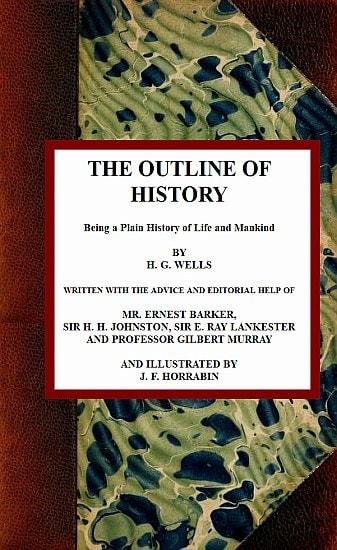
The Outline of History: Being a Plain History of Life and Mankind
1920
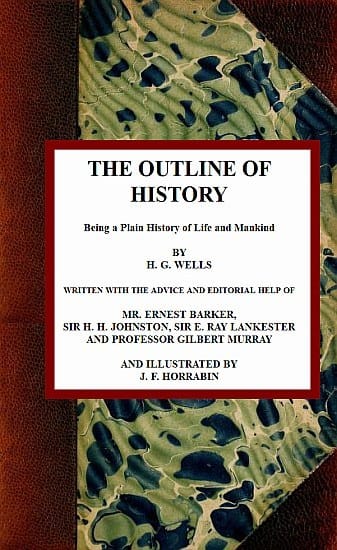
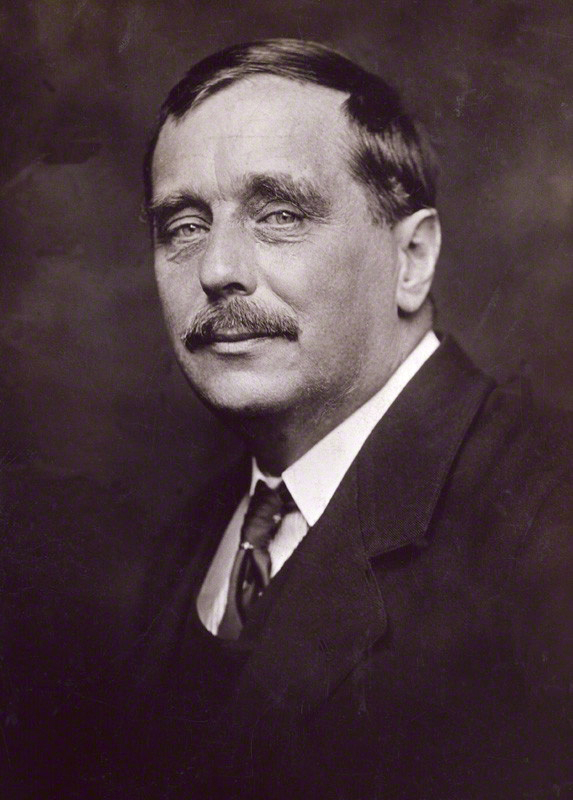
The legendary author of The Time Machine and The War of the Worlds turns his narrative gifts to the actual story of humanity. Written in the aftermath of the Great War, Wells sought to show that all of humanity shares a common past, that the boundaries between nations are recent inventions atop a vast shared history stretching back to the formation of the Earth itself. Beginning with the cooling crust of a young planet and the first stirrings of life in ancient seas, he traces the sweep of civilizations, the rise and fall of empires, and the slow ascent of human consciousness. It's bold, ambitious, and unapologetically grand in scale - exactly what you'd expect from a man who imagined the future. This is popular history written as Wells understood it: not as a catalog of dates and battles, but as a story worth telling. The book sold over two million copies and shaped how generations understood the human journey.
Editions
X-Ray
“It is well to understand how empty space is. If, as we have said, the sun were a ball nine feet across, our earth would, in proportion, be the size of a one-inch ball, and at a distance of 323 yards from the sun. The moon would be a speck the size of a small pea, thirty inches from the earth. Nearer to the sun than the earth would be two other very similar specks, the planets Mercury and Venus, at a distance of 125 and 250 yards respectively. Beyond the earth would come the planets Mars, Jupiter, Saturn, Uranus, and Neptune, at distances of 500, 1806, 3000, 6000, and 9500 yards respectively.””
— H. G. Wells
“In the Palæozoic period, as we have said, life had not spread beyond the swampy river valleys and the borders of sea lagoons and the like; but in the Mesozoic, life was growing ever more accustomed to the thinner medium of the air, was sweeping boldly up over the plains and towards the hillsides. It is well for the student of human history and the human future to note that. If a disembodied intelligence with no knowledge of the future had come to earth and studied life during the early Palæozoic age, he might very reasonably have concluded that life was absolutely confined to the water, and that it could never spread over the land. It found a way. In the Later Palæozoic Period that visitant might have been equally sure that life could not go beyond the edge of a swamp. The Mesozoic Period would still have found him setting bounds to life far more limited than the bounds that are set to-day. And so to-day, though we mark how life and man are still limited to five miles of air and a depth of perhaps a mile or so of sea, we must not conclude from that present limitation that life, through man, may not presently spread out and up and down to a range of living as yet inconceivable.””
— H. G. Wells
“No animal will change when its conditions are good enough for present survival. And in this matter man is still an animal.””
— H. G. Wells
“they had a tradition of greater solidarity. Greek was hostile to Greek; Jew stood by Jew. Wherever a Jew went, he found men of like mind and like tradition with himself. He could get shelter, food, loans, and legal help.””
— H. G. Wells
“But such accounts as we have from the Romans were written in periods of panic, and the Roman could lie about his enemies with a freedom and vigour that must arouse the envy even of the modern propagandist. He could talk of Punic faith as a byword for perfidy while committing the most abominable treacheries against Carthage, and his railing accusations of systematic cruelty against this people or that were usually the prelude and excuse for some frightful massacre or enslavement or robbery on his own part. He had quite a Modern passion for self-justification. We must remember that these accounts of the savagery and frightfulness of the Huns came from a people whose chief amusement was gladiatorial shows, and whose chief method of dealing with insurrection and sedition was nailing the offender to a cross to die.””
— H. G. Wells
“A shambling, hairy, brutish, but probably very cunning creature with a big brain behind; so someone, I think it was Sir Harry Johnston, has described Homo Neanderthalensis. To this day we must still use similar terms to describe the soul of the politician. The statesman has still to oust the politician from his lairs and weapon heaps. History has still to become a record of human dignity. Finance””
— H. G. Wells
“We have already described the gatherings of the popular comitia; but that clumsy assembly in sheep pens does not convey the full extent to which the gerrymandering of popular representation could be carried in Rome. Whenever there was a new enfranchisement of citizens in Italy, there would be the most elaborate trickery and counter-trickery to enrol the new voters into as few or as many of the thirty old tribes as possible, or to put them into as few as possible new tribes. Since the vote was taken by tribes, it is obvious that however great the number of new additions made, if they were all got together into one tribe, their opinion would only count for one tribal vote, and similarly if they were crowded into just a few tribes, old or new. On the other hand, if they were put into too many tribes their effect in any particular tribe might be inconsiderable. Here was the sort of work to fascinate every smart knave in politics. The comitia tributa could be worked at times so as to vote right counter to the general feeling of the people.””
— H. G. Wells
“the freedom money gives the poor man is nothing to the freedom money has given the rich man. With money rich men ceased to be tied to lands, houses, stores, flocks and herds. They could change the nature and locality of their possessions with an unheard-of freedom.””
— H. G. Wells
“Money, like most other inventions, had happened to mankind, and men had still to develop to-day they have still to perfect the science and morality of money.””
— H. G. Wells
Link to this book
Add a free, dofollow link to Lex on your blog, forum, syllabus, or reading list.

<a href="https://lex-books.com/book/the-outline-of-history-being-a-plain-history-of-life-and-mankind-e4390053-7c55-4054-b26b-3e71771b101e"><img src="https://lex-books.com/badges/read-on-lex.svg" alt="Read The Outline of History: Being a Plain History of Life and Mankind by H. G. Wells free on Lex" width="160" height="40"></a>[](https://lex-books.com/book/the-outline-of-history-being-a-plain-history-of-life-and-mankind-e4390053-7c55-4054-b26b-3e71771b101e)[url=https://lex-books.com/book/the-outline-of-history-being-a-plain-history-of-life-and-mankind-e4390053-7c55-4054-b26b-3e71771b101e][img]https://lex-books.com/badges/read-on-lex.svg[/img][/url]Read The Outline of History: Being a Plain History of Life and Mankind by H. G. Wells free on Lex: https://lex-books.com/book/the-outline-of-history-being-a-plain-history-of-life-and-mankind-e4390053-7c55-4054-b26b-3e71771b101eCite this book
Reading this edition for a paper or guide? Copy a citation.
Wells, H. G.. The Outline of History: Being a Plain History of Life and Mankind. Lex, lex-books.com/book/the-outline-of-history-being-a-plain-history-of-life-and-mankind-e4390053-7c55-4054-b26b-3e71771b101e.Wells, H. G. (1920). The Outline of History: Being a Plain History of Life and Mankind. Lex. https://lex-books.com/book/the-outline-of-history-being-a-plain-history-of-life-and-mankind-e4390053-7c55-4054-b26b-3e71771b101eWells, H. G.. The Outline of History: Being a Plain History of Life and Mankind. Lex. https://lex-books.com/book/the-outline-of-history-being-a-plain-history-of-life-and-mankind-e4390053-7c55-4054-b26b-3e71771b101e.