A Short History of the World
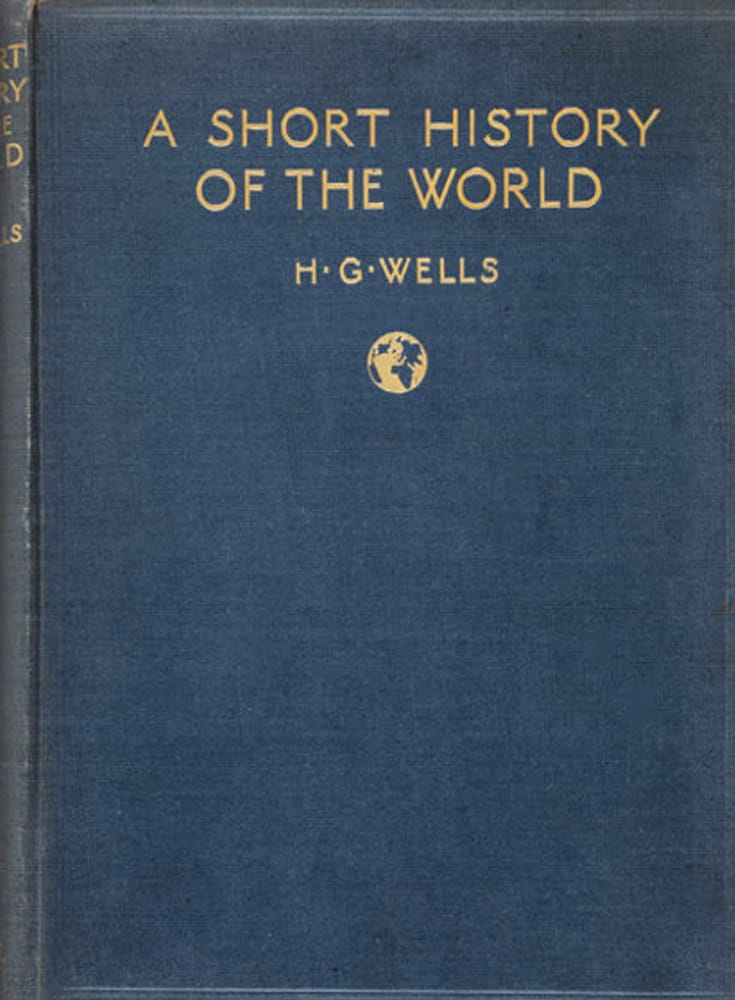
H.G. Wells, the man who imagined time machines and alien invasions, turns his formidable imagination on the story that matters most: our own. Written in 1922, as the ruins of World War I still smoldered, A Short History of the World attempts something daring, to distil four billion years of existence into a single readable narrative. Wells traces the long, improbable journey from primordial fire to the fractured modernity he inhabited, weaving science, empire, religion, and revolution into a story that feels urgent rather than academic. This is not a textbook but a vision, filtered through one of the 20th century's most restless minds, who believed history was not just something that happened to us but something we might, with effort, understand. The book carries the peculiar magic of being written by a novelist who happened to be a historian, a futurist who couldn't stop thinking about the past. It captures both the grandeur of deep time and the fragile contingency of civilization, how easily it all might not have happened, how easily it all might be lost.
Editions

X-Ray
“Most of the social and political ills from which you suffer are under your control, given only the will and courage to change them. You can live in another and a wiser fashion if you choose to think it out and work it out. You are not awake to your own power.””
— H. G. Wells
“When the mind grapples with a great and intricate problem, it makes its advances step by step, with but little realization of the gains it has made, until suddenly, with an effect of abrupt illumination, it realizes its victory. So it happened to Gautama.””
— H. G. Wells
“To the bulk of the English people India was a remote, fantastic, almost inaccessible land, to which adventurous poor young men went out, to return after many years very rich and very choleric old gentlemen. It was difficult for the English to conceive what the life of these countless brown millions in the eastern sunshine could be. Their imaginations declined the task. India””
— H. G. Wells
“In form the Aryan peoples were altogether victorious; but the struggle of Aryan, Semitic and Egyptian ideas and methods was continued long after the sceptre was in Aryan hands. It is indeed a struggle that goes on through all the rest of history and still in a manner continues to this day.””
— H. G. Wells
Link to this book
Add a free, dofollow link to Lex on your blog, forum, syllabus, or reading list.

<a href="https://lex-books.com/book/a-short-history-of-the-world-2472a995-5847-44f7-8ff5-152c615c33ac"><img src="https://lex-books.com/badges/read-on-lex.svg" alt="Read A Short History of the World by H. G. Wells free on Lex" width="160" height="40"></a>[](https://lex-books.com/book/a-short-history-of-the-world-2472a995-5847-44f7-8ff5-152c615c33ac)[url=https://lex-books.com/book/a-short-history-of-the-world-2472a995-5847-44f7-8ff5-152c615c33ac][img]https://lex-books.com/badges/read-on-lex.svg[/img][/url]Read A Short History of the World by H. G. Wells free on Lex: https://lex-books.com/book/a-short-history-of-the-world-2472a995-5847-44f7-8ff5-152c615c33acCite this book
Reading this edition for a paper or guide? Copy a citation.
Wells, H. G.. A Short History of the World. Lex, lex-books.com/book/a-short-history-of-the-world-2472a995-5847-44f7-8ff5-152c615c33ac.Wells, H. G. (n.d.). A Short History of the World. Lex. https://lex-books.com/book/a-short-history-of-the-world-2472a995-5847-44f7-8ff5-152c615c33acWells, H. G.. A Short History of the World. Lex. https://lex-books.com/book/a-short-history-of-the-world-2472a995-5847-44f7-8ff5-152c615c33ac.