The Birth of Tragedy; Or, Hellenism and Pessimism
1872
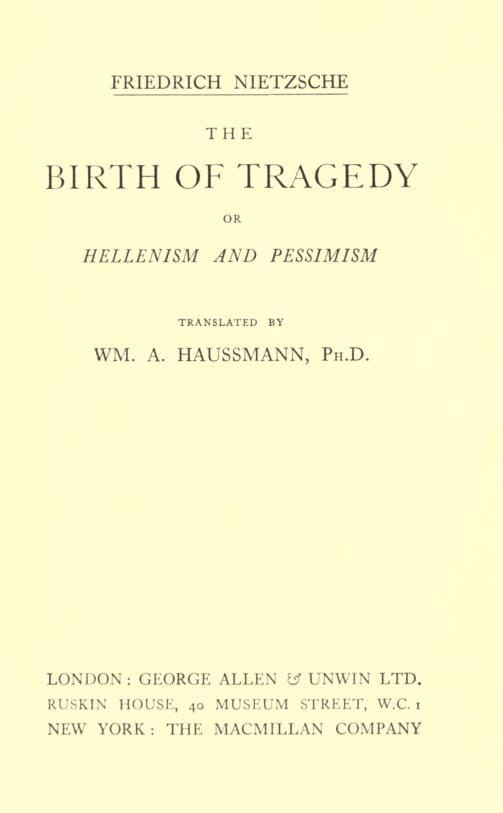
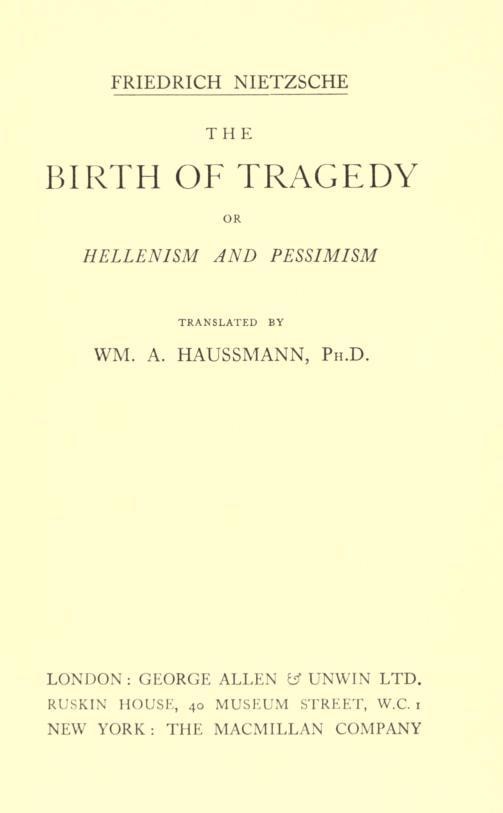
The Birth of Tragedy; Or, Hellenism and Pessimism
1872
Translated by William A. Haussmann
Before Nietzsche became the most dangerous thinker of the 20th century, he was a 27-year-old philologist with a radical idea. The Birth of Tragedy argues that the highest expressions of human culture do not emerge from reason or restraint but from a confrontation with chaos and suffering. Nietzsche names this duality the Apollonian and the Dionysian: Apollo representing form, beauty, and the individuated self, while Dionysus embodies primal ecstasy, dissolution, and the terrifying truth that the world lacks any ultimate meaning. The Greeks, he argues, understood that art must synthesize both forces. Their tragedies did not comfort audiences with easy answers but plunged them into suffering, then transfigured that suffering into something sublime. Here is Nietzsche's passionate, sometimes unhinged case that art is not decoration but necessity, if we are to bear existence at all. He dedicated the book to Richard Wagner as a prophet of cultural rebirth, and though Nietzsche would later disavow it, every idea that made him famous lives inside these pages in seed form.
Editions
X-Ray
“Knowledge kills action; action requires the veils of illusion.””
— Friedrich Wilhelm Nietzsche
“Christianity was from the beginning, essentially and fundamentally, life's nausea and disgust with life, merely concealed behind, masked by, dressed up as, faith in "another" or "better" life.””
— Friedrich Wilhelm Nietzsche
“The best of all things is something entirely outside your grasp: not to be born, not to be, to be nothing. But the second best thing for you is to die soon.””
— Friedrich Wilhelm Nietzsche
“Without myth, however, every culture loses its healthy creative natural power: it is only a horizon encompassed with myth that rounds off to unity a social movement.””
— Friedrich Wilhelm Nietzsche
“Suppose a human being has thus put his ear, as it were, to the heart chamber of the world will and felt the roaring desire for existence pouring from there into all the veins of the world, as a thundering current or as the gentlest brook, dissolving into a mist”
— Friedrich Wilhelm Nietzsche
“What does our great historical hunger signify, our clutching about us of countless cultures, our consuming desire for knowledge, if not the loss of myth, of a mythic home, the mythic womb?””
— Friedrich Wilhelm Nietzsche
“I fear that, with our current veneration for the natural and the real, we have arrived at the opposite pole to all idealism, and have landed in the region of the waxworks.””
— Friedrich Wilhelm Nietzsche
“Why does Homer give us descriptions so much more vivid than all the poets. Because he sees so much more around him. We speak about poetry so abstractly because we all tend to be poor poets. The aesthetic phenomenon is fundamentally simple: if someone simply possesses the capacity to see a living game going on continually and to live all the time surrounded by hordes of ghosts, then the man is a poet; if someone simply feels the urge to change himself and to speak out from other bodies and souls, then that person is a dramatist.””
— Friedrich Wilhelm Nietzsche
“نسمع في لحظات الفرح الغامر صرخات الرعب أو البكاء الموجع اشتياقاً إلى شيء ما فقدناه بلا رجعة””
— Friedrich Wilhelm Nietzsche
Link to this book
Add a free, dofollow link to Lex on your blog, forum, syllabus, or reading list.

<a href="https://lex-books.com/book/the-birth-of-tragedy-or-hellenism-and-pessimism-f820ff60-a195-4560-8202-377faf171b8e"><img src="https://lex-books.com/badges/read-on-lex.svg" alt="Read The Birth of Tragedy; Or, Hellenism and Pessimism by Friedrich Wilhelm Nietzsche free on Lex" width="160" height="40"></a>[](https://lex-books.com/book/the-birth-of-tragedy-or-hellenism-and-pessimism-f820ff60-a195-4560-8202-377faf171b8e)[url=https://lex-books.com/book/the-birth-of-tragedy-or-hellenism-and-pessimism-f820ff60-a195-4560-8202-377faf171b8e][img]https://lex-books.com/badges/read-on-lex.svg[/img][/url]Read The Birth of Tragedy; Or, Hellenism and Pessimism by Friedrich Wilhelm Nietzsche free on Lex: https://lex-books.com/book/the-birth-of-tragedy-or-hellenism-and-pessimism-f820ff60-a195-4560-8202-377faf171b8eCite this book
Reading this edition for a paper or guide? Copy a citation.
Nietzsche, Friedrich Wilhelm. The Birth of Tragedy; Or, Hellenism and Pessimism. Lex, lex-books.com/book/the-birth-of-tragedy-or-hellenism-and-pessimism-f820ff60-a195-4560-8202-377faf171b8e.Nietzsche, F. W. (1872). The Birth of Tragedy; Or, Hellenism and Pessimism. Lex. https://lex-books.com/book/the-birth-of-tragedy-or-hellenism-and-pessimism-f820ff60-a195-4560-8202-377faf171b8eNietzsche, Friedrich Wilhelm. The Birth of Tragedy; Or, Hellenism and Pessimism. Lex. https://lex-books.com/book/the-birth-of-tragedy-or-hellenism-and-pessimism-f820ff60-a195-4560-8202-377faf171b8e.