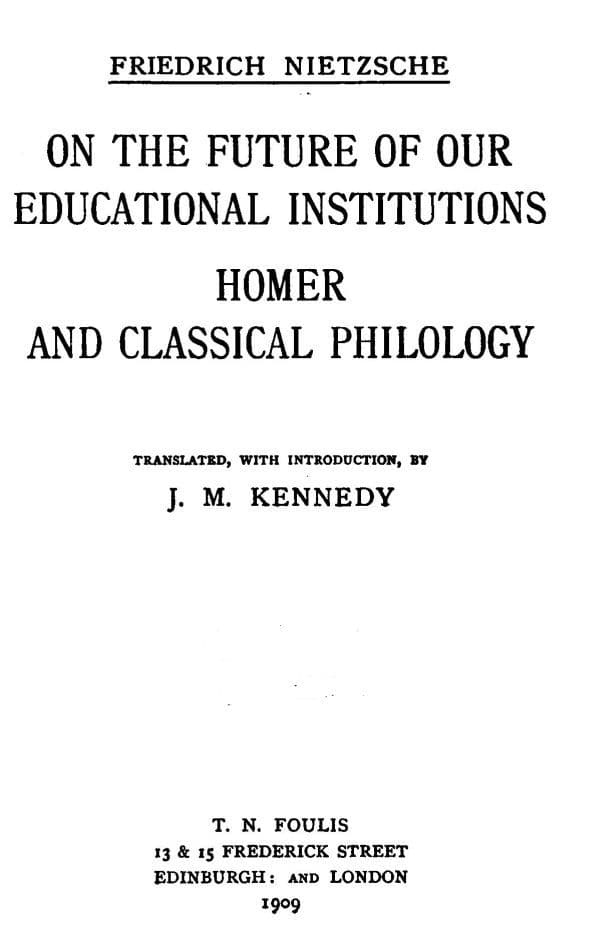
Homer and Classical Philology
Delivered as an inaugural address at Bâle University, this is young Nietzsche at his most electrifying: a philologist who refuses to worship at the altar of singular genius. With devastating precision, he dismantles the notion of Homer as a solitary bard, arguing instead that the Iliad and Odyssey emerged from centuries of oral tradition, collective memory, and cultural synthesis. The 'Homeric question' becomes a mirror for larger debates about how we read the past and who gets to be called a creator. Nietzsche insists that the greatness of these epics lies not in one poet's inspiration but in the living tradition that shaped and reshaped them. This is philosophy of literature before philosophy consumed him entirely, and it remains radical: a protest against the modern tendency to reduce vast cultural achievements to individual authorship.
Editions
Link to this book
Add a free, dofollow link to Lex on your blog, forum, syllabus, or reading list.

<a href="https://lex-books.com/book/homer-and-classical-philology-2ff232fd-626e-4ccd-89f2-ea23526c4611"><img src="https://lex-books.com/badges/read-on-lex.svg" alt="Read Homer and Classical Philology by Friedrich Wilhelm Nietzsche free on Lex" width="160" height="40"></a>[](https://lex-books.com/book/homer-and-classical-philology-2ff232fd-626e-4ccd-89f2-ea23526c4611)[url=https://lex-books.com/book/homer-and-classical-philology-2ff232fd-626e-4ccd-89f2-ea23526c4611][img]https://lex-books.com/badges/read-on-lex.svg[/img][/url]Read Homer and Classical Philology by Friedrich Wilhelm Nietzsche free on Lex: https://lex-books.com/book/homer-and-classical-philology-2ff232fd-626e-4ccd-89f2-ea23526c4611Cite this book
Reading this edition for a paper or guide? Copy a citation.
Nietzsche, Friedrich Wilhelm. Homer and Classical Philology. Lex, lex-books.com/book/homer-and-classical-philology-2ff232fd-626e-4ccd-89f2-ea23526c4611.Nietzsche, F. W. (n.d.). Homer and Classical Philology. Lex. https://lex-books.com/book/homer-and-classical-philology-2ff232fd-626e-4ccd-89f2-ea23526c4611Nietzsche, Friedrich Wilhelm. Homer and Classical Philology. Lex. https://lex-books.com/book/homer-and-classical-philology-2ff232fd-626e-4ccd-89f2-ea23526c4611.