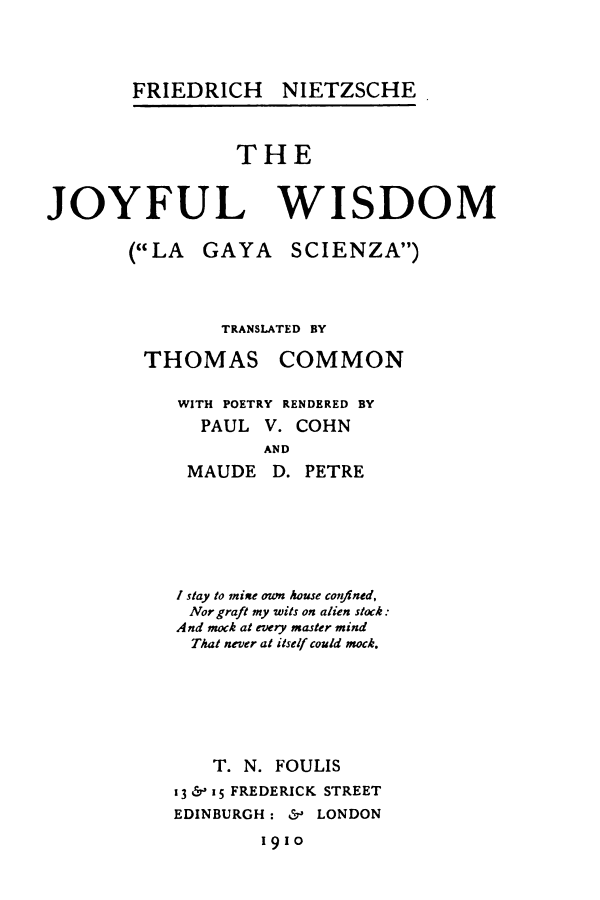
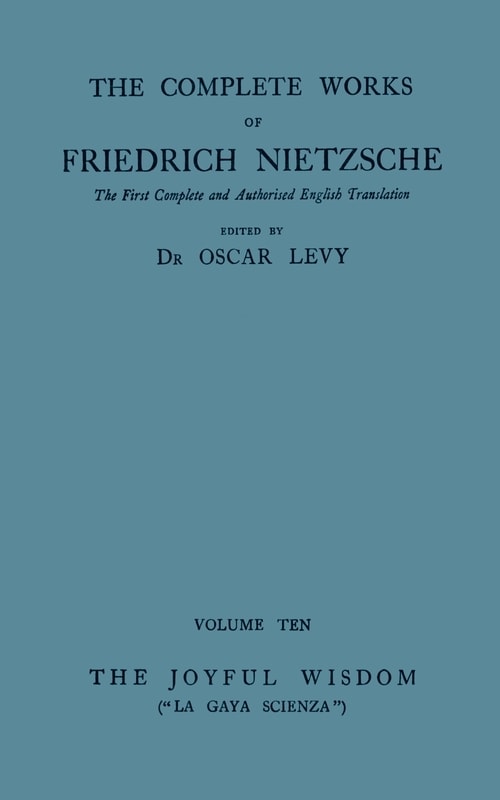
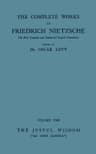
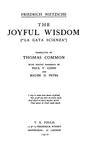
The Joyful Wisdom ("La Gaya Scienza")
1882
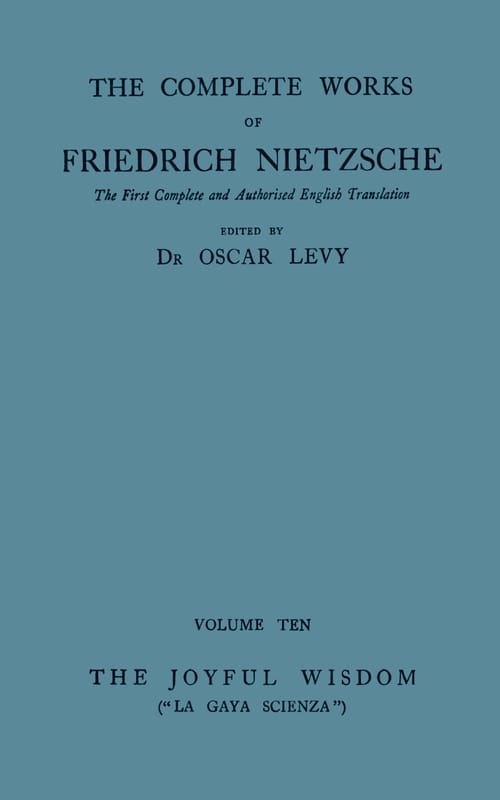
The Joyful Wisdom ("La Gaya Scienza")
1882
Translated by Paul V. (Paul Victor) Cohn
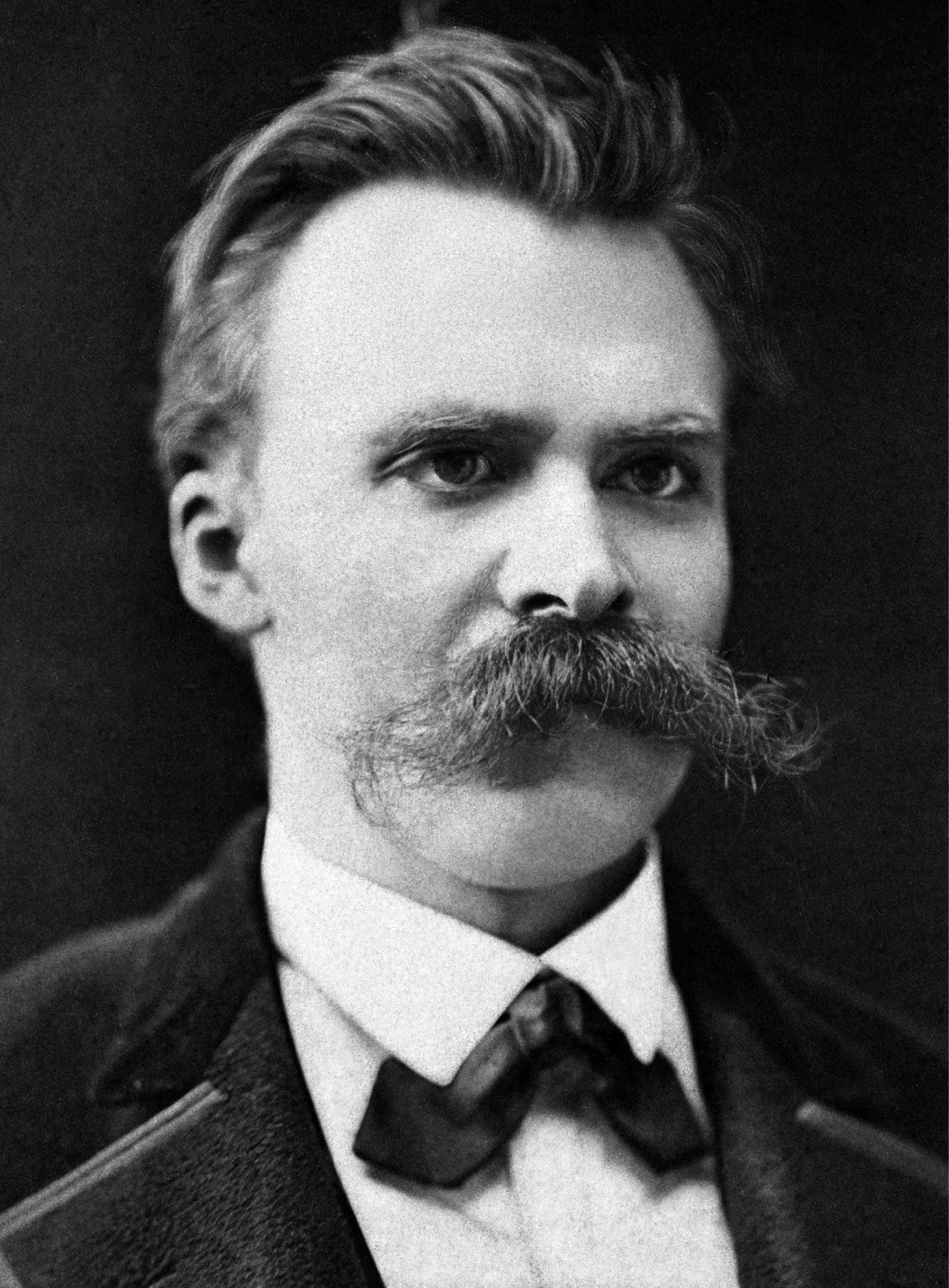
Here, in 1882, Nietzsche uttered the words that still echo through modern thought: 'God is dead.' But The Joyful Wisdom is no nihilist's lament. It is the book where Nietzsche discovers that the death of absolute meaning is not a catastrophe but a liberation, and that true wisdom leads not to despair but to laughter. Written in fragments, aphorisms, and sudden lyrical bursts, it bridges his earlier iconoclasm and the revolutionary Later, Nietzsche presents eternal recurrence as the ultimate test: would you will each moment of your life to repeat infinitely? The answer, he insists, must be joy. This is Nietzsche at his most personal, most vulnerable, and most exhilarating. It contains his largest collection of poetry, glimpses of the Zarathustra to come, and the concept of the 'intellectual conscience' that would shape existentialism. Not a textbook of conclusions but a book of experiments in living.
Editions
X-Ray
“What, if some day or night a demon were to steal after you into your loneliest loneliness and say to you: 'This life as you now live it and have lived it, you will have to live once more and innumerable times more' ... Would you not throw yourself down and gnash your teeth and curse the demon who spoke thus? Or have you once experienced a tremendous moment when you would have answered him: 'You are a god and never have I heard anything more divine.””
— Friedrich Wilhelm Nietzsche
“I want to learn more and more to see as beautiful what is necessary in things; then I shall be one of those who make things beautiful. Amor fati: let that be my love henceforth! I do not want to wage war against what is ugly. I do not want to accuse; I do not even want to accuse those who accuse. Looking away shall be my only negation. And all in all and on the whole: some day I wish to be only a Yes-sayer.””
— Friedrich Wilhelm Nietzsche
“The heaviest burden: “What, if some day or night, a demon were to steal after you into your loneliest loneliness and say to you: ‘This life, as you now live it and have lived it, you will have to live once more and innumerable times more; and there will be nothing new in it, but every pain and every joy and every thought and sigh… must return to you”
— Friedrich Wilhelm Nietzsche
“Love, too, has to be learned.””
— Friedrich Wilhelm Nietzsche
“For believe me!”
— Friedrich Wilhelm Nietzsche
“Those who know that they are profound strive for clarity. Those who would like to seem profound to the crowd strive for obscurity. For the crowd believes that if it cannot see to the bottom of something it must be profound. It is so timid and dislikes going into the water.””
— Friedrich Wilhelm Nietzsche
“Only great pain, the long, slow pain that takes its time... compels us to descend to our ultimate depths... I doubt that such pain makes us "better"; but I know it makes us more profound... In the end, lest what is most important remain unsaid: from such abysses, from such severe sickness, one returns newborn, having shed one's skin... with merrier senses, with a second dangerous innocence in joy, more childlike and yet a hundred times subtler than one has ever been before.””
— Friedrich Wilhelm Nietzsche
“A bad conscience is easier to cope with than a bad reputation.””
— Friedrich Wilhelm Nietzsche
“In the end we are always rewarded for our good will, our patience, fair-mindedness, and gentleness with what is strange.””
— Friedrich Wilhelm Nietzsche
Link to this book
Add a free, dofollow link to Lex on your blog, forum, syllabus, or reading list.

<a href="https://lex-books.com/book/the-joyful-wisdom-la-gaya-scienza-5222efed-4357-400a-803c-56af84edda17"><img src="https://lex-books.com/badges/read-on-lex.svg" alt="Read The Joyful Wisdom ("La Gaya Scienza") by Friedrich Wilhelm Nietzsche free on Lex" width="160" height="40"></a>[](https://lex-books.com/book/the-joyful-wisdom-la-gaya-scienza-5222efed-4357-400a-803c-56af84edda17)[url=https://lex-books.com/book/the-joyful-wisdom-la-gaya-scienza-5222efed-4357-400a-803c-56af84edda17][img]https://lex-books.com/badges/read-on-lex.svg[/img][/url]Read The Joyful Wisdom ("La Gaya Scienza") by Friedrich Wilhelm Nietzsche free on Lex: https://lex-books.com/book/the-joyful-wisdom-la-gaya-scienza-5222efed-4357-400a-803c-56af84edda17Cite this book
Reading this edition for a paper or guide? Copy a citation.
Nietzsche, Friedrich Wilhelm. The Joyful Wisdom ("La Gaya Scienza"). Lex, lex-books.com/book/the-joyful-wisdom-la-gaya-scienza-5222efed-4357-400a-803c-56af84edda17.Nietzsche, F. W. (1882). The Joyful Wisdom ("La Gaya Scienza"). Lex. https://lex-books.com/book/the-joyful-wisdom-la-gaya-scienza-5222efed-4357-400a-803c-56af84edda17Nietzsche, Friedrich Wilhelm. The Joyful Wisdom ("La Gaya Scienza"). Lex. https://lex-books.com/book/the-joyful-wisdom-la-gaya-scienza-5222efed-4357-400a-803c-56af84edda17.