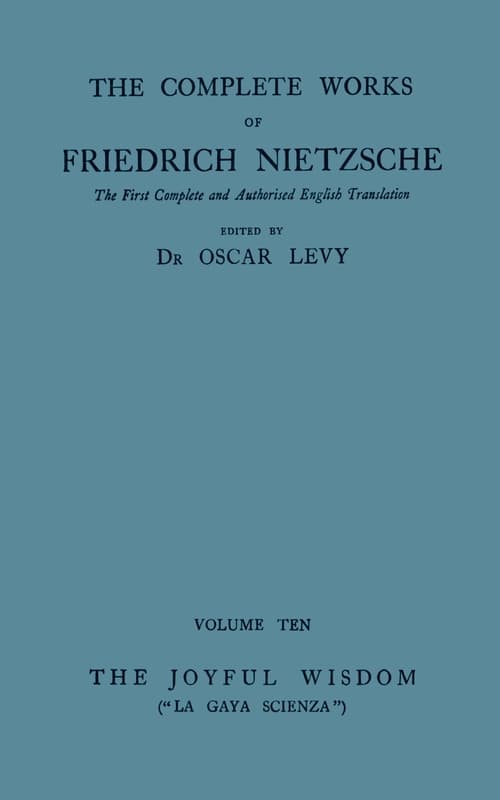
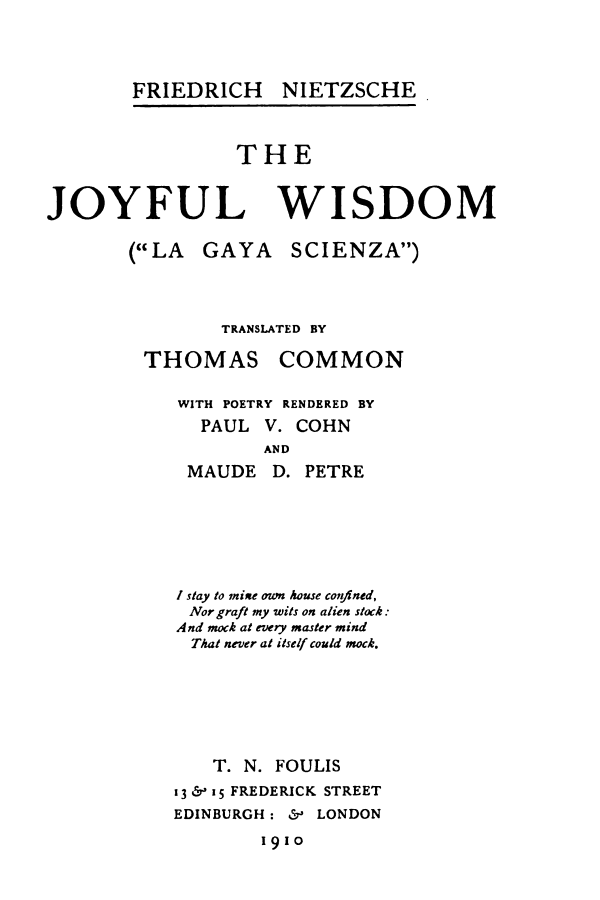
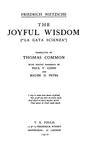
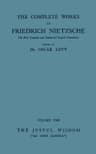
The Joyful Wisdom ("La Gaya Scienza")complete Works, Volume Ten
1882
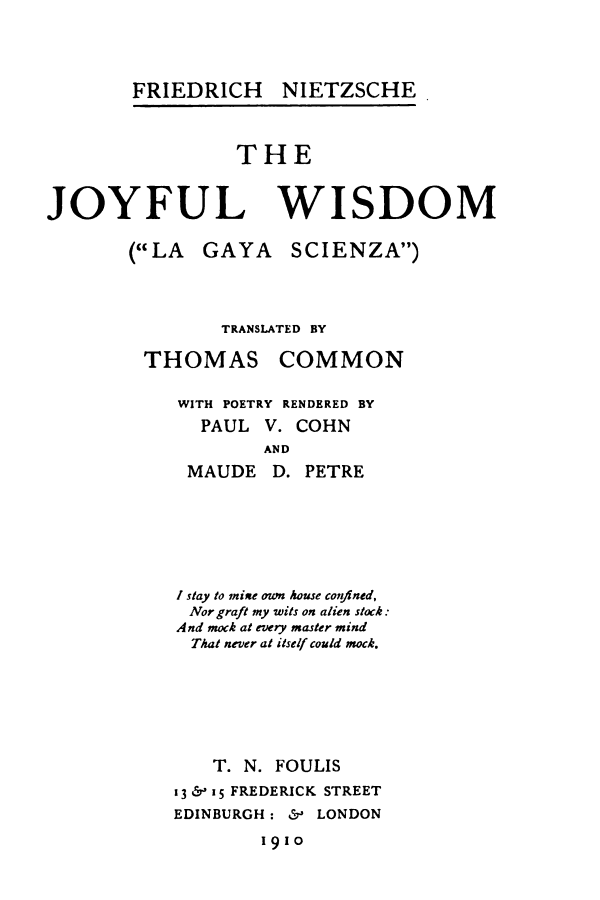
The Joyful Wisdom ("La Gaya Scienza")complete Works, Volume Ten
1882
Translated by Paul V. (Paul Victor) Cohn
A philosophical treatise written in the late 19th century. The work explores themes of life, laughter, morality, and the human condition, attempting to reconcile the often painful realities of existence with a joyful acceptance of life itself. Nietzsche's distinctive voice and provocative ideas challenge conventional beliefs, positioning him as a significant figure in existential thought. The opening of ''The Joyful Wisdom'' establishes the groundwork for Nietzsche's exploration of happiness and human experience. He introduces the concept of ''joyful wisdom'' as a playful yet profound response to life's trials, reflecting on ideas of health and convalescence, and suggesting that genuine wisdom can emerge from suffering. Nietzsche emphasizes the importance of questioning existing moral frameworks while advocating for a new understanding of life that embraces both its joyous and tragic elements. He suggests that humor and lightness are essential tools in navigating existence, setting the stage for a critical examination of conventional beliefs about morality, suffering, and happiness throughout the text.
Editions
Link to this book
Add a free, dofollow link to Lex on your blog, forum, syllabus, or reading list.

<a href="https://lex-books.com/book/the-joyful-wisdom-la-gaya-scienza-complete-works-volume-ten-523b3bd7-7970-491b-8cf6-bf2187dcee47"><img src="https://lex-books.com/badges/read-on-lex.svg" alt="Read The Joyful Wisdom ("La Gaya Scienza")complete Works, Volume Ten by Friedrich Wilhelm Nietzsche free on Lex" width="160" height="40"></a>[](https://lex-books.com/book/the-joyful-wisdom-la-gaya-scienza-complete-works-volume-ten-523b3bd7-7970-491b-8cf6-bf2187dcee47)[url=https://lex-books.com/book/the-joyful-wisdom-la-gaya-scienza-complete-works-volume-ten-523b3bd7-7970-491b-8cf6-bf2187dcee47][img]https://lex-books.com/badges/read-on-lex.svg[/img][/url]Read The Joyful Wisdom ("La Gaya Scienza")complete Works, Volume Ten by Friedrich Wilhelm Nietzsche free on Lex: https://lex-books.com/book/the-joyful-wisdom-la-gaya-scienza-complete-works-volume-ten-523b3bd7-7970-491b-8cf6-bf2187dcee47Cite this book
Reading this edition for a paper or guide? Copy a citation.
Nietzsche, Friedrich Wilhelm. The Joyful Wisdom ("La Gaya Scienza")complete Works, Volume Ten. Lex, lex-books.com/book/the-joyful-wisdom-la-gaya-scienza-complete-works-volume-ten-523b3bd7-7970-491b-8cf6-bf2187dcee47.Nietzsche, F. W. (1882). The Joyful Wisdom ("La Gaya Scienza")complete Works, Volume Ten. Lex. https://lex-books.com/book/the-joyful-wisdom-la-gaya-scienza-complete-works-volume-ten-523b3bd7-7970-491b-8cf6-bf2187dcee47Nietzsche, Friedrich Wilhelm. The Joyful Wisdom ("La Gaya Scienza")complete Works, Volume Ten. Lex. https://lex-books.com/book/the-joyful-wisdom-la-gaya-scienza-complete-works-volume-ten-523b3bd7-7970-491b-8cf6-bf2187dcee47.