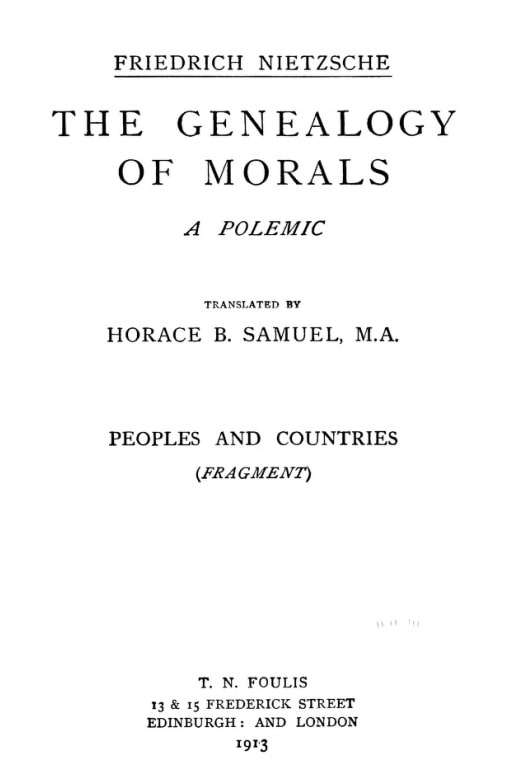
The Genealogy of Morals: The Complete Works, Volume Thirteen, Edited by Dr. Oscar Levy.
1887
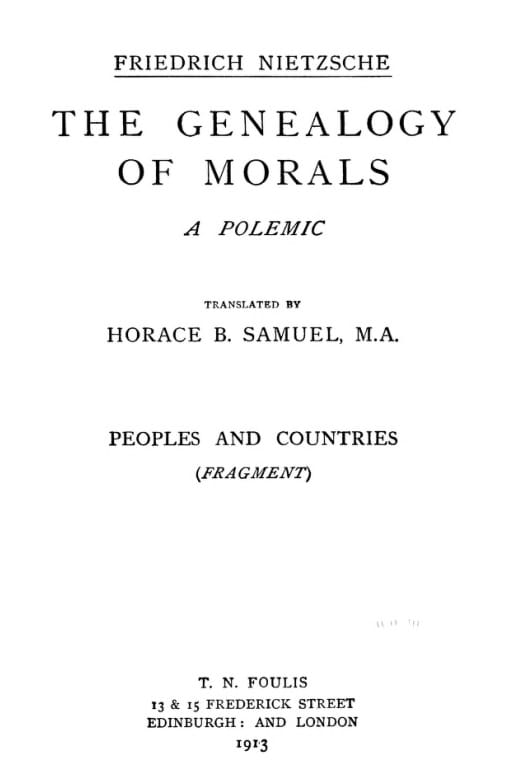
The Genealogy of Morals: The Complete Works, Volume Thirteen, Edited by Dr. Oscar Levy.
1887
Translated by J. M. (John McFarland) Kennedy
Where do your moral certainties come from? Nietzsche argues they are not divine gifts or rational discoveries, but products of a brutal historical process. The Genealogy traces how concepts like "good" and "evil" emerged from the psychological wreckage of ancient cultures, how the weak invented morality to cage the strong, and how the ascetic ideal became humanity's most cunning instrument of self-domestication. Written in three interconnected essays, this book rewrites the history of ethics as a history of cruelty, exposing compassion, equality, and justice as the descendents of resentment and the will to power. Nietzsche does not merely critique traditional values; he turns his genealogical knife on his own reasoning, interrogating the presuppositions that underlie his entire project. The result is a work of devastating honesty that leaves no moral conviction unexamined, no sacred cow unbloodied. It remains essential for anyone willing to interrogate the foundations of their own conscience.
Editions

X-Ray
“Man, the bravest of animals, and the one most accustomed to suffering, does not repudiate suffering as such; he desires it, he even seeks it out, provided he is shown a meaning for it, a purpose of suffering. The meaninglessness of suffering, not suffering itself, was the curse that lay over mankind so far.””
— Friedrich Wilhelm Nietzsche
“We are unknown to ourselves, we men of knowledge - and with good reason. We have never sought ourselves - how could it happen that we should ever find ourselves? It has rightly been said: "Where your treasure is, there will your heart be also"; our treasure is where the beehives of our knowledge are.””
— Friedrich Wilhelm Nietzsche
“Human history would be nothing but a record of stupidity save for the cunning contributions of the weak””
— Friedrich Wilhelm Nietzsche
“Thus, the philosopher dislikes marriage as well as what might persuade him into it??marriage is a barrier and a disaster along his route to the optimal. What great philosopher up to now has been married? Heraclitus, Plato, Descartes, Spinoza, Leibtniz, Kant, Schopenhauer?? None of these got married. What`s more, we cannot even imagine them married. A married philosopher belongs in a comedy, that`s my principle. And Socrates, the exception, the malicious Socrates, it appears, got married ironically to demonstrate this very principle.Every philosopher would speak as once Buddha spoke when someone told him of the birth his son, "Rahula has been born to me. A shackle has been forged for me." (Rahula here means "a little demon"). To every "free spirit" there must come a reflective hour, provided that previously he has had a one without thought, of the sort that came then to Buddha - "Life in a house," he thought to himself, "is narrow and confined, a polluted place. Freedom consists of abandoning houses;" "because he thought this way, he left the house.””
— Friedrich Wilhelm Nietzsche
“. . . there is no being behind doing, effecting, becoming; "the doer" is merely a fiction added to the deed”
— Friedrich Wilhelm Nietzsche
“Man will desire oblivion rather than not desire at all.””
— Friedrich Wilhelm Nietzsche
“...'I suffer: someone or other must be guilty' – and every sick sheep thinks the same.””
— Friedrich Wilhelm Nietzsche
“The sick are the greatest danger for the healthy; it is not from the strongest that harm comes to the strong, but from the weakest.””
— Friedrich Wilhelm Nietzsche
“But there is no such substratum; there is no "being" behind doing, effecting, becoming; "the doer" is merely a fiction added to the deed-the deed is everything.””
— Friedrich Wilhelm Nietzsche
Link to this book
Add a free, dofollow link to Lex on your blog, forum, syllabus, or reading list.

<a href="https://lex-books.com/book/the-genealogy-of-morals-the-complete-works-volume-thirteen-edited-by-dr-oscar-le-669a6b23-2780-4d41-a2ee-dc7c7a2f4bca"><img src="https://lex-books.com/badges/read-on-lex.svg" alt="Read The Genealogy of Morals: The Complete Works, Volume Thirteen, Edited by Dr. Oscar Levy. by Friedrich Wilhelm Nietzsche free on Lex" width="160" height="40"></a>[](https://lex-books.com/book/the-genealogy-of-morals-the-complete-works-volume-thirteen-edited-by-dr-oscar-le-669a6b23-2780-4d41-a2ee-dc7c7a2f4bca)[url=https://lex-books.com/book/the-genealogy-of-morals-the-complete-works-volume-thirteen-edited-by-dr-oscar-le-669a6b23-2780-4d41-a2ee-dc7c7a2f4bca][img]https://lex-books.com/badges/read-on-lex.svg[/img][/url]Read The Genealogy of Morals: The Complete Works, Volume Thirteen, Edited by Dr. Oscar Levy. by Friedrich Wilhelm Nietzsche free on Lex: https://lex-books.com/book/the-genealogy-of-morals-the-complete-works-volume-thirteen-edited-by-dr-oscar-le-669a6b23-2780-4d41-a2ee-dc7c7a2f4bcaCite this book
Reading this edition for a paper or guide? Copy a citation.
Nietzsche, Friedrich Wilhelm. The Genealogy of Morals: The Complete Works, Volume Thirteen, Edited by Dr. Oscar Levy.. Lex, lex-books.com/book/the-genealogy-of-morals-the-complete-works-volume-thirteen-edited-by-dr-oscar-le-669a6b23-2780-4d41-a2ee-dc7c7a2f4bca.Nietzsche, F. W. (1887). The Genealogy of Morals: The Complete Works, Volume Thirteen, Edited by Dr. Oscar Levy.. Lex. https://lex-books.com/book/the-genealogy-of-morals-the-complete-works-volume-thirteen-edited-by-dr-oscar-le-669a6b23-2780-4d41-a2ee-dc7c7a2f4bcaNietzsche, Friedrich Wilhelm. The Genealogy of Morals: The Complete Works, Volume Thirteen, Edited by Dr. Oscar Levy.. Lex. https://lex-books.com/book/the-genealogy-of-morals-the-complete-works-volume-thirteen-edited-by-dr-oscar-le-669a6b23-2780-4d41-a2ee-dc7c7a2f4bca.