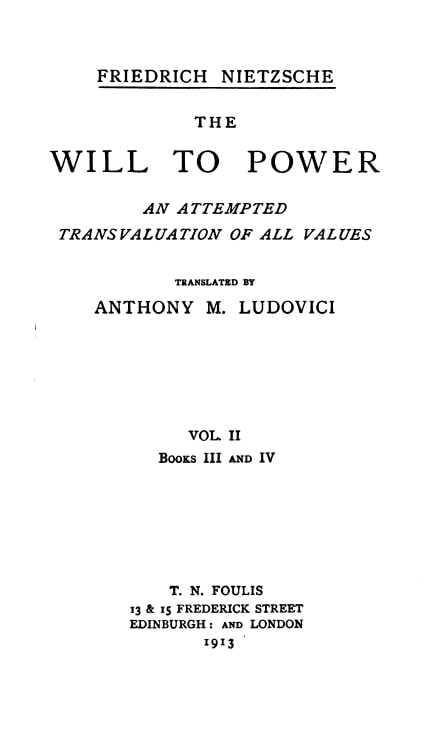
The Will to Power: An Attempted Transvaluation of All Values. Book III and IV
1901
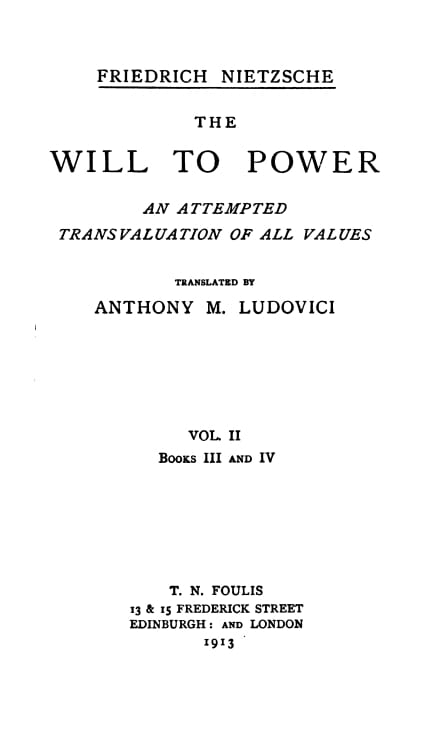
The Will to Power: An Attempted Transvaluation of All Values. Book III and IV
1901
Translated by Anthony M. (Anthony Mario) Ludovici
The Will to Power is not a finished book but a excavation of Nietzsche's mind at its most ferocious. Compiled from his private notebooks, it represents his attempt to construct a systematic philosophy around the concept that would become his most notorious: the drive not merely to survive, but to expand, dominate, and create. Here Nietzsche dismantles the pillars of Western certainty with prosecutorial intensity. Science, he argues, is not objective observation but the expression of will; causality is a grammatical habit imposed on reality; the ego is a fiction. What remains is the Will to Power as the fundamental motor of existence, and the demand that we transvalue all values rather than merely critique them. This is philosophy as grenade. The text moves through nihilism, art, morality, religion, and theory of knowledge, always circling back to the same insistence: that meaning is not found but made, and that the weak call their weakness virtue only because they lack the strength to call it power. The enduring power of this work lies in its refusal to comfort. It is for readers who want philosophy to hurt.
Editions
X-Ray
“To those human beings who are of any concern to me I wish suffering, desolation, sickness, ill-treatment, indignities”
— Friedrich Wilhelm Nietzsche
“It is a self-deception of philosophers and moralists to imagine that they escape decadence by opposing it. That is beyond their will; and, however little they acknowledge it, one later discovers that they were among the most powerful promoters of decadence.””
— Friedrich Wilhelm Nietzsche
“And do you know what “the world” is to me? Shall I show it to you in my mirror? This world: a monster of energy, without beginning, without end; a firm, iron magnitude of force that does not grow bigger or smaller, that does not expend itself but only transforms itself; as a whole, of unalterable size, a household without expenses or losses, but likewise without increase or income; enclosed by “nothingness” as by a boundary; not something blurry or wasted, not something endlessly extended, but set in a definite space as a definite force, and not a space that might be “empty” here or there, but rather as force throughout, as a play of forces and waves of forces, at the same time one and many, increasing here and at the same time decreasing there; a sea of forces flowing and rushing together, eternally changing, eternally flooding back, with tremendous years of recurrence, with an ebb and a flood of its forms; out of the simplest forms striving toward the most complex, out of the stillest, most rigid, coldest forms striving toward the hottest, most turbulent, most self-contradictory, and then again returning home to the simple out of this abundance, out of the play of contradictions back to the joy of concord, still affirming itself in this uniformity of its courses and its years, blessing itself as that which must return eternally, as a becoming that knows no satiety, no disgust, no weariness: this, my Dionysian world of the eternally self- creating, the eternally self-destroying, this mystery world of the twofold voluptuous delight, my “beyond good and evil,” without goal, unless the joy of the circle is itself a goal; without will, unless a ring feels good will toward itself”
— Friedrich Wilhelm Nietzsche
“The higher man is distinguished from the lower by his fearlessness and his readiness to challenge misfortune.””
— Friedrich Wilhelm Nietzsche
“Virtue is under certain circumstances merely an honorable form of stupidity: who could be ill-disposed toward it on that account? And this kind of virtue has not been outlived even today. A kind of sturdy peasant simplicity, which, however, is possible in all classes and can be encountered only with respect and a smile, believes even today that everything is in good hands, namely in the "hands of God"; and when it maintains this proportion with the same modest certainty as it would that two and two make four, we others certainly refrain from contradicting. Why disturb THIS pure foolishness? Why darken it with our worries about man, people, goal, future? And even if we wanted to do it, we could not. They project their own honorable stupidity and goodness into the heart of things (the old God, deus myops, still lives among them!); we others”
— Friedrich Wilhelm Nietzsche
“My humanity is a constant self-overcoming.””
— Friedrich Wilhelm Nietzsche
“How does one become stronger? By deciding slowly; and by holding firmly to the decision once it is made. Everything else follows of itself.””
— Friedrich Wilhelm Nietzsche
“Well-meaning, helpful, good-natured attitudes of mind have not come to be honored on account of their usefulness, but because they are states of richer souls that are capable of bestowing and have their value in the feeling of the plenitude of life.””
— Friedrich Wilhelm Nietzsche
“Of what is great one must either be silent or speak with greatness. With greatness--that means cynically and with innocence.””
— Friedrich Wilhelm Nietzsche
Link to this book
Add a free, dofollow link to Lex on your blog, forum, syllabus, or reading list.

<a href="https://lex-books.com/book/the-will-to-power-an-attempted-transvaluation-of-all-values-book-iii-and-iv-0f7d5195-5703-468e-b42a-65121567682b"><img src="https://lex-books.com/badges/read-on-lex.svg" alt="Read The Will to Power: An Attempted Transvaluation of All Values. Book III and IV by Friedrich Wilhelm Nietzsche free on Lex" width="160" height="40"></a>[](https://lex-books.com/book/the-will-to-power-an-attempted-transvaluation-of-all-values-book-iii-and-iv-0f7d5195-5703-468e-b42a-65121567682b)[url=https://lex-books.com/book/the-will-to-power-an-attempted-transvaluation-of-all-values-book-iii-and-iv-0f7d5195-5703-468e-b42a-65121567682b][img]https://lex-books.com/badges/read-on-lex.svg[/img][/url]Read The Will to Power: An Attempted Transvaluation of All Values. Book III and IV by Friedrich Wilhelm Nietzsche free on Lex: https://lex-books.com/book/the-will-to-power-an-attempted-transvaluation-of-all-values-book-iii-and-iv-0f7d5195-5703-468e-b42a-65121567682bCite this book
Reading this edition for a paper or guide? Copy a citation.
Nietzsche, Friedrich Wilhelm. The Will to Power: An Attempted Transvaluation of All Values. Book III and IV. Lex, lex-books.com/book/the-will-to-power-an-attempted-transvaluation-of-all-values-book-iii-and-iv-0f7d5195-5703-468e-b42a-65121567682b.Nietzsche, F. W. (1901). The Will to Power: An Attempted Transvaluation of All Values. Book III and IV. Lex. https://lex-books.com/book/the-will-to-power-an-attempted-transvaluation-of-all-values-book-iii-and-iv-0f7d5195-5703-468e-b42a-65121567682bNietzsche, Friedrich Wilhelm. The Will to Power: An Attempted Transvaluation of All Values. Book III and IV. Lex. https://lex-books.com/book/the-will-to-power-an-attempted-transvaluation-of-all-values-book-iii-and-iv-0f7d5195-5703-468e-b42a-65121567682b.