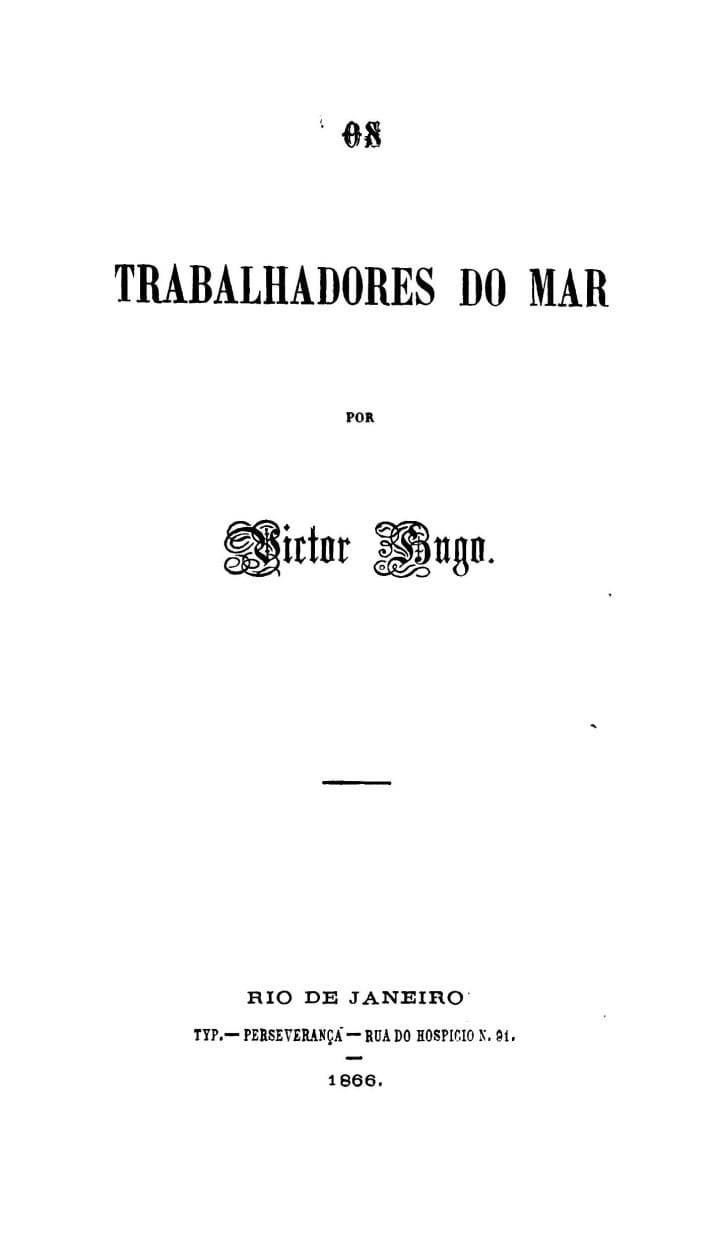
Os Trabalhadores Do Mar
1866
In the gray islands of the English Channel, where the sea never rests and the wind carries old superstitions, lives Gilliatt, a man the village has rejected, a fisherman who dwells in a house they call haunted. When a great steamship runs aground on the dangerous rocks near his shore, the community that has spurned him turns to no one else. To win the hand of Deruchette, the shipowner's daughter, Gilliatt must attempt what no diver has attempted before: descend into the shark-infested waters and free the propeller tangled in the rocks below. Hugo's forgotten masterpiece is a meditation on labor, isolation, and what it means to be deemed useless by the world. Written during his Guernsey exile, it pulses with the rhythm of the sea and the quiet dignity of a man who has nothing but his own hands. This is the story of how an outsider becomes indispensable, how the world that dismissed him must finally look at what he can do. For readers who believe that work is prayer, that love asks everything, and that the forgotten deserve their epic too.
Editions

X-Ray
“In joined hands there is still some token of hope, in the clinched fist none.””
— Victor Hugo
“Reality in strong doses frightens.””
— Victor Hugo
“As time rolls on, however, we discover that duty is a series of compromises; we contemplate life, regard its end, and submit; but it is a submission which makes the heart bleed.””
— Victor Hugo
“To have lied is to have suffered.””
— Victor Hugo
“Then overwhelmed by the sense of that unknown infinity, like one bewildered by a strange persecution, confronting the shadows of night, in the presence of that impenetrable darkness, in the midst of the murmur of the waves, the swell, the foam, the breeze, under the clouds, under that vast diffusion of force, under that mysterious firmament of wings, of stars, of gulfs, having around him and beneath him the ocean above him the constellations, under the great unfathomable deep, he sank, gave up the struggle, lay down upon the rock, his face towards the stars, humble, and uplifting his joined hands towards the terrible depths, he cried aloud, "Have mercy.””
— Victor Hugo
“One becomes gradually accustomed to poison.””
— Victor Hugo
“Let us not, however, exaggerate our power. Whatever man does, the great lines of creation persist; the supreme mass does not depend on man. He has power over the detail, not over the whole. And it is right that this should be so. The Whole is providential. Its laws pass over our head. What we do goes no farther than the surface. Man clothes or unclothes the earth; clearing a forest is like taking off a garment. But to slow down the rotation of the globe on its axis, to accelerate the course of the globe on its orbit, to add or subtract a fathom on he earth's daily journey of 718,000 leagues around the sun, to modify the precession of the equinoxes, to eliminate one drop of rain--never! What is on high remains on high. Man can change the climate, but not the seasons Just try and make the moon revolve anywhere but in the ecliptic!Dreamers, some of them illustrious, have dreamed of restoring perpetual spring to the earth. The extreme seasons, summer and winter, are produced by the excess of the inclination of the earth's axis over the place of the ecliptic of which we have just spoken. In order to eliminate the seasons it would be necessary only to straighten this axis. Nothing could be simpler. Just plant a stake on the Pole and drive it in to the center of the globe; attach a chain to it; find a base outside the earth; have 10 billion teams, each of 10 billion horses, and get them to pull. THe axis will straighten up, ad you will have your spring. As you can see, an easy task.We must look elsewhere for Eden. Spring is good; but freedom and justice are beter. Eden is moral, not material. To be free and just depends on ourselves.””
— Victor Hugo
“Man is at the mercy of events. Life is a perpetual succession of events, and we must submit to it. We never know from what quarter the sudden blow of chance will come. Catastrophe and good fortune come upon us and then depart, like unexpected visitors. They have their own laws, their own orbits, their own gravitational force, all independent of man.””
— Victor Hugo
“There, at a depth to which divers would find it difficult to descend, are caverns, haunts, and dusky mazes, where monstrous creatures multiply and destroy each other. Huge crabs devour fish and are devoured in their turn. Hideous shapes of living things, not created to be seen by human eyes wander in this twilight. Vague forms of antennae, tentacles, fins, open jaws, scales, and claws, float about there, quivering, growing larger, or decomposing and perishing in the gloom, while horrible swarms of swimming things prowl about seeking their prey.To gaze into the depths of the sea is, in the imagination, like beholding the vast unknown, and from its most terrible point of view. The submarine gulf is analogous to the realm of night and dreams. There also is sleep, unconsciousness, or at least apparent unconsciousness, of creation. There in the awful silence and darkness, the rude first forms of life, phantomlike, demoniacal, pursue their horrible instincts.””
— Victor Hugo
Link to this book
Add a free, dofollow link to Lex on your blog, forum, syllabus, or reading list.

<a href="https://lex-books.com/book/os-trabalhadores-do-mar-4869815d-43fd-4c08-8dec-c1a69dbd7f22"><img src="https://lex-books.com/badges/read-on-lex.svg" alt="Read Os Trabalhadores Do Mar by Victor Hugo free on Lex" width="160" height="40"></a>[](https://lex-books.com/book/os-trabalhadores-do-mar-4869815d-43fd-4c08-8dec-c1a69dbd7f22)[url=https://lex-books.com/book/os-trabalhadores-do-mar-4869815d-43fd-4c08-8dec-c1a69dbd7f22][img]https://lex-books.com/badges/read-on-lex.svg[/img][/url]Read Os Trabalhadores Do Mar by Victor Hugo free on Lex: https://lex-books.com/book/os-trabalhadores-do-mar-4869815d-43fd-4c08-8dec-c1a69dbd7f22Cite this book
Reading this edition for a paper or guide? Copy a citation.
Hugo, Victor. Os Trabalhadores Do Mar. Lex, lex-books.com/book/os-trabalhadores-do-mar-4869815d-43fd-4c08-8dec-c1a69dbd7f22.Hugo, V. (1866). Os Trabalhadores Do Mar. Lex. https://lex-books.com/book/os-trabalhadores-do-mar-4869815d-43fd-4c08-8dec-c1a69dbd7f22Hugo, Victor. Os Trabalhadores Do Mar. Lex. https://lex-books.com/book/os-trabalhadores-do-mar-4869815d-43fd-4c08-8dec-c1a69dbd7f22.