House Flies
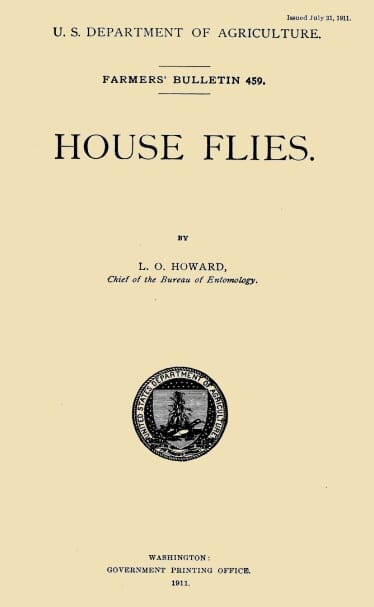
This 1910 USDA bulletin reads like a dispatch from the front lines of an invisible war. L. O. Howard, the era's foremost entomologist, knew what most people did not: the humble house fly was a serial killer. In an age when typhoid, cholera, and dysentery stalked American cities, Howard mapped the fly's entire life cycle with military precision, documenting how this ubiquitous insect transported lethal bacteria from cesspools to dinner tables. His writing crackles with the urgency of a man who understood that the mosquito's cousin was far more than a nuisance. The book ranges from fly anatomy to municipal sanitation codes, from breeding habitats to the first serious proposals for renaming an insect (Howard's infamous suggestion to call Musca domestica the "typhoid fly" was a masterclass in public health branding). For anyone curious about how we learned to fear the ordinary, this is a time capsule of American hygiene's heroic age.
Editions
Link to this book
Add a free, dofollow link to Lex on your blog, forum, syllabus, or reading list.

<a href="https://lex-books.com/book/house-flies-4226e38d-1abf-4c95-baab-d51628845621"><img src="https://lex-books.com/badges/read-on-lex.svg" alt="Read House Flies by L. O. Howard free on Lex" width="160" height="40"></a>[](https://lex-books.com/book/house-flies-4226e38d-1abf-4c95-baab-d51628845621)[url=https://lex-books.com/book/house-flies-4226e38d-1abf-4c95-baab-d51628845621][img]https://lex-books.com/badges/read-on-lex.svg[/img][/url]Read House Flies by L. O. Howard free on Lex: https://lex-books.com/book/house-flies-4226e38d-1abf-4c95-baab-d51628845621Cite this book
Reading this edition for a paper or guide? Copy a citation.
Howard, L. O.. House Flies. Lex, lex-books.com/book/house-flies-4226e38d-1abf-4c95-baab-d51628845621.Howard, L. O. (n.d.). House Flies. Lex. https://lex-books.com/book/house-flies-4226e38d-1abf-4c95-baab-d51628845621Howard, L. O.. House Flies. Lex. https://lex-books.com/book/house-flies-4226e38d-1abf-4c95-baab-d51628845621.