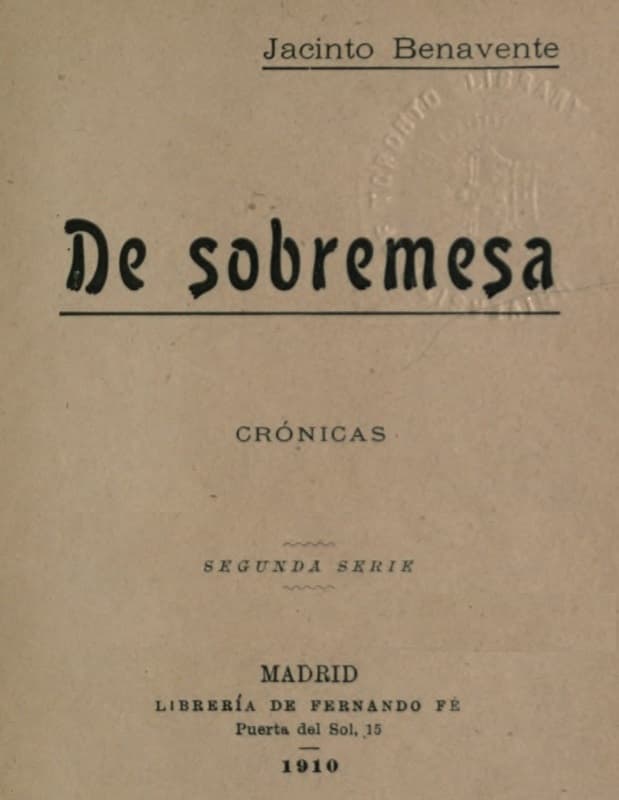
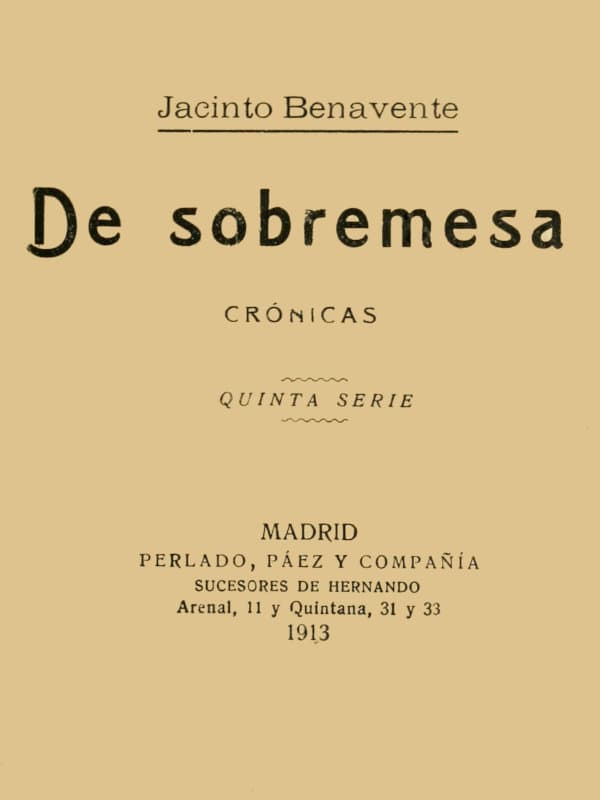
De Sobremesa; Crónicas, Cuarta Parte (de 5)
1913
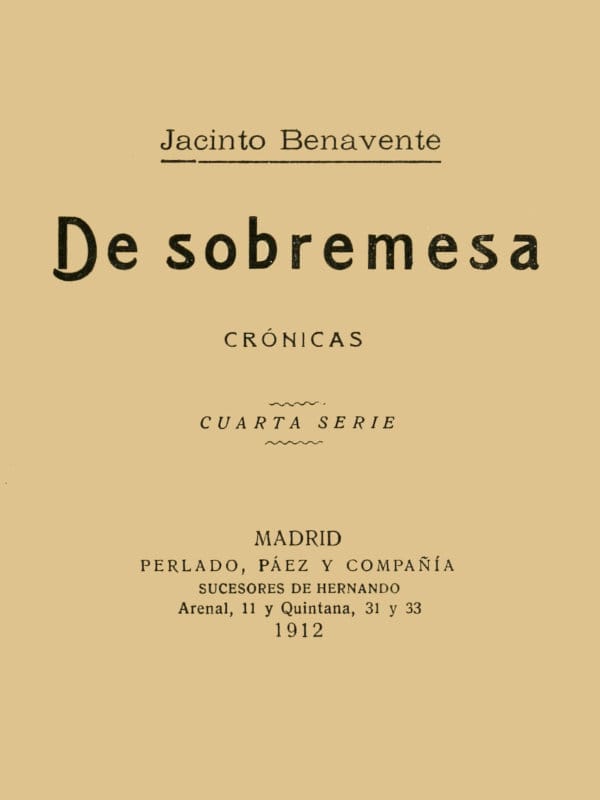
Jacinto Benavente, the 1922 Nobel laureate in literature, turns his razor-sharp eye onto early twentieth-century Spain in these chronicles. The book opens with a tribute to playwright Gregorio Martínez Sierra's comedy "Canción de cuna" but quickly reveals Benavente's true preoccupation: the distinction between genuine artistic achievement and the illusion of sudden success. What follows is a vibrant dispatch from the intellectual and theatrical world of Madrid, where Benavente mixes personal anecdote with pointed social commentary. He skewers the politicization of culture (noting wryly how even the discovery of a supposed Cervantes portrait becomes a political program and quasi-Catholic dogma), critiques the theatrical landscape, and offers sharp observations on women and Spanish society. The tone is reflective yet frequently lethal, with humor deployed as a precision instrument. These chronicles capture a Spain in transformation, caught between tradition and modernity, with Benavente serving as an exacting, often unsparing witness to the human comedy playing out across art, morality, and public life.
Editions
Link to this book
Add a free, dofollow link to Lex on your blog, forum, syllabus, or reading list.

<a href="https://lex-books.com/book/de-sobremesa-cr-nicas-cuarta-parte-de-5-b200a917-f969-42f3-8d19-2338bb0cd75f"><img src="https://lex-books.com/badges/read-on-lex.svg" alt="Read De Sobremesa; Crónicas, Cuarta Parte (de 5) by Jacinto Benavente free on Lex" width="160" height="40"></a>[](https://lex-books.com/book/de-sobremesa-cr-nicas-cuarta-parte-de-5-b200a917-f969-42f3-8d19-2338bb0cd75f)[url=https://lex-books.com/book/de-sobremesa-cr-nicas-cuarta-parte-de-5-b200a917-f969-42f3-8d19-2338bb0cd75f][img]https://lex-books.com/badges/read-on-lex.svg[/img][/url]Read De Sobremesa; Crónicas, Cuarta Parte (de 5) by Jacinto Benavente free on Lex: https://lex-books.com/book/de-sobremesa-cr-nicas-cuarta-parte-de-5-b200a917-f969-42f3-8d19-2338bb0cd75fCite this book
Reading this edition for a paper or guide? Copy a citation.
Benavente, Jacinto. De Sobremesa; Crónicas, Cuarta Parte (de 5). Lex, lex-books.com/book/de-sobremesa-cr-nicas-cuarta-parte-de-5-b200a917-f969-42f3-8d19-2338bb0cd75f.Benavente, J. (1913). De Sobremesa; Crónicas, Cuarta Parte (de 5). Lex. https://lex-books.com/book/de-sobremesa-cr-nicas-cuarta-parte-de-5-b200a917-f969-42f3-8d19-2338bb0cd75fBenavente, Jacinto. De Sobremesa; Crónicas, Cuarta Parte (de 5). Lex. https://lex-books.com/book/de-sobremesa-cr-nicas-cuarta-parte-de-5-b200a917-f969-42f3-8d19-2338bb0cd75f.