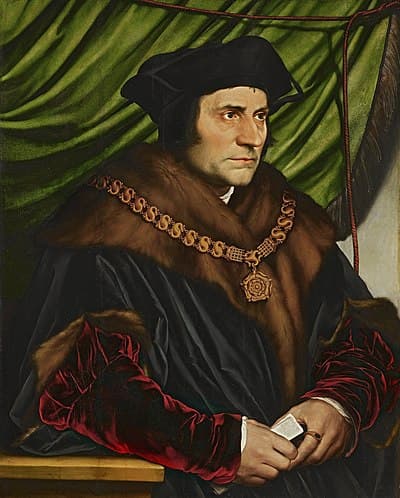
Thomas, Saint More
Saint Thomas More was an English lawyer, statesman, and humanist, best known for his work as a writer and his steadfast moral integrity. Born in London in 1478, he was educated at Oxford and became a prominent figure in the court of King Henry VIII. More's most famous work, "Utopia," published in 1516, presented a visionary society on an imaginary island, critiquing contemporary European society and exploring themes of justice, governance, and human nature. This seminal text not only established him as a leading humanist thinker but also influenced political philosophy for centuries to come. More's life took a dramatic turn when he opposed Henry VIII's separation from the Catholic Church and the establishment of the Church of England. His refusal to endorse the King's divorce and subsequent marriage to Anne Boleyn led to his arrest and execution in 1535. More's martyrdom for his beliefs solidified his legacy as a symbol of integrity and conviction in the face of tyranny. He was canonized as a saint by the Catholic Church in 1935, and his writings continue to be studied for their insights into ethics, governance, and the human condition, marking him as a pivotal figure in the Renaissance and Reformation periods.
Famous Quotes
View all 9 quotes“That the saints may enjoy their beatitude and the grace of God more abundantly they are permitted to see the punishment of the damned in hell.””
“The times are never so bad but that a good man can live in them.””
“Sir Thomas More (7 February 1478 – 6 July 1535), also known as Saint Thomas More, was an English lawyer, author, and statesman. During his lifetime he earned a reputation as a leading humanist scholar and occupied many public offices, including that of Lord Chancellor from 1529 to 1532. More coined the word "utopia", a name he gave to an ideal, imaginary island nation whose political system he described in a book published in 1516. He is chiefly remembered for his principled refusal to accept King Henry VIII's claim to be supreme head of the Church of England, a decision which ended his political career and led to his execution as a traitor. In 1935, four hundred years after his death, More was canonized in the Catholic Church by Pope Pius XI, and was later declared the patron saint of lawyers and statesmen. He shares his feast day, June 22 on the Catholic calendar of saints, with Saint John Fisher, the only Bishop during the English Reformation to maintain his allegiance to the Pope. More was added to the Anglican Churches' calendar of saints in 1980. Source: Wikipedia””
Books from the author



Link to this page
Add a free, dofollow link to Lex on your blog, forum, syllabus, or reading list.

<a href="https://lex-books.com/author/thomas-saint-more"><img src="https://lex-books.com/badges/read-on-lex.svg" alt="Thomas, Saint More on Lex" width="160" height="40"></a>[](https://lex-books.com/author/thomas-saint-more)[url=https://lex-books.com/author/thomas-saint-more][img]https://lex-books.com/badges/read-on-lex.svg[/img][/url]Thomas, Saint More on Lex: https://lex-books.com/author/thomas-saint-more