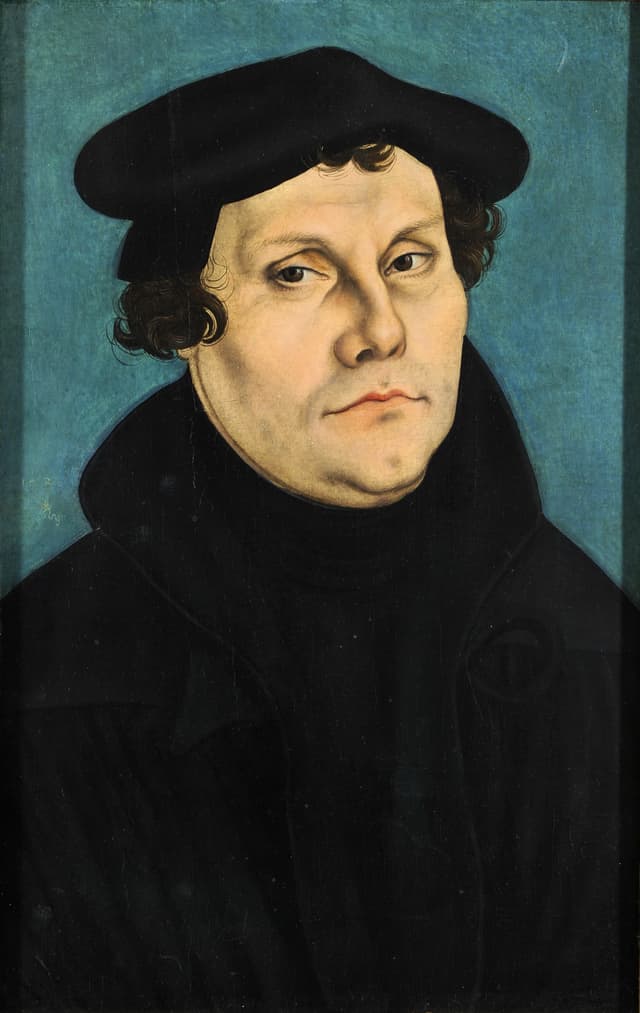
Martin Luther
Martin Luther was a German priest, theologian, and professor who played a pivotal role in the Protestant Reformation. Born in Eisleben, he was ordained in 1507 and soon began to question the practices of the Roman Catholic Church, particularly the sale of indulgences and the authority of the papacy. His 1517 work, the Ninety-five Theses, sparked a monumental debate that would lead to his excommunication by Pope Leo X in 1521 and condemnation as an outlaw by Holy Roman Emperor Charles V at the Diet of Worms. Luther's teachings emphasized salvation through faith alone, the priesthood of all believers, and the Bible as the sole source of divine revelation, fundamentally challenging the established church hierarchy and practices of his time. Luther's theological contributions laid the groundwork for Lutheranism and significantly influenced the course of Western Christianity. His insistence on justification by faith and the necessity of good works as a manifestation of living faith reshaped Christian doctrine and practice. Luther's legacy endures not only in the millions of Lutherans worldwide but also in the broader context of Christian thought, where his ideas continue to provoke discussion and reflection on faith, authority, and the nature of salvation.
Famous Quotes
View all 19 quotes“Darkness cannot drive out darkness: only light can do that. Hate cannot drive out hate: only love can do that.””
“I have decided to stick to love...Hate is too great a burden to bear.””
“Our lives begin to end the day we become silent about things that matter.””
Books from the author


Link to this page
Add a free, dofollow link to Lex on your blog, forum, syllabus, or reading list.

<a href="https://lex-books.com/author/martin-luther"><img src="https://lex-books.com/badges/read-on-lex.svg" alt="Martin Luther on Lex" width="160" height="40"></a>[](https://lex-books.com/author/martin-luther)[url=https://lex-books.com/author/martin-luther][img]https://lex-books.com/badges/read-on-lex.svg[/img][/url]Martin Luther on Lex: https://lex-books.com/author/martin-luther