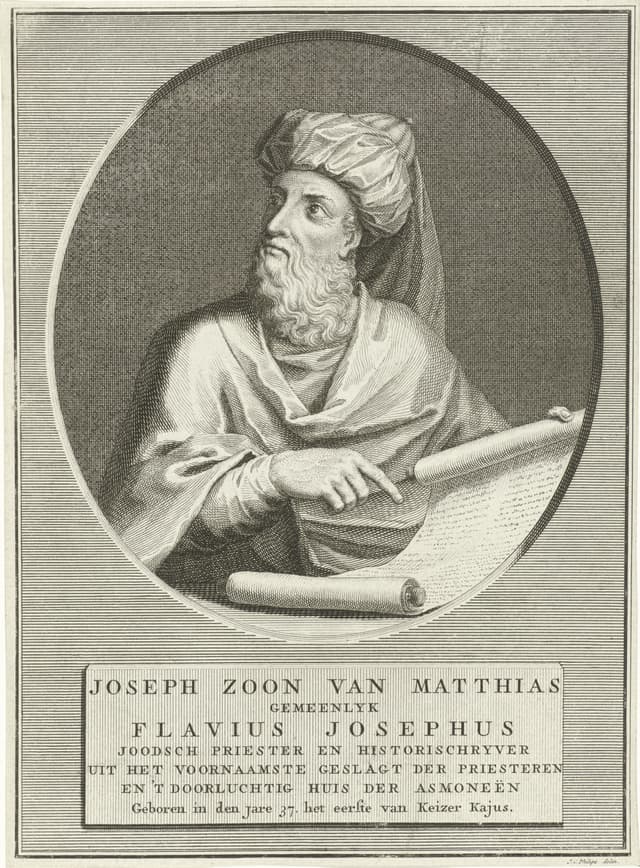
Flavius Josephus
Flavius Josephus was a Roman-Jewish historian and military leader, born in Jerusalem to a family of priestly descent. Initially a general for the Jewish forces during the First Jewish-Roman War, he fought valiantly against the Roman Empire until his surrender in AD 67 after the siege of Yodfat. Following his capture, Josephus claimed that Jewish prophecies foretold the rise of Vespasian as emperor, which led to his decision to align himself with the Romans. Freed by Vespasian in AD 69, he adopted the name Flavius and became a Roman citizen, ultimately serving as an advisor and translator for Vespasian's son, Titus, during the siege of Jerusalem in AD 70, a pivotal event that culminated in the destruction of the Second Temple. Josephus is best known for his historical writings, particularly 'The Jewish War,' which provides a detailed account of the Jewish revolt against Rome and offers invaluable insights into Jewish history and culture during this tumultuous period. His other significant work, 'Antiquities of the Jews,' chronicles the history of the Jewish people from creation to the Jewish War, aiming to present Judaism in a favorable light to a Greco-Roman audience. Josephus's writings are crucial for understanding the context of early Christianity and the Jewish diaspora, marking him as a significant figure in both Jewish and Roman history. His legacy endures through his contributions to historical scholarship, providing a bridge between Jewish and Roman narratives.
Famous Quotes
View all 16 quotes“Truth is a thing that is immortal and eternal.””
“But when he saw that Adam had no female companion, no society, for there was no such created, and that he wondered at the other animals which were male and female, he laid him asleep, and took away one of his ribs, and out of it formed the woman; whereupon Adam knew her when she was brought to him, and acknowledged that she was made out of himself. Now a woman is called in the Hebrew tongue Issa; but the name of this woman was Eve, which signifies the mother of all living.””
“He says further, that, “the people of Jerusalem came accordingly upon the Egyptians, and overthrew their cities, and burnt their temples, and slew their horsemen, and, in short, abstained from no sort of wickedness nor barbarity; and for that priest who settled their polity and their laws,” he says, “he was by birth of Hellopolis, and his name was Osarsiph, from Osyris the god of Hellopolis, but that he changed his name, and called himself Moses.””
Books from the author



Link to this page
Add a free, dofollow link to Lex on your blog, forum, syllabus, or reading list.

<a href="https://lex-books.com/author/flavius-josephus"><img src="https://lex-books.com/badges/read-on-lex.svg" alt="Flavius Josephus on Lex" width="160" height="40"></a>[](https://lex-books.com/author/flavius-josephus)[url=https://lex-books.com/author/flavius-josephus][img]https://lex-books.com/badges/read-on-lex.svg[/img][/url]Flavius Josephus on Lex: https://lex-books.com/author/flavius-josephus