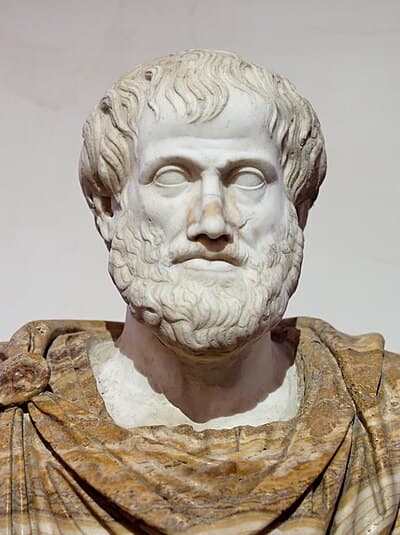
Aristotle
Aristotle was an ancient Greek philosopher and polymath whose extensive writings laid the foundation for numerous fields of study, including natural sciences, philosophy, and the arts. A student of Plato, he later founded his own school, the Lyceum in Athens, where he developed the Peripatetic school of thought. His works, such as 'Nicomachean Ethics', 'Politics', and 'Metaphysics', explored a wide array of topics, from ethics and governance to metaphysics and biology, establishing a comprehensive framework that influenced both ancient and modern thought. Aristotle's significance lies not only in his vast contributions to various disciplines but also in his method of systematic observation and classification, which paved the way for the scientific method. His ideas on logic, particularly through the development of syllogism, have had a lasting impact on Western philosophy and science. The Aristotelian tradition has continued to shape intellectual discourse for centuries, making him one of the most influential figures in Western history, whose legacy endures in contemporary philosophy, science, and education.
Famous Quotes
View all 11 quotes“Knowing yourself is the beginning of all wisdom.””
“What is a friend? A single soul dwelling in two bodies.””
“Educating the mind without educating the heart is no education at all.””
Books from the author





Link to this page
Add a free, dofollow link to Lex on your blog, forum, syllabus, or reading list.

<a href="https://lex-books.com/author/aristotle"><img src="https://lex-books.com/badges/read-on-lex.svg" alt="Aristotle on Lex" width="160" height="40"></a>[](https://lex-books.com/author/aristotle)[url=https://lex-books.com/author/aristotle][img]https://lex-books.com/badges/read-on-lex.svg[/img][/url]Aristotle on Lex: https://lex-books.com/author/aristotle