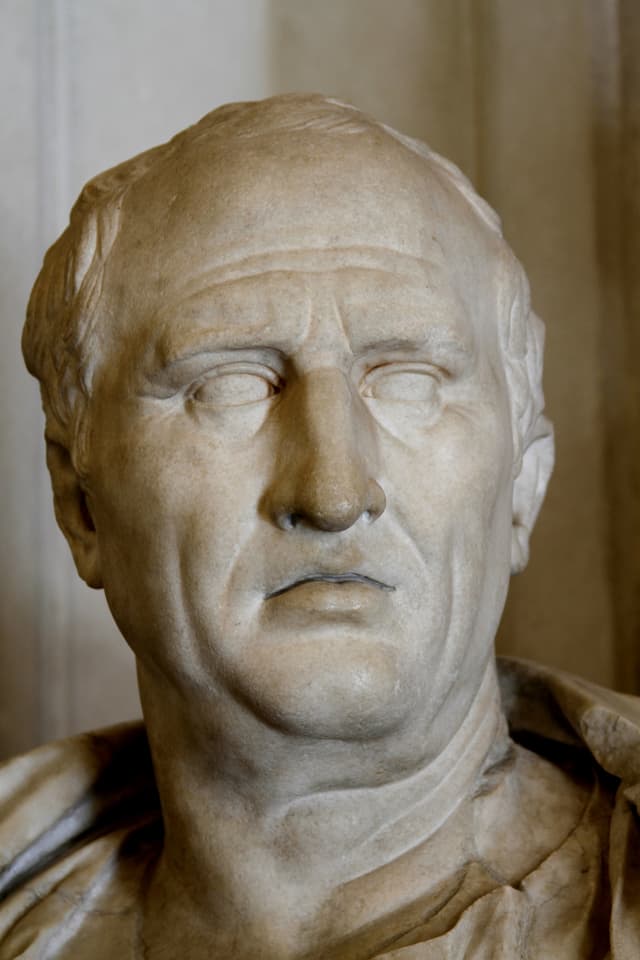
Marcus Tullius Cicero
Marcus Tullius Cicero was a prominent Roman statesman, lawyer, and philosopher whose influence extended far beyond his lifetime. Born into a wealthy equestrian family, he received a comprehensive education in Rome and Greece, which laid the foundation for his exceptional skills in oratory and writing. Cicero's political career was marked by his staunch defense of the Republic during a tumultuous period that ultimately led to the rise of the Roman Empire. As consul in 63 BC, he famously exposed the Catiline Conspiracy, showcasing his commitment to the principles of the optimate faction, which sought to preserve the traditional republican governance of Rome. Cicero's literary legacy is vast, encompassing treatises on rhetoric, philosophy, and politics that have shaped Western thought. His works, including "De Oratore," "Philippics," and "Tusculan Disputations," exemplify his mastery of prose and rhetoric, establishing what is now known as Ciceronian rhetoric. His philosophical writings introduced Greek philosophical concepts to Roman audiences, making him a pivotal figure in the transmission of ideas between cultures. Cicero's ability to blend eloquence with intellectual depth has earned him a lasting reputation as one of Rome's greatest orators and prose stylists, influencing generations of writers and thinkers throughout history.
Famous Quotes
View all 20 quotes“A room without books is like a body without a soul.””
“Six mistakes mankind keeps making century after century:Believing that personal gain is made by crushing others;Worrying about things that cannot be changed or corrected;Insisting that a thing is impossible because we cannot accomplish it;Refusing to set aside trivial preferences;Neglecting development and refinement of the mind;Attempting to compel others to believe and live as we do.””
“To be ignorant of what occurred before you were born is to remain always a child. For what is the worth of human life, unless it is woven into the life of our ancestors by the records of history?””
Books from the author




Link to this page
Add a free, dofollow link to Lex on your blog, forum, syllabus, or reading list.

<a href="https://lex-books.com/author/marcus-tullius-cicero"><img src="https://lex-books.com/badges/read-on-lex.svg" alt="Marcus Tullius Cicero on Lex" width="160" height="40"></a>[](https://lex-books.com/author/marcus-tullius-cicero)[url=https://lex-books.com/author/marcus-tullius-cicero][img]https://lex-books.com/badges/read-on-lex.svg[/img][/url]Marcus Tullius Cicero on Lex: https://lex-books.com/author/marcus-tullius-cicero