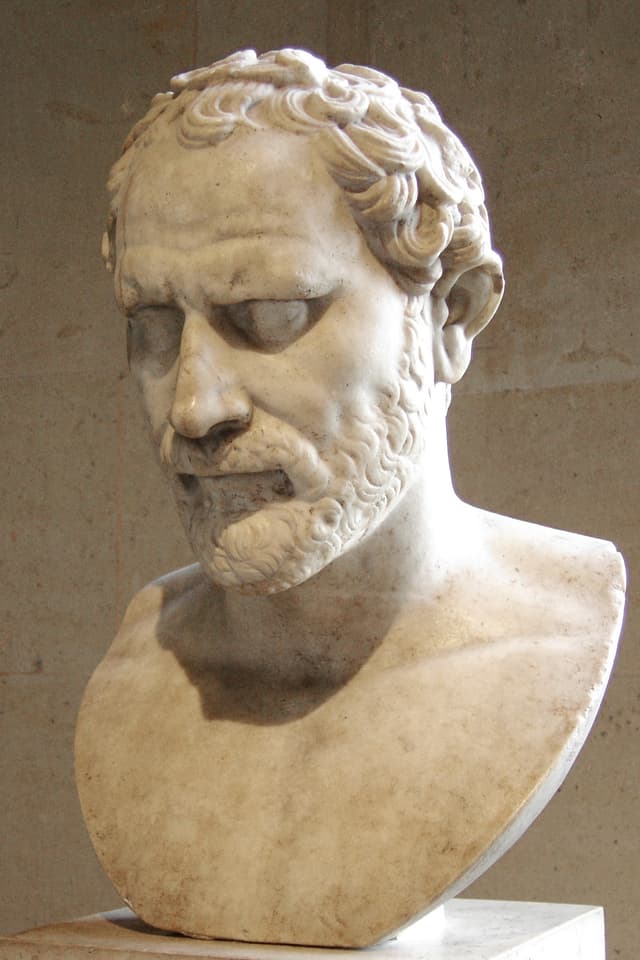
Demosthenes
Demosthenes was a prominent Athenian orator and statesman, widely regarded as one of the greatest speakers of ancient Greece. Born in 385 BC, he faced significant challenges in his early life, including a speech impediment and the loss of his father at a young age. Despite these obstacles, he dedicated himself to the art of rhetoric, famously practicing by speaking with pebbles in his mouth and delivering speeches by the seashore to overcome his difficulties. His commitment to oratory and public speaking led him to become a key figure in Athenian politics, particularly during a time of rising Macedonian power under Philip II and later his son, Alexander the Great. Demosthenes is best known for his powerful speeches, particularly the "Philippics," a series of orations that vehemently opposed Philip II's expansionist policies and called for Athenian unity against Macedonian domination. His eloquence and persuasive techniques not only galvanized Athenian citizens but also set a standard for oratory that influenced generations of speakers and writers. His legacy endures as a symbol of civic engagement and resistance against tyranny, and his works remain a cornerstone of rhetorical study, showcasing the art of persuasion and the importance of public discourse in democratic societies.
Famous Quotes
View all 9 quotes“Nothing is easier than self-deceit.For what every man wishes,that he also believes to be true.””
“Small opportunities are often the beginning of great enterprises.””
“Since we are not yet fully comfortable with the idea that people from the next village are as human as ourselves, it is presumptuous in the extreme to suppose we could ever look at sociable, tool-making creatures who are from other evolutionary paths and see not beasts, but brothers, not rivals, but fellow pilgrims journeying to the shrine of intelligence...The difference... is not in the creature judged, but in the creature judging.””
Books from the author






Link to this page
Add a free, dofollow link to Lex on your blog, forum, syllabus, or reading list.

<a href="https://lex-books.com/author/demosthenes"><img src="https://lex-books.com/badges/read-on-lex.svg" alt="Demosthenes on Lex" width="160" height="40"></a>[](https://lex-books.com/author/demosthenes)[url=https://lex-books.com/author/demosthenes][img]https://lex-books.com/badges/read-on-lex.svg[/img][/url]Demosthenes on Lex: https://lex-books.com/author/demosthenes