On the Future of Our Educational Institutions
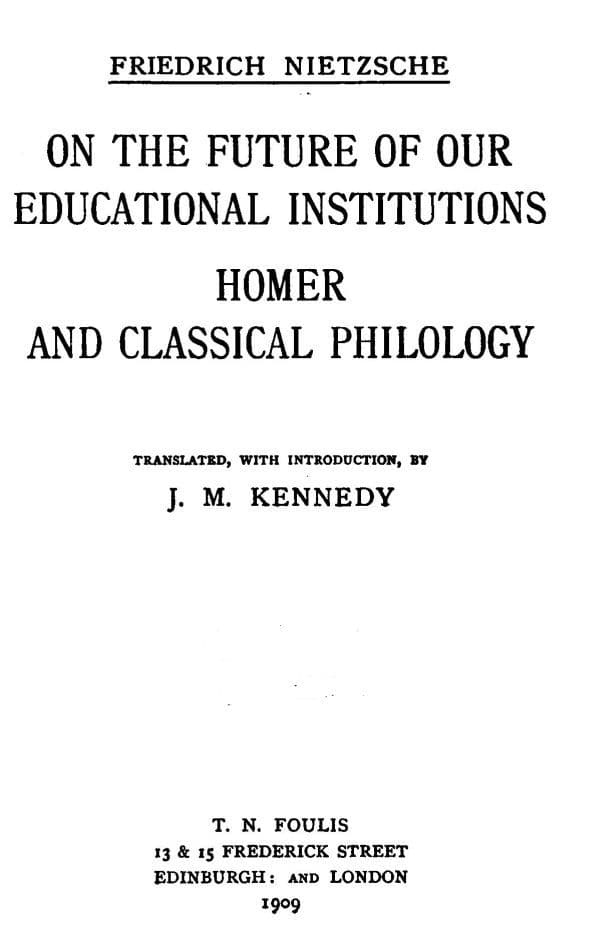
On the Future of Our Educational Institutions
Translated by J. M. (John McFarland) Kennedy
Nietzsche was never interested in making readers comfortable, and this blistering attack on 19th-century German education proves it. Written as a dialogue between a philosopher and his companion, the text dismantles the era's obsession with educational expansion, arguing that flooding the world with half-educated people who merely possess "knowledge" but lack genuine culture serves no one. He saves his sharpest contempt for education bent toward utility and conformity, seeing it as a betrayal of what learning should truly be: the difficult cultivation of exceptional individuals capable of thinking for themselves. The format is deceptive. What begins as casual conversation quickly reveals itself as one of Nietzsche's most passionate critiques, a contrast between the expansion and mediocrity of contemporary methods and his vision of education as a force for cultural transformation. He argues that true learning transcends mere vocational training, that the deepest needs of humanity require a renaissance in educational thought. The provocation remains: perhaps education should be difficult, perhaps not everyone deserves a credential, perhaps making learning easy has made it worthless. For readers willing to challenge their assumptions about merit, culture, and what education is actually for.
Editions
Link to this book
Add a free, dofollow link to Lex on your blog, forum, syllabus, or reading list.

<a href="https://lex-books.com/book/on-the-future-of-our-educational-institutions-521eb4dc-ad63-4e2b-8520-3ae90538205f"><img src="https://lex-books.com/badges/read-on-lex.svg" alt="Read On the Future of Our Educational Institutions by Friedrich Wilhelm Nietzsche free on Lex" width="160" height="40"></a>[](https://lex-books.com/book/on-the-future-of-our-educational-institutions-521eb4dc-ad63-4e2b-8520-3ae90538205f)[url=https://lex-books.com/book/on-the-future-of-our-educational-institutions-521eb4dc-ad63-4e2b-8520-3ae90538205f][img]https://lex-books.com/badges/read-on-lex.svg[/img][/url]Read On the Future of Our Educational Institutions by Friedrich Wilhelm Nietzsche free on Lex: https://lex-books.com/book/on-the-future-of-our-educational-institutions-521eb4dc-ad63-4e2b-8520-3ae90538205fCite this book
Reading this edition for a paper or guide? Copy a citation.
Nietzsche, Friedrich Wilhelm. On the Future of Our Educational Institutions. Lex, lex-books.com/book/on-the-future-of-our-educational-institutions-521eb4dc-ad63-4e2b-8520-3ae90538205f.Nietzsche, F. W. (n.d.). On the Future of Our Educational Institutions. Lex. https://lex-books.com/book/on-the-future-of-our-educational-institutions-521eb4dc-ad63-4e2b-8520-3ae90538205fNietzsche, Friedrich Wilhelm. On the Future of Our Educational Institutions. Lex. https://lex-books.com/book/on-the-future-of-our-educational-institutions-521eb4dc-ad63-4e2b-8520-3ae90538205f.