O Napoleão De Notting Hill
1904
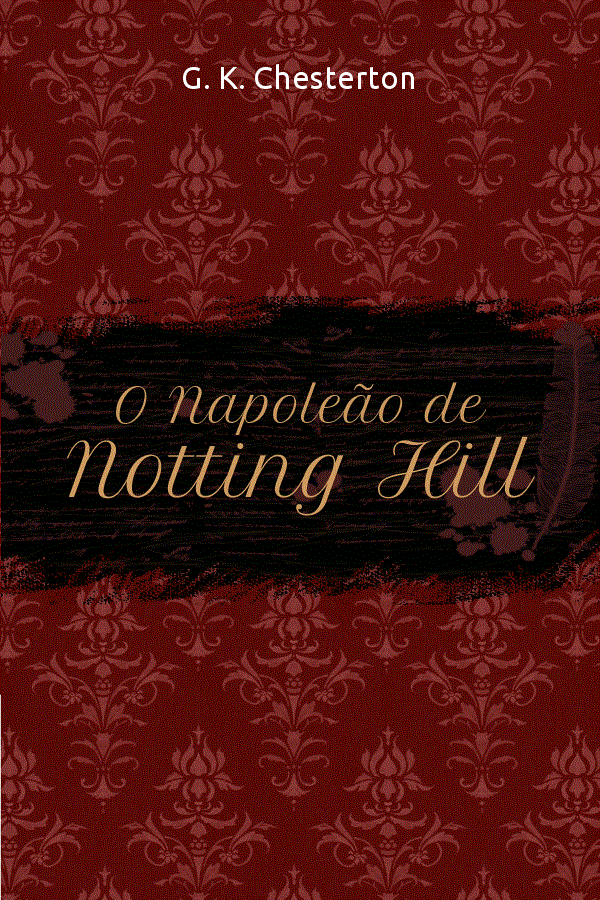
O Napoleão De Notting Hill
1904
Published in 1904, 'O Napoleão De Notting Hill' is G. K. Chesterton's first novel, set in a fantastical, semi-dystopian London. The story follows Auberon Quin, a whimsical clerk who becomes head of state and transforms the city into a medieval carnival, challenging societal norms and governance. Through humor and absurdity, the novel critiques the disillusionment of a society burdened by bureaucracy and capitalism. It is notable for its imaginative exploration of individuality and local pride, and has been recognized as one of the best first novels of the twentieth century.
Editions
X-Ray
“There is a law written in the darkest of the Books of Life, and it is this: If you look at a thing nine hundred and ninety-nine times, you are perfectly safe; if you look at it the thousandth time, you are in frightful danger of seeing it for the first time.””
— G. K. Chesterton
“The human race, to which so many of my readers belong, has been playing at children's games from the beginning, and will probably do it till the end, which is a nuisance for the few people who grow up. And one of the games to which it is most attached is called "Keep to-morrow dark," and which is also named (by the rustics in Shropshire, I have no doubt) "Cheat the Prophet." The players listen very carefully and respectfully to all that the clever men have to say about what is to happen in the next generation. The players then wait until all the clever men are dead, and bury them nicely. They then go and do something else. That is all. For a race of simple tastes, however, it is great fun.””
— G. K. Chesterton
“Individually, men may present a more or less rational appearance, eating, sleeping, and scheming. But humanity as a whole is changeful, mystical, fickle, delightful. Men are men, but Man is a woman.””
— G. K. Chesterton
“Adventures happen on dull days, and not on sunny ones. When the chord of monotony is stretched most tight, then it breaks with a sound like song.””
— G. K. Chesterton
“Be careful how you suggest things to me. For there is in me a madness which goes beyond martyrdom, the madness of an utterly idle man.””
— G. K. Chesterton
“To each man one soul only is given; to each soul only is given a little power - the power at some moments to outgrow and swallow up the stars.””
— G. K. Chesterton
“He is a man, I think," he said, "who cares for nothing but a joke. He is a dangerous man."Lambert laughed in the act of lifting some macaroni to his mouth."Dangerous!" he said. "You don't know little Quin, sir!""Every man is dangerous," said the old man, without moving, "Who cares only for one thing. I was once dangerous myself.””
— G. K. Chesterton
“Many clever men like you have trusted to civilization. Many clever Babylonians, many clever Egyptians, many clever men at the end of Rome. Can you tell me, in a world that is flagrant with the failures of civilisation, what there is particularly immortal about yours?””
— G. K. Chesterton
“Adam Wayne, the conqueror, with his face flung back and his mane like a lion's, stood with his great sword point upwards, the red raiment of his office flapping around him like the red wings of an archangel. And the King saw, he knew not how, something new and overwhelming. The great green trees and the great red robes swung together in the wind. The preposterous masquerade, born of his own mockery, towered over him and embraced the world. This was the normal, this was sanity, this was nature, and he himself, with his rationality, and his detachment and his black frock-coat, he was the exception and the accident - a blot of black upon a world of crimson and gold.””
— G. K. Chesterton
Link to this book
Add a free, dofollow link to Lex on your blog, forum, syllabus, or reading list.

<a href="https://lex-books.com/book/o-napole-o-de-notting-hill-f0330cdf-b053-4bfb-b0ce-dd9033a706d7"><img src="https://lex-books.com/badges/read-on-lex.svg" alt="Read O Napoleão De Notting Hill by G. K. Chesterton free on Lex" width="160" height="40"></a>[](https://lex-books.com/book/o-napole-o-de-notting-hill-f0330cdf-b053-4bfb-b0ce-dd9033a706d7)[url=https://lex-books.com/book/o-napole-o-de-notting-hill-f0330cdf-b053-4bfb-b0ce-dd9033a706d7][img]https://lex-books.com/badges/read-on-lex.svg[/img][/url]Read O Napoleão De Notting Hill by G. K. Chesterton free on Lex: https://lex-books.com/book/o-napole-o-de-notting-hill-f0330cdf-b053-4bfb-b0ce-dd9033a706d7Cite this book
Reading this edition for a paper or guide? Copy a citation.
Chesterton, G. K.. O Napoleão De Notting Hill. Lex, lex-books.com/book/o-napole-o-de-notting-hill-f0330cdf-b053-4bfb-b0ce-dd9033a706d7.Chesterton, G. K. (1904). O Napoleão De Notting Hill. Lex. https://lex-books.com/book/o-napole-o-de-notting-hill-f0330cdf-b053-4bfb-b0ce-dd9033a706d7Chesterton, G. K.. O Napoleão De Notting Hill. Lex. https://lex-books.com/book/o-napole-o-de-notting-hill-f0330cdf-b053-4bfb-b0ce-dd9033a706d7.