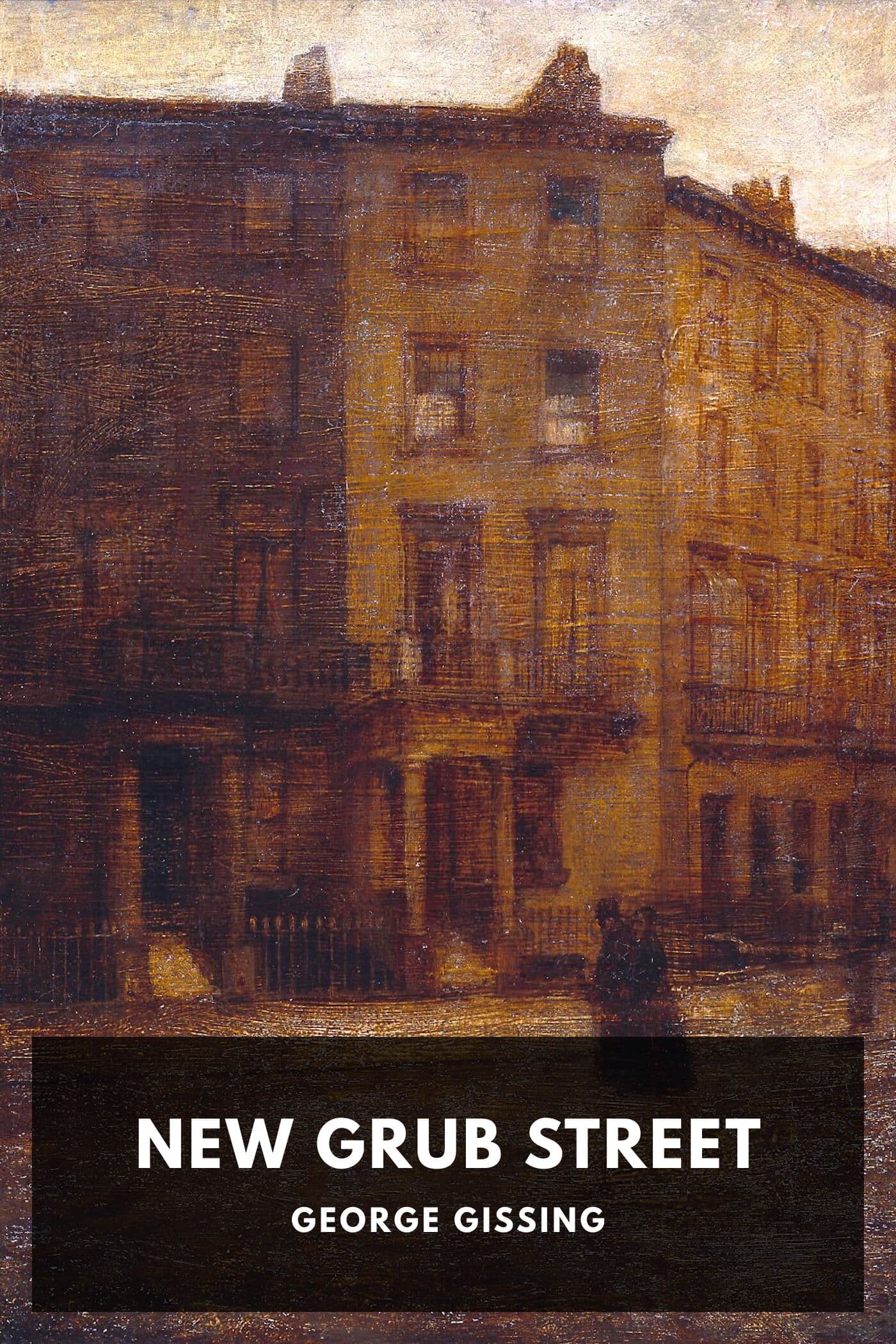
New Grub Street
In the literary slums of 1880s London, two writers face a question no artist wants to answer: create meaningful work, or eat today? Edwin Reardon has principles. His novel is good, his critical reputation solid, but his bank account is empty. His wife Amy measures his worth in guineas he cannot earn. Meanwhile, Jasper Milvain, the man Edwin once called a friend, understands the game. He'll write what sells, flatter whom he must, and sleep soundly in a warm bed. As both men descend into the grinding poverty and petty cruelties of Grub Street, Gissing charts the slow murder of idealism with the precision of an autopsy. The novel drips with dark irony: writers who cannot afford to write, critics who review spitefully because they're paid to, marriages that collapse under the weight of a shillings. This is no nostalgic period piece. The battle between art and commerce, between integrity and survival, has only grown uglier since Gissing wrote it from his own garret.
Editions

X-Ray
“Well, I wasn't going to abuse him. I was only going to ask: Is there any quality which distinguishes his work from that of twenty struggling writers one could name? Of course not. He's a clever, prolific man; so are they. But he began with money and friends; he came from Oxford into the thick of advertised people; his name was mentioned in print six times a week before he had written a dozen articles. This kind of thing will become the rule. Men won't succeed in literature that they may get into society, but will get into society that they may succeed in literature.””
— George Gissing
“To the relatively poor (who are so much worse off than the poor absolutely) education is in most cases a mocking cruelty.””
— George Gissing
“Poverty will make the best people bad, if it gets hard enough. Why there’s so much of it in the world, I’m sure I can’t see.””
— George Gissing
“But the loneliness of her life had developed in her a sensitiveness which could not endure situations such as the present; difficulties which are of small account to people who take their part in active social life, harassed her to the destruction of all peace.””
— George Gissing
“Poverty can’t rob me of those memories. I have lived in an ideal world that was not deceitful, a world which seems to me, when I recall it, beyond the human sphere, bathed in diviner light.””
— George Gissing
“My aim is to have easy command of all the pleasures desired by a cultivated man. I want to live among beautiful things, and never to be troubled by a thought of vulgar difficulties. I want to travel and enrich my mind in foreign countries. I want to associate on equal terms with refined and interesting people. I want to be known, to be familiarly referred to, to feel when I enter a room that people regard me with some curiosity.””
— George Gissing
“But just understand the difference between a man like Reardon and a man like me. He is the old type of unpractical artist; I am the literary man of 1882. He won't make concessions, or rather, he can't make them; he can't supply the market. I--well, you may say that at present, I do nothing; but that's a great mistake, I am learning my business. Literature nowadays is a trade. Putting aside men of genius, who may succeed by mere cosmic force, your successful man of letters is your skilful tradesman. He thinks first and foremost of the markets; when one kind of goods begins to go off slackly, he is ready with something new and appetising. He knows perfectly all the possible sources of income. Whatever he has to sell, he'll get payment for it from all sorts of various quarters; none of your unpractical selling for a lump sum to a middleman who will make six distinct profits.””
— George Gissing
“A few days ago her startled eye had caught an advertisement in the newspaper, headed 'Literary Machine'; had it then been invented at last, some automaton to supply the place of such poor creatures as herself to turn out books and articles? Alas! the machine was only one for holding volumes conveniently, that the work of literary manufacture might be physically lightened. But surely before long some Edison would make the true automaton; the problem must be comparatively such a simple one. Only to throw in a given number of old books, and have them reduced, blended, modernised into a single one for to-day's consumption.””
— George Gissing
“Confound it! It's just because nobody does anything that things have come to this pass!””
— George Gissing
Link to this book
Add a free, dofollow link to Lex on your blog, forum, syllabus, or reading list.

<a href="https://lex-books.com/book/new-grub-street-0048b215-9cb0-473a-820a-ce7963cd2bec"><img src="https://lex-books.com/badges/read-on-lex.svg" alt="Read New Grub Street by George Gissing free on Lex" width="160" height="40"></a>[](https://lex-books.com/book/new-grub-street-0048b215-9cb0-473a-820a-ce7963cd2bec)[url=https://lex-books.com/book/new-grub-street-0048b215-9cb0-473a-820a-ce7963cd2bec][img]https://lex-books.com/badges/read-on-lex.svg[/img][/url]Read New Grub Street by George Gissing free on Lex: https://lex-books.com/book/new-grub-street-0048b215-9cb0-473a-820a-ce7963cd2becCite this book
Reading this edition for a paper or guide? Copy a citation.
Gissing, George. New Grub Street. Lex, lex-books.com/book/new-grub-street-0048b215-9cb0-473a-820a-ce7963cd2bec.Gissing, G. (n.d.). New Grub Street. Lex. https://lex-books.com/book/new-grub-street-0048b215-9cb0-473a-820a-ce7963cd2becGissing, George. New Grub Street. Lex. https://lex-books.com/book/new-grub-street-0048b215-9cb0-473a-820a-ce7963cd2bec.