
Etienne Dolet
Étienne Dolet was a prominent French scholar, translator, and printer who emerged during the tumultuous period of the Renaissance. Known for his fervent advocacy of free expression, Dolet's early career was marked by his outspoken criticism of the French Inquisition and local authorities in Toulouse. His controversial writings and translations, particularly those published in Lyon, drew the ire of the Inquisition, leading to his being closely monitored and ultimately imprisoned multiple times. Despite the dangers, he continued to champion intellectual freedom, which culminated in his conviction for heresy by the parlement of Paris and the Sorbonne. In a tragic end, he was executed by hanging and burning alongside his works on the Place Maubert in Paris. Dolet's legacy endures as a symbol of the struggle for freedom of speech and the press. His life and death highlighted the tensions between emerging humanist thought and the oppressive forces of censorship and dogma. His contributions to literature and translation, alongside his courageous stand against authoritarianism, have cemented his place in history as a martyr for intellectual freedom, inspiring future generations to advocate for the rights of expression and thought.
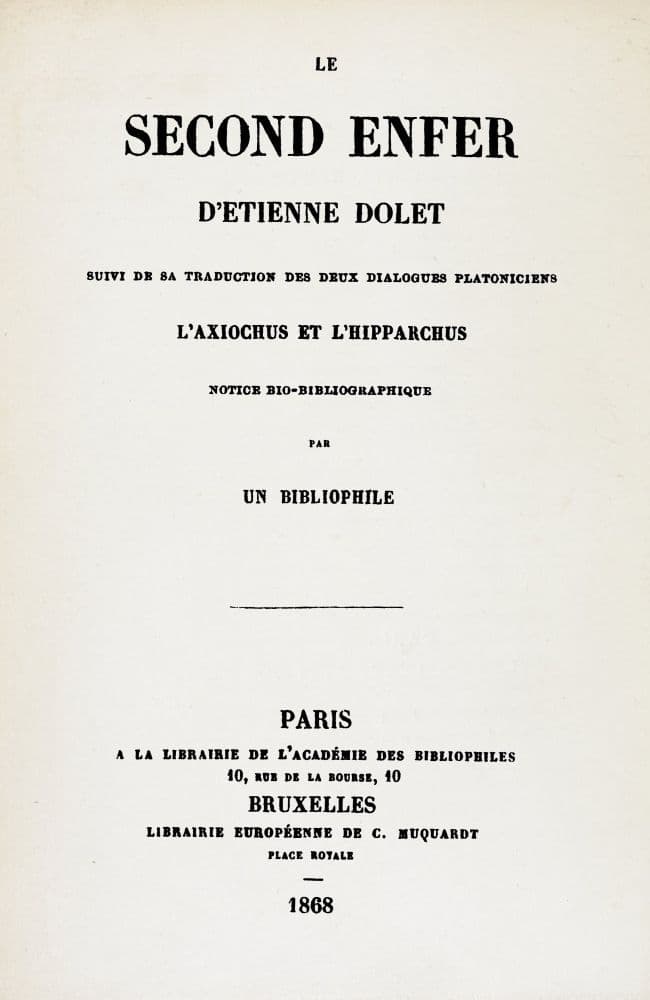
Books from the author









Link to this page
Add a free, dofollow link to Lex on your blog, forum, syllabus, or reading list.

<a href="https://lex-books.com/author/etienne-dolet"><img src="https://lex-books.com/badges/read-on-lex.svg" alt="Etienne Dolet on Lex" width="160" height="40"></a>[](https://lex-books.com/author/etienne-dolet)[url=https://lex-books.com/author/etienne-dolet][img]https://lex-books.com/badges/read-on-lex.svg[/img][/url]Etienne Dolet on Lex: https://lex-books.com/author/etienne-dolet