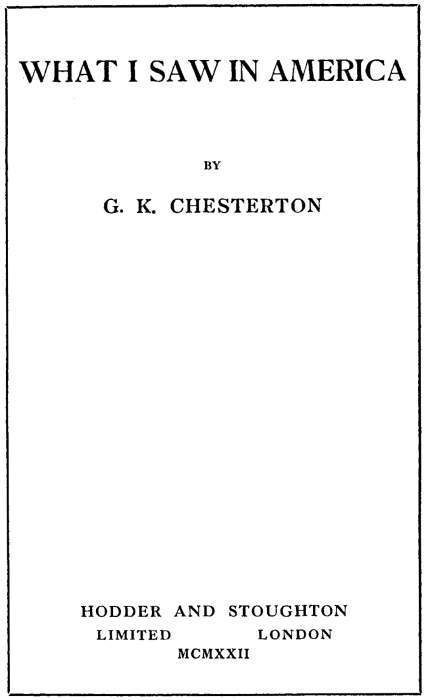
What I Saw in America
1922
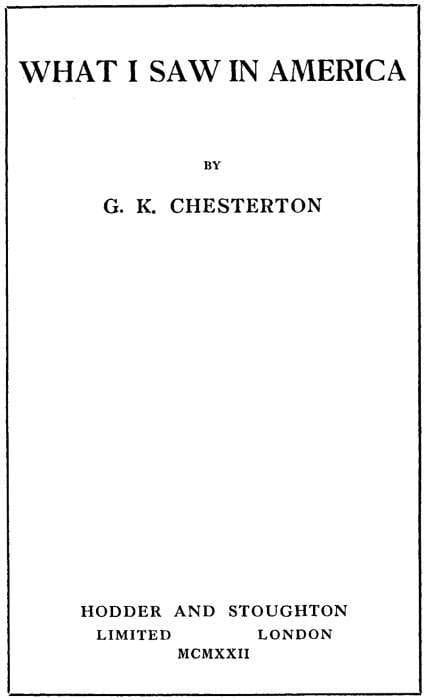
In 1921, G.K. Chesterton arrived in America for a lecture tour and found a nation suspended between magnificent ideals and messy reality. What follows is neither fawning tribute nor hostile critique, but something far more valuable: a brilliant outsider's attempt to understand a country that confounded and delighted him in equal measure. He writes about American equality with the eye of a philosopher who sees both its genuine nobility and its peculiar contradictions, about democracy as practiced and democracy as dreamed. There is bureaucratic absurdity here, and genuine warmth, and the kind of travel writing that reveals as much about the observer as the observed. Chesterton's wit is legendary, but what surprises is his tenderness beneath the irony. This is America seen through eyes that refused easy answers, and nearly a century later, his observations about national self-confidence, hospitality, and the strange experiments of democracy feel less like period pieces than urgent questions we are still answering.
Editions
X-Ray
“I wish we could sometimes love the characters in real life as we love the characters in romances. There are a great many human souls whom we should accept more kindly, and even appreciate more clearly, if we simply thought of them as people in a story.””
— G. K. Chesterton
“The devil can quote Scripture for his purpose; and the text of Scripture which he now most commonly quotes is, “The Kingdom of heaven is within you.” That text has been the stay and support of more Pharisees and prigs and self-righteous spiritual bullies than all the dogmas in creation; it has served to identify self-satisfaction with the peace that passes all understanding. And the text to be quoted in answer to it is that which declares that no man can receive the kingdom except as a little child. What we are to have inside is a childlike spirit; but the childlike spirit is not entirely concerned about what is inside. It is the first mark of possessing it that one is interested in what is outside. The most childlike thing about a child is his curiosity and his appetite and his power of wonder at the world. We might almost say that the whole advantage of having the kingdom within is that we look for it somewhere else.””
— G. K. Chesterton
“Democracy is reproached with saying that the majority is always right. But progress says that the minority is always right.””
— G. K. Chesterton
“It is at least as possible for a Philadelphian to feel the presence of Penn and Franklin as for an Englishman to see the ghosts of Alfred and Becket. Tradition does not mean a dead town; it does not mean that the living are dead but that the dead are alive. It means that it still matters what Penn did two hundred years ago or what Franklin did a hundred years ago; I never could feel in New York that it mattered what anybody did an hour ago.””
— G. K. Chesterton
“Progress is Providence without God. That is, it is a theory that everything has always perpetually gone right by accident. It is a sort of atheistic optimism, based on an everlasting coincidence far more miraculous than a miracle.””
— G. K. Chesterton
“The Americans are very patriotic, and wish to make their new citizens patriotic Americans. But it is the idea of making a new nation literally out of any old nation that comes along. In a word, what is unique is not America but what is called Americanisation. We understand nothing till we understand the amazing ambition to Americanise the Kamskatkan and the Hairy Ainu. We are not trying to Anglicise thousand of French cooks or Italian organ-grinders. France is not trying to Gallicise thousands of English trippers or German prisoners of war. America is the only place in the world where this process, healthy or unhealthy, possible or impossible, is going on. And the process, as I have pointed out, is not internationalization. It would be truer to say it is the nationalization of the internationalized. It is making a home out of vagabonds and a nation out of exiles.””
— G. K. Chesterton
“We have never even begun to understand a people until we have found something that we do not understand. So long as we find the character easy to read, we are reading into it our own character.””
— G. K. Chesterton
“Americans have a taste for…rocking-chairs. A flippant critic might suggest that they select rocking-chairs so that, even when they are sitting down, they need not be sitting still. Something of this restlessness in the race may really be involved in the matter; but I think the deeper significance of the rocking-chair may still be found in the deeper symbolism of the rocking-horse. I think there is behind all this fresh and facile use of wood a certain spirit that is childish in the good sense of the word; something that is innocent, and easily pleased.””
— G. K. Chesterton
“America is the only nation in the world that is founded on a creed. That creed is set forth with dogmatic and even theological lucidity in the Declaration of Independence; perhaps the only piece of practical politics that is also theoretical politics and also great literature. It enunciates that all men are equal in their claim to justice, that governments exist to give them that justice, and that their authority is for that reason just. It certainly does condemn anarchism, and it does also by inference condemn atheism, since it clearly names the Creator as the ultimate authority from whom these equal rights are derived. Nobody expects a modern political system to proceed logically in the application of such dogmas, and in the matter of God and Government it is naturally God whose claim is taken more lightly. The point is that there is a creed, if not about divine, at least about human things.””
— G. K. Chesterton
Link to this book
Add a free, dofollow link to Lex on your blog, forum, syllabus, or reading list.

<a href="https://lex-books.com/book/what-i-saw-in-america-4aa1476e-ec01-4443-afa7-e60c6be1303f"><img src="https://lex-books.com/badges/read-on-lex.svg" alt="Read What I Saw in America by G. K. Chesterton free on Lex" width="160" height="40"></a>[](https://lex-books.com/book/what-i-saw-in-america-4aa1476e-ec01-4443-afa7-e60c6be1303f)[url=https://lex-books.com/book/what-i-saw-in-america-4aa1476e-ec01-4443-afa7-e60c6be1303f][img]https://lex-books.com/badges/read-on-lex.svg[/img][/url]Read What I Saw in America by G. K. Chesterton free on Lex: https://lex-books.com/book/what-i-saw-in-america-4aa1476e-ec01-4443-afa7-e60c6be1303fCite this book
Reading this edition for a paper or guide? Copy a citation.
Chesterton, G. K.. What I Saw in America. Lex, lex-books.com/book/what-i-saw-in-america-4aa1476e-ec01-4443-afa7-e60c6be1303f.Chesterton, G. K. (1922). What I Saw in America. Lex. https://lex-books.com/book/what-i-saw-in-america-4aa1476e-ec01-4443-afa7-e60c6be1303fChesterton, G. K.. What I Saw in America. Lex. https://lex-books.com/book/what-i-saw-in-america-4aa1476e-ec01-4443-afa7-e60c6be1303f.