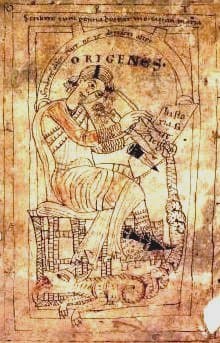
Origen
Origen of Alexandria, also known as Origen Adamantius, was a pivotal early Christian scholar and theologian whose work laid foundational principles for Christian thought. Born in Alexandria, he dedicated much of his life to theological study and ascetic practice, producing an impressive body of work that included approximately 2,000 treatises covering diverse topics such as textual criticism, biblical exegesis, and spirituality. His innovative approach to scripture and doctrine made him a key figure in the development of early Christian theology, though his ideas often sparked controversy among contemporaries and later theologians. Origen's contributions to Christian literature and thought were immense, as he sought to reconcile faith with reason, emphasizing the importance of allegorical interpretation of the Bible. His works, including the 'Hexapla,' a critical edition of the Old Testament, and various commentaries, influenced both Eastern and Western theological traditions. Despite facing significant opposition and eventual condemnation for some of his views, Origen's legacy as a thinker and writer has endured, earning him recognition as one of the most significant figures in the history of Christianity.
Famous Quotes
View all 3 quotes“One who prays ceaselessly is one who combines prayer with work and work with prayer.””
“He makes Himself known to those who, after doing all that their powers will allow, confess that they need help from Him.””
“It is not only possible, but also the case that all rational creatures will eventually submit to one Law […] We profess that at a certain point the Logos will have obtained the hegemony over all rational creatures and will have transformed every soul to the perfection that is proper to it, when each one, exerting its own free will, will have made its own choices and reaches the state that it had elected. But we hold that it will not happen as in the case of material bodies […] it is not so in the case of illnesses derived from sin. For it is certainly not the case that the supreme God, who dominates over all rational creatures, can not cure them. Indeed, since the Logos is more powerful than any evil that can exist in the soul [πάντων γὰρ τῶν ἐν ψυχῇ κακῶν δυνατώτερος ὁ Λόγος], it applies the necessary therapy to every individual, according to God's will. And the ultimate end of all things will be the elimination of evil [τὸ τέλος τῶν πραγμάτων ἀναιρεθῆναί ἐστι τὴν κακίαν]. (CC 8.72)””
Books from the author




Link to this page
Add a free, dofollow link to Lex on your blog, forum, syllabus, or reading list.

<a href="https://lex-books.com/author/origen"><img src="https://lex-books.com/badges/read-on-lex.svg" alt="Origen on Lex" width="160" height="40"></a>[](https://lex-books.com/author/origen)[url=https://lex-books.com/author/origen][img]https://lex-books.com/badges/read-on-lex.svg[/img][/url]Origen on Lex: https://lex-books.com/author/origen