
Hannah Adams
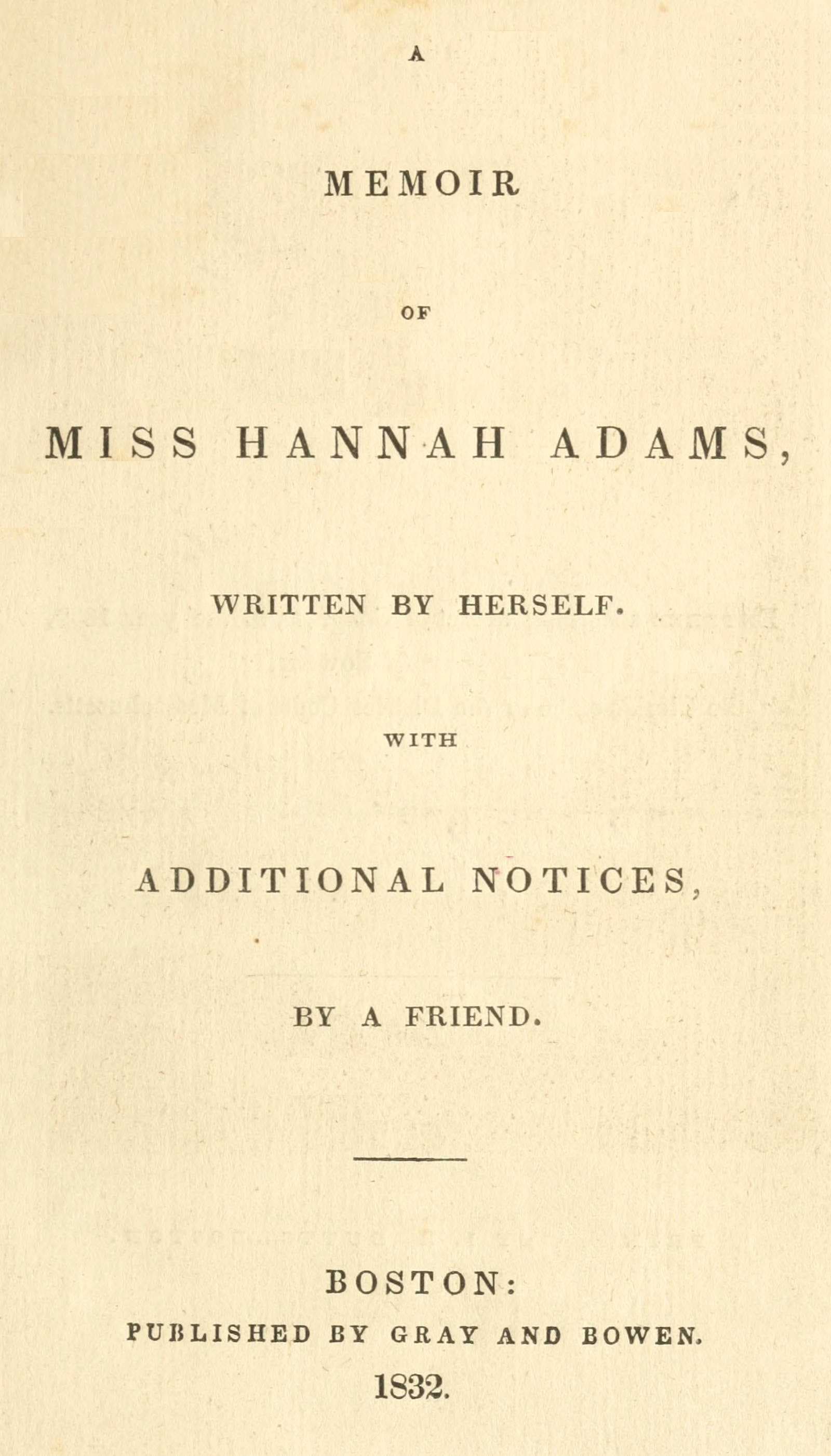
Hannah Adams was a pioneering American author known for her contributions to comparative religion and early United States history. Born in Medfield, Massachusetts, she grew up in a modest household where her father, a Harvard-educated storekeeper, fostered her education despite the societal limitations placed on women at the time. Adams was largely self-taught, and her determination to learn led her to acquire knowledge in Greek and Latin, which she later taught. Her early struggles with health and financial instability did not deter her from pursuing a career in writing, making her one of the first professional female writers in the United States. Adams's notable works include "A View of Religions," published in 1784, which was significant for its comparative approach to various faiths and was expanded in a second edition in 1791. In 1799, she released "A Summary History of New-England," a comprehensive account that required extensive research, ultimately affecting her eyesight. Her most ambitious project, "The History of the Jews since the destruction of Jerusalem," was recognized internationally, being reprinted in London in 1818. Adams's legacy as a trailblazer for women in literature and her scholarly contributions to religious and historical discourse have left an enduring mark on American intellectual history.
Famous Quotes
View all 12 quotes“The flourishing of historical and political legends came to a rather abrupt end with the birth of Christianity. Its interpretation of history, from the days of Adam to the Last Judgment, as one single road to redemption and salvation, offered the most powerful and all-inclusive legendary explanation of human destiny.””
“The point was that the ‘continual toil’ and want of leisure of the majority of the population would automatically exclude them from active participation in government though, of course, not from being represented and from choosing their representatives. But representation is no more than a matter of 'self-preservation' or self-interest, necessary to protect the lives of the labourers and to shield them against the encroachment of government; these essentially negative safeguards by no means open the political realm to the many, nor can they arouse in them that 'passion for distinction' - the 'desire not only to equal or resemble, but to excel' - which, according to John Adams, 'next to self-preservation will forever be the great spring of human actions'. Hence the predicament of the poor after their self-preservation has been assured is that their lives are without consequence, and that they remain excluded from the light of the public realm where excellence can shine;””
“In the society founded on Adam man has made himself independent of the Creator. He depends on other persons and not on God. The human race as such originates in Adam and not in the Creator. It has come to be by generation and relates to its source only through all its generations. Based on kinship, the human community is thereby a society from and with the dead; in other words this community is historical.””
Books from the author



Link to this page
Add a free, dofollow link to Lex on your blog, forum, syllabus, or reading list.

<a href="https://lex-books.com/author/hannah-adams"><img src="https://lex-books.com/badges/read-on-lex.svg" alt="Hannah Adams on Lex" width="160" height="40"></a>[](https://lex-books.com/author/hannah-adams)[url=https://lex-books.com/author/hannah-adams][img]https://lex-books.com/badges/read-on-lex.svg[/img][/url]Hannah Adams on Lex: https://lex-books.com/author/hannah-adams