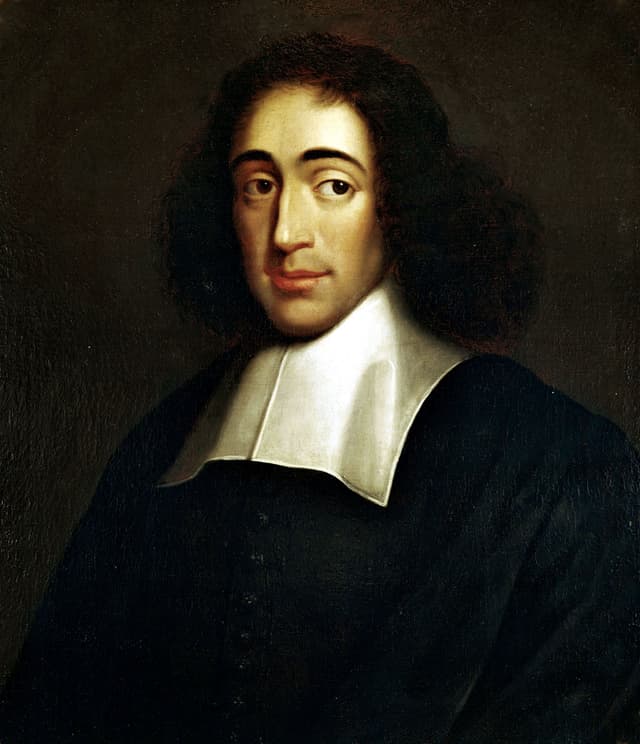
Benedictus de Spinoza
Benedictus de Spinoza was a pioneering philosopher of Portuguese-Jewish descent, born in the Dutch Republic. He emerged as a significant figure during the Dutch Golden Age, profoundly influencing modern biblical criticism and rationalist thought. Spinoza's early life was marked by a traditional Jewish education, but his radical ideas led to his expulsion from the Jewish community in Amsterdam in 1656. Following this, he distanced himself from religious affiliations and dedicated his life to philosophical inquiry, often working as a lens grinder to support himself. Despite publishing little due to fears of persecution, his works laid the groundwork for modern philosophy and political theory. His most notable writings include the "Tractatus Theologico-Politicus," where he challenged the divine origin of the Hebrew Bible and argued for the separation of church and state, and "Ethics," which presents a pantheistic view of God and emphasizes human freedom. Spinoza's rejection of messianism and focus on valuing life for its own sake marked a significant shift in philosophical thought. By advocating for individual liberty across moral, psychological, and metaphysical dimensions, he established the foundations of secular theology and left a lasting legacy that would influence Enlightenment thinkers and modern philosophy.
Famous Quotes
View all 5 quotes“There is no hope unmingled with fear, and no fear unmingled with hope.””
“Hatred is increased by being reciprocated, and can on the other hand be destroyed by love. Hatred which is completely vanquished by love, passes into love; and love is thereupon greater, than id hatred had not preceded it. ””
Books from the author











Link to this page
Add a free, dofollow link to Lex on your blog, forum, syllabus, or reading list.

<a href="https://lex-books.com/author/benedictus-de-spinoza"><img src="https://lex-books.com/badges/read-on-lex.svg" alt="Benedictus de Spinoza on Lex" width="160" height="40"></a>[](https://lex-books.com/author/benedictus-de-spinoza)[url=https://lex-books.com/author/benedictus-de-spinoza][img]https://lex-books.com/badges/read-on-lex.svg[/img][/url]Benedictus de Spinoza on Lex: https://lex-books.com/author/benedictus-de-spinoza